“Best Of” Dinner on 28Jan2013

Gathered my gung-ho friends for a meal at my most recent homecooked dinner on 28Jan2013.
“Best Of” refers to the different dishes (French, Spanish, Italian, fusion) I was trying out in the MENU above, NOT that I was best in any of them..lol..I had 3 pan-seared Hokkaido scallops made for a friend who couldn’t take wagyu, & mercifully they turned up very well after I learned of the very simple technique from chef John of foodwishes.com (just make sure the scallops are bone dry at room temperature & the non stick pan is very hot – scallops & fish etc tend to have lots of water & if not dry, then pan temperature will drop instantly and you end up steaming & NOT searing the meat!).
This was also the first time I tried my skin-on pan-roasted chicken breast on my friends and they all loved it. The slow roast belly pork was still very much a work-in-progress BUT the saving grace was the spicy, sour Spanish mustard sauce. 🙂 This, together with the original sauce from the belly pork made very lovely dips.
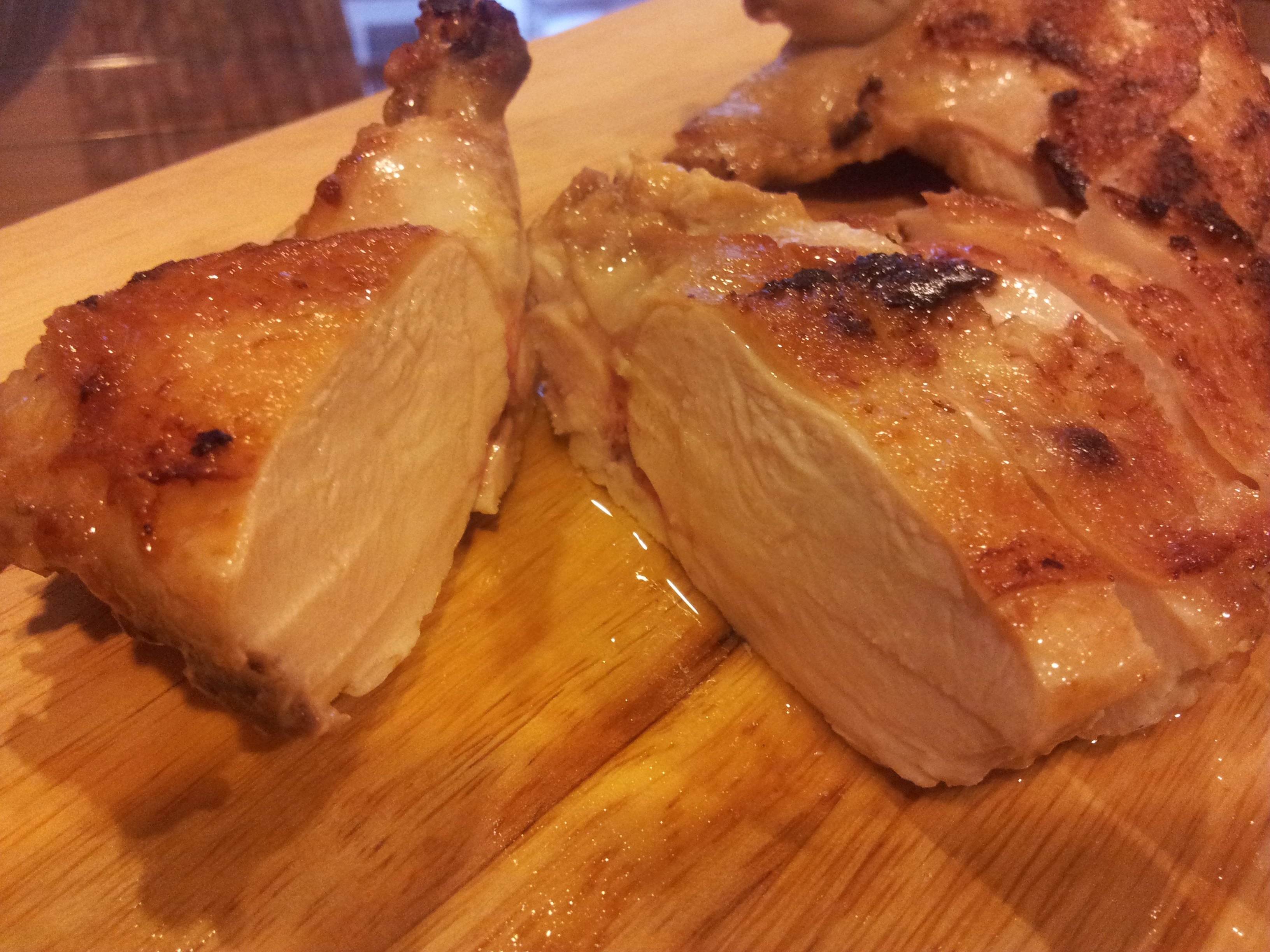
Skin-on pan-roasted brined chicken breast
The Margaret River wagyu striploin with marbling score 4/5 (while pale in comparison with Japanese wagyu), was 1 of the dinner highlights & garnered many supporters. 🙂 I did it the GR (Gordon Ramsay) way – leave steak at room temperature for 1/2 hr, greased non-stick pan with fat from striploin, very high heat, turnover once & add butter, then rest for 5minutes before cutting.
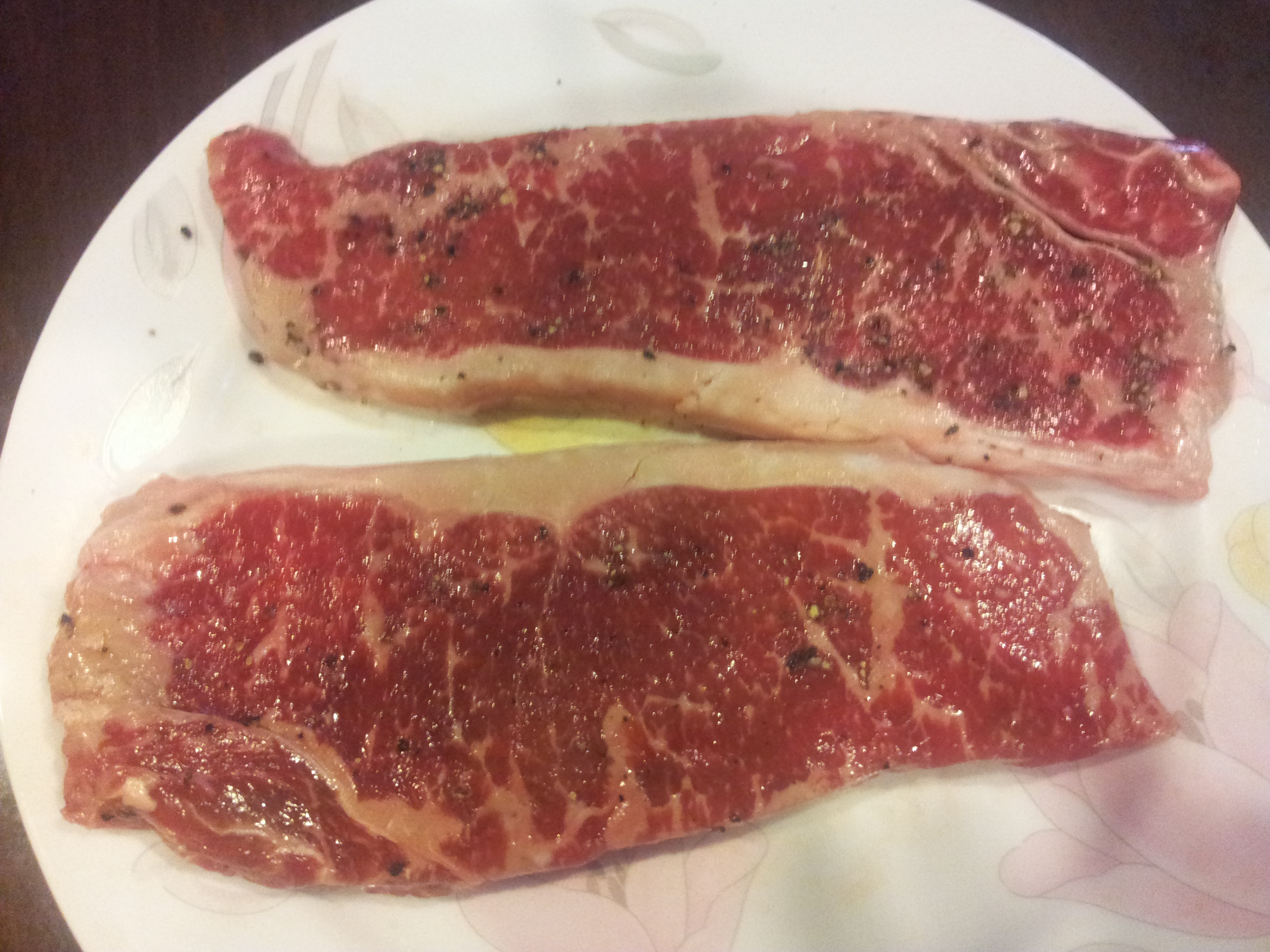
Margaret River wagyu MBS 4/5
The garlic jumbo prawns (these are 130g size – 10 prawns=1.3 kg) is one of my regular dishes, done with just minced garlic & chilli padi in a dry wok in very high heat, and only adding fish sauce at the very end before removing & serve.

Garlic jumbo prawns 130g each
I also had a very smooth & sweet tasting Basque seafood soup using stock from prawn shells + chicken stock + leek, carrot & onions strained, adding poached prawn, sotong (squid) and mussels when serving.
Next up were the 2 pastas. The seafood alio olio spaghetti with white wine is my usual fare, and this time I added a fusion pasta using a chilli crab sauce I prepared from the prawn shell stock.
The main course was a Spanish 2hr slow-cooked beef ribs with chorizos, celery, carrots, red peppers, yellow onions & using just a dash of tumeric for the colour. They all loved this very tender & tasty dish.
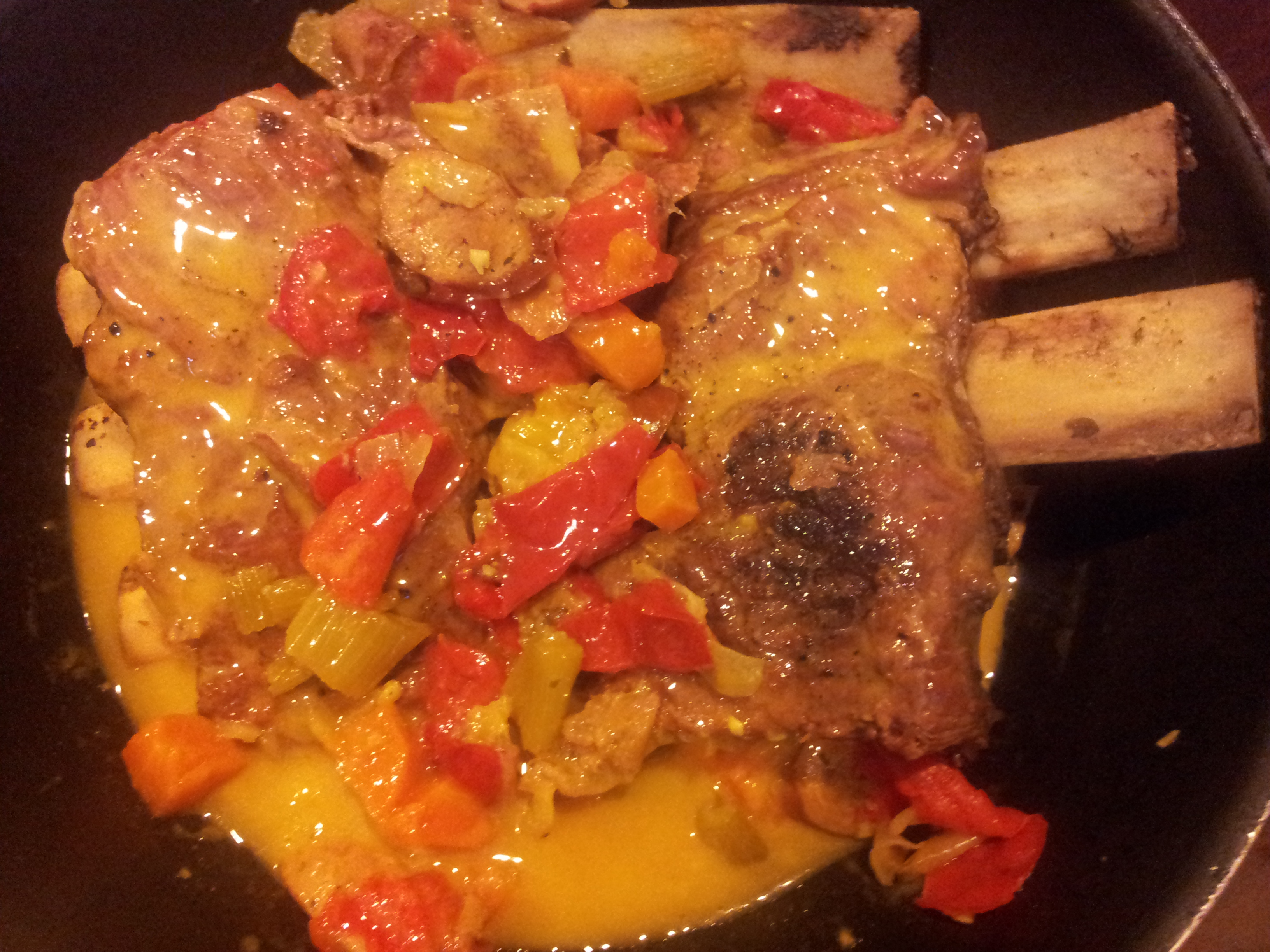
Spansh slow-cooked beef ribs with chorizos
And after all that, we still had room for a very nice chocolate lava cake (my usual fare) to round out the evening.
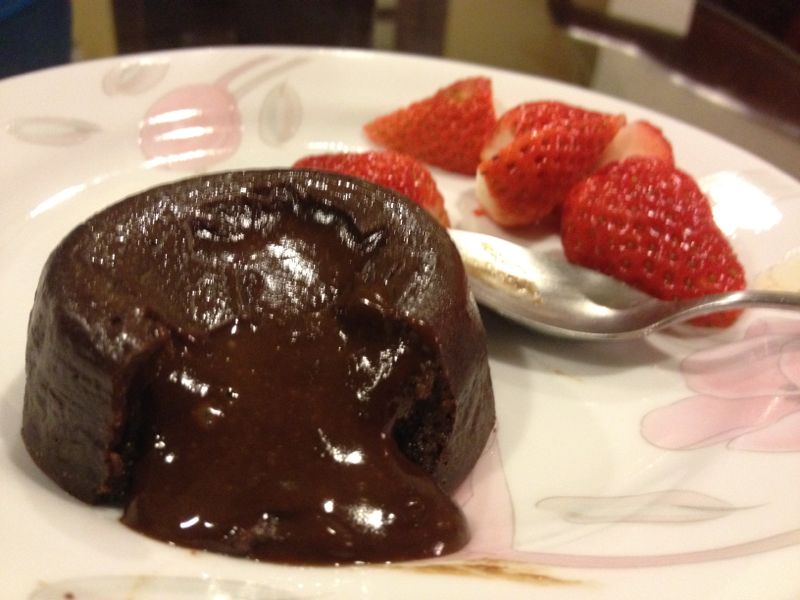
Chocolate lava cake oozing lava served with strawberries
c.h.e.f andy
Capri Challenge Dinner on 20Dec2012
 I had this Capri Challenge dinner after going to Capri Trattoria & Pizzeria couple times with friends & family. Capri’s $18 cold cut platter is a real quality & value-for-money deal. The $36 tagliata di manzo (sliced beef) is quite ok but pricy for the size & cut of meat. The pastas are maybe 3/4 the price of Valentino, however both times I thought the pastas were very average.
Anyway, after testing out a belly pork arrabiata and a fusion chilli crab pasta, I decided to string together a 4 pasta dinner and got my obliging “kakis” (aka mates in Malay) – namely Choon Hung, Chong Lee & the lot – to come as guinea pigs as usual.
I started with a tagliata di manzo with rockets & cherry tomatoes using a mock fillet mignon recipe for cheap chuck tender. It involves tenderising the meat with sodium bicarbonate, grilling both sides in a 210degC oven for 25minutes, then slow-cooking at 90degC for 1.5hrs. This recipe is ok but I still prefer to go with the usual costlier striploin & ribeyes.
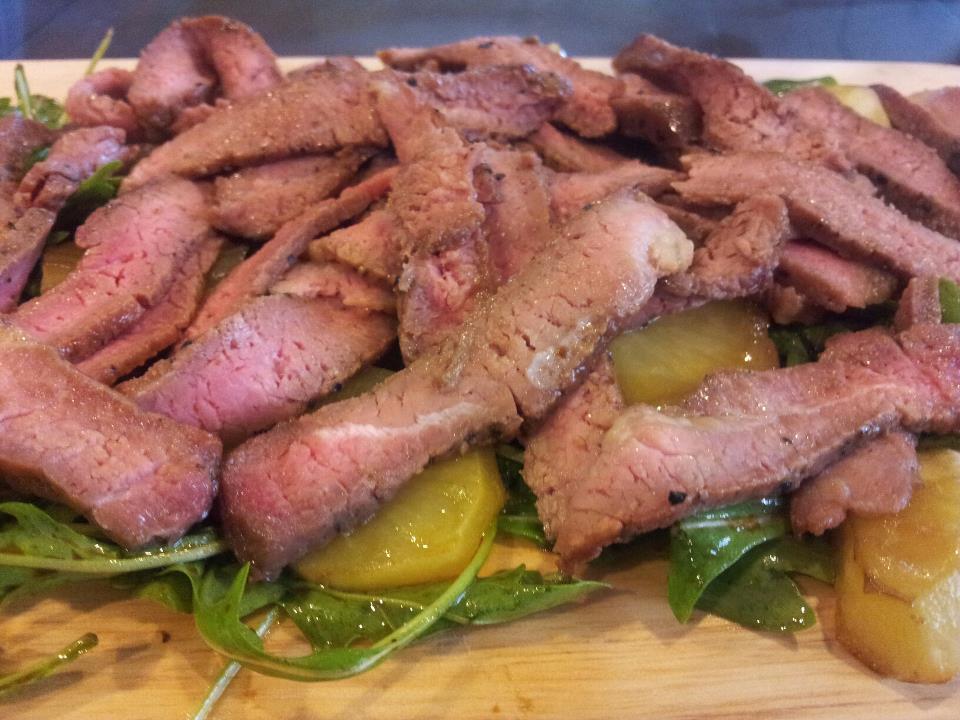
tagliata di manzo (Italian sliced beef) using chuck tender as mock fillet mignon with rockets, cherry tomatoes & roast potatoes
Next I have my usual roast chicken, tender & tasty & quite moist, but kind of boring as noted in the post on pan-roasted brined chicken.
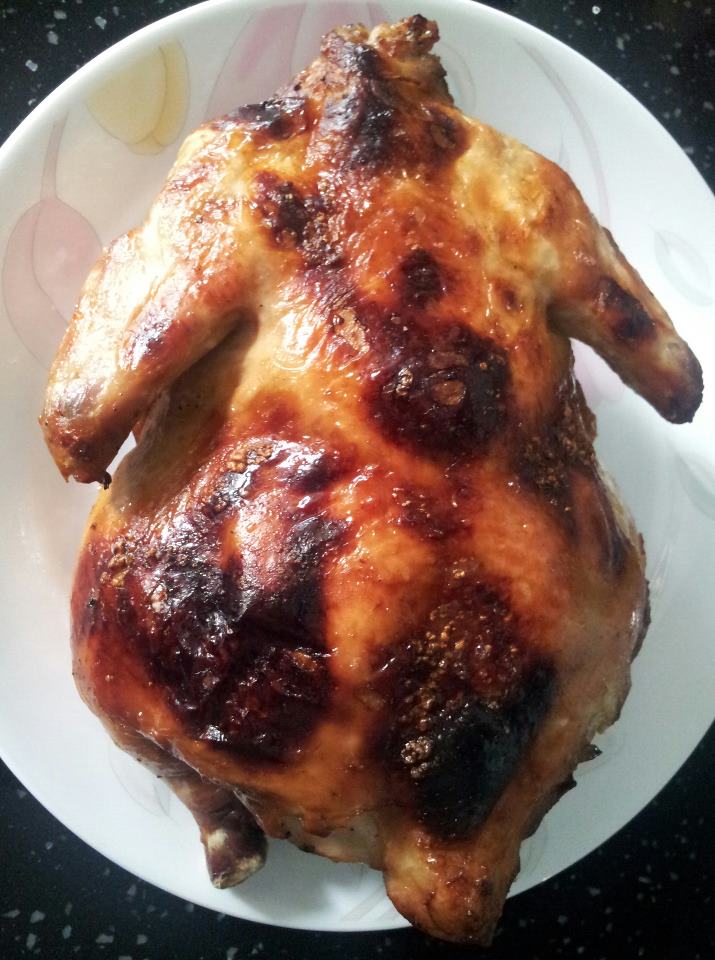
roast chicken rubbed with salt, pepper, herbs, oyster sauce & olive oil
A medley of 4 pastas followed. My usual seafood alio olio spaghetti with white wine is by now a very popular dish amongst family & friends. Next I have a belly pork arrabiata (spicy tamato) spaghetti. I cooked the belly pork the Japanese “kakuni” way, at low heat using an induction heater for 1.5hrs, then added in canned whole tomatoes (cut into small pieces) and sauce, yellow onions and soy sauce and cooked for another 1/2 hr. This can be put aside for tossing with the pasta when required.
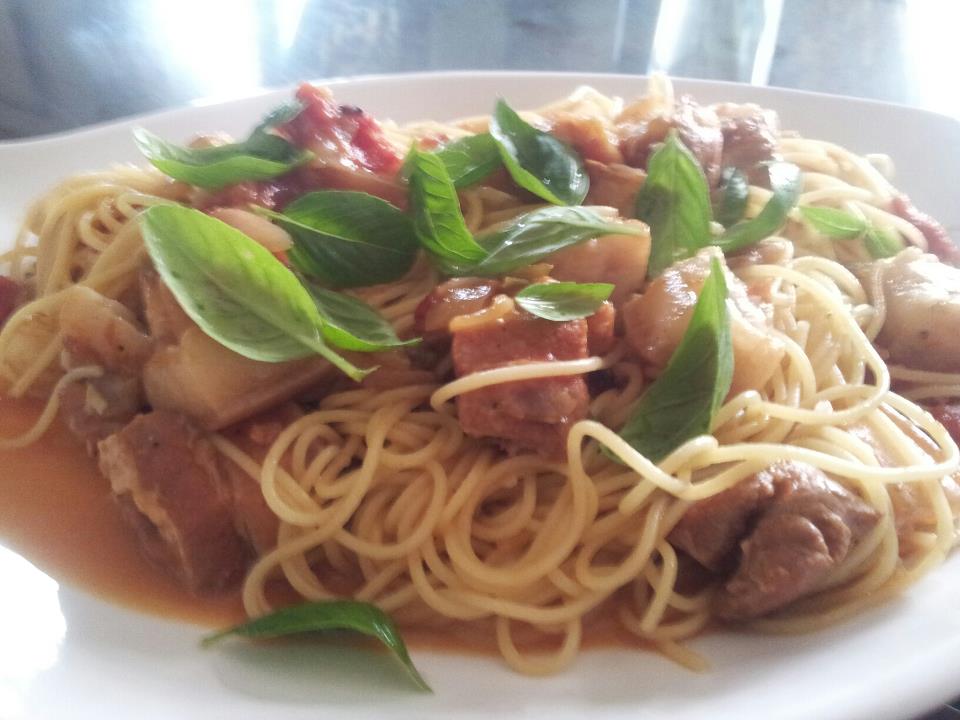
belly pork arrabiata(spicy tomatoes) spaghetti
A more interesting experiment is with the chilli crab pasta. I found a chilli crab sauce recipe & substituted the crab with prawn shell stock – the crab or prawn or shellfish flavour is needed to make the sauce taste genuine like real chilli crab sauce. This turned out very well indeed at the first attempt & by the time of the dinner I had 2 previous successful tries.
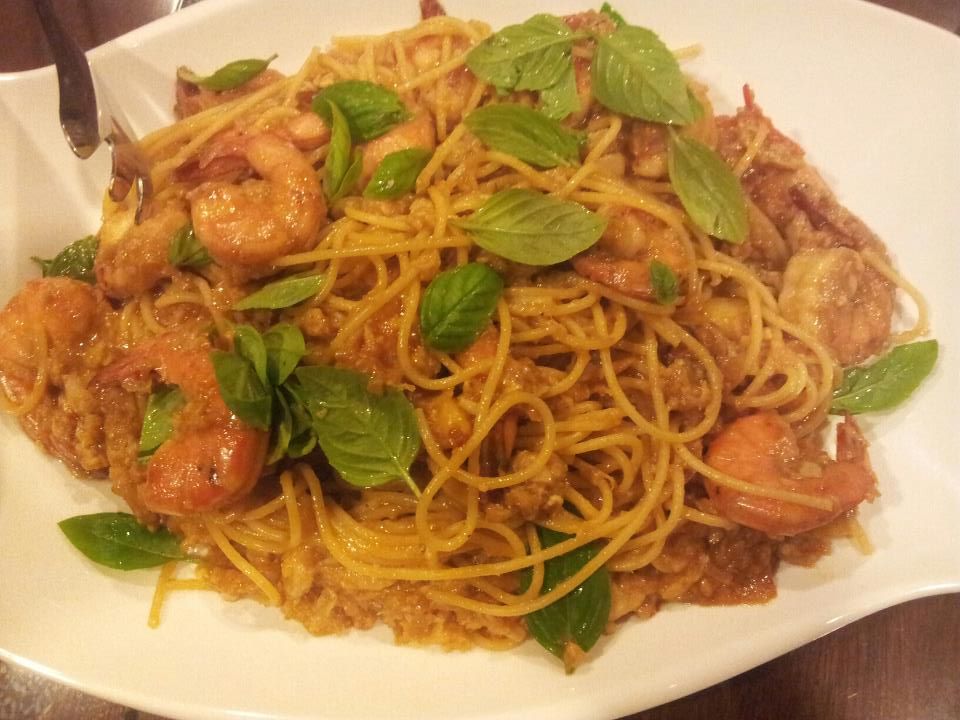
chilli crab spaghetti with prawns & shelled crab pincers
My attempt at a creamy funghi pasta though is rather forgettable, will have to revisit at a later time as I am quite keen on funghi pasta & risotto. Garlic king prawn ia one of my usual fare and very good really so I find little incentive to try out other recipes like the Spanish garlic prawn tapas. A dinner highlight is the angus striploin. I attempted aging the striploin in the fridge (it is supposed to intensify the flavours and also tenderise). The one below is aged 48hrs in the fridge. I cooked the striploin by the usual GR (Gordon Ramsay) method. It is very good with distinct maillard reaction brown ring, though I cannot say after trying this aging a few times that it really is better than the same meat w/o the aging.
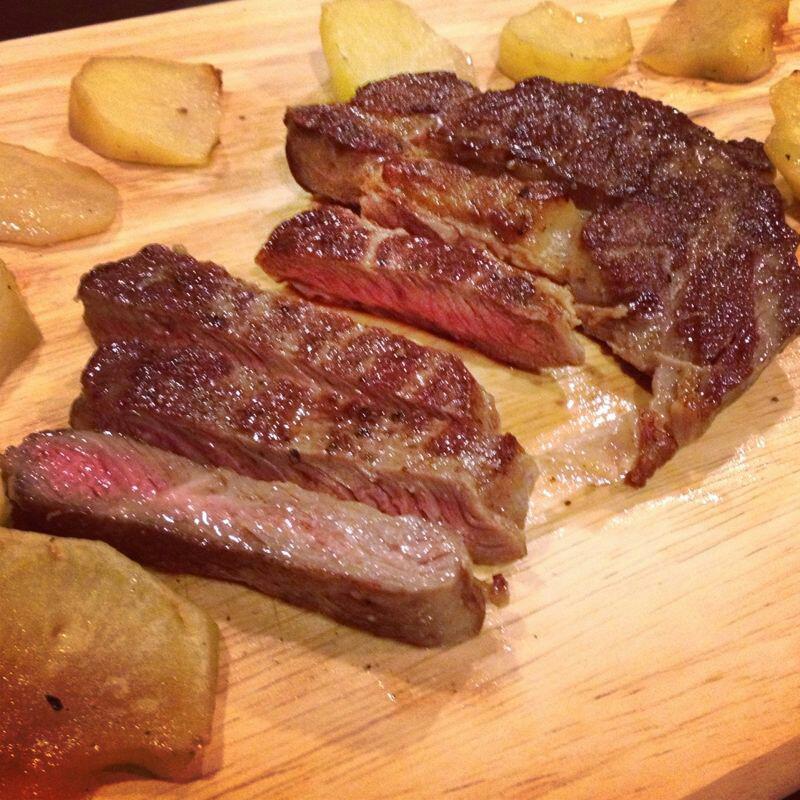
pan-fried medium rare angus striploin aged 48hrs in fridge
Afterwards we had the usual chocolate lava cake. Choon Hung has by now become our regular ice-cream supplier & thanks to him, I do not have to drive to Daily Scoop at Sunset Way to pick up the Salted Mr Brown & Coconut Fantasy ice-creams – both are very good and even better when taken with chocolate lava cake..lol.
c.h.e.f andy
23 Pax Buffet Dinner for My Raffles Institution (RI) Friends on 26Nov2012
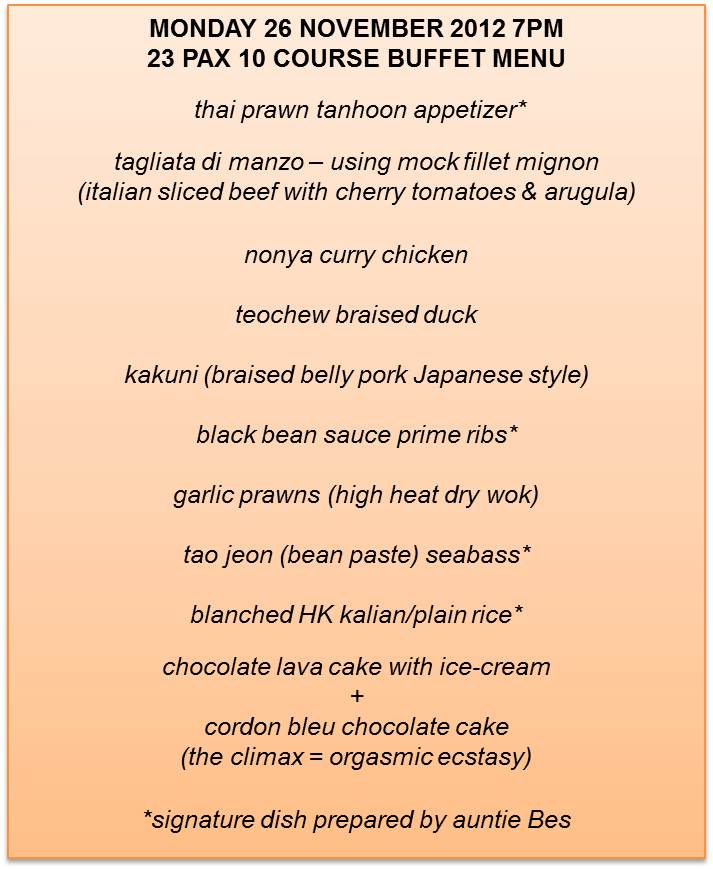
I tried out a few Asian dishes such as nonya curry chicken, braised duck and kakuni (a Japanese braised belly pork) and decided to attempt a buffet dinner. 23 of my old classmates and schoolmates from RI (Raffles Institution) gallantly responded, and we had a most fun evening ferreting lost memories of youth(ful) years (or was it memories of lost youth), special thanks to PH for her largely uncorroborated recollections. 🙂
The buffet layout includes the following –
- very nice Thai seafood tanhoon appetizer prepared by auntie Bes.
- tagliata di manzo (Italian sliced beef) using chuck tender as mock fillet mignon with rockets and cherry tomatoes
- teochew braised duck
- nonya curry chicken
- black bean sauce pork prime ribs prepared by auntie Bes
- kakuni – Japanaese braised belly pork
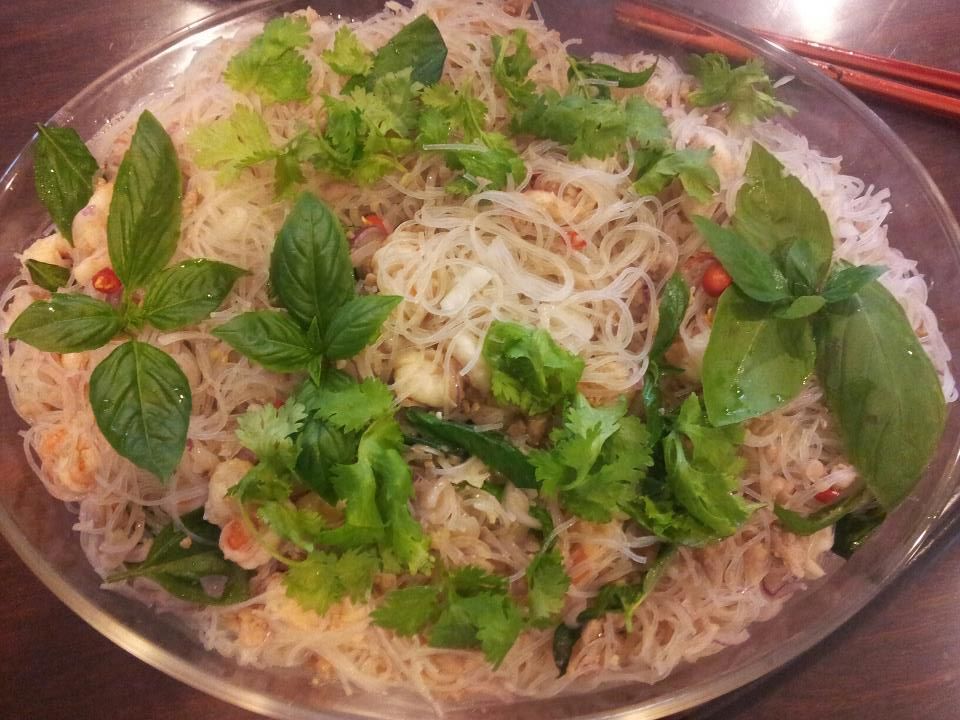
auntie Bes famous Thai seafood tanhoon appertiser
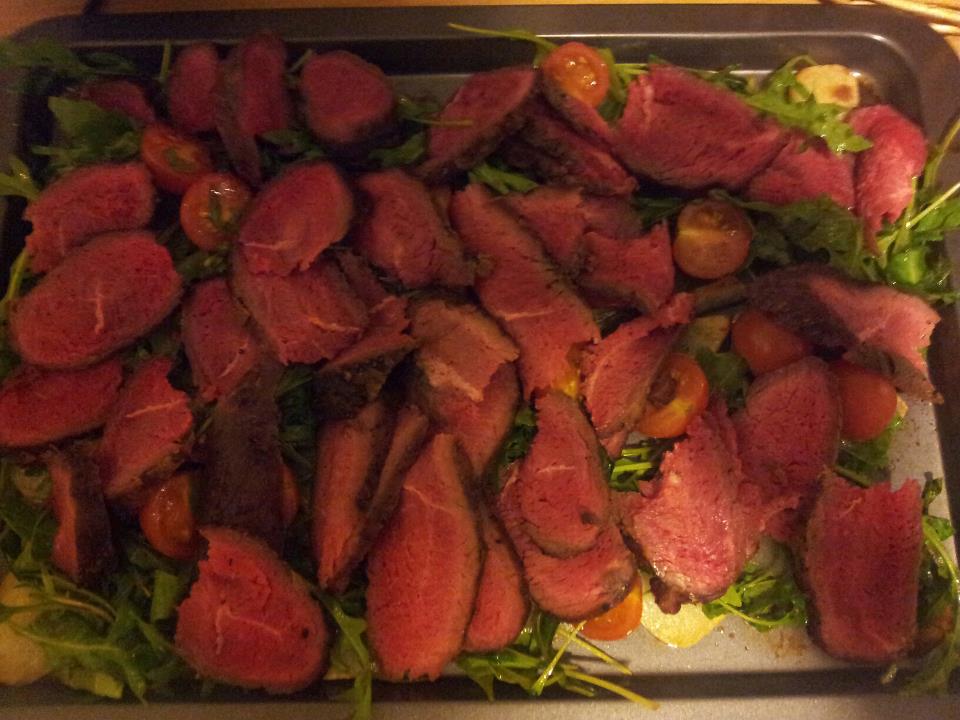
tagliata di manzo with rockets and cherry tomatoes
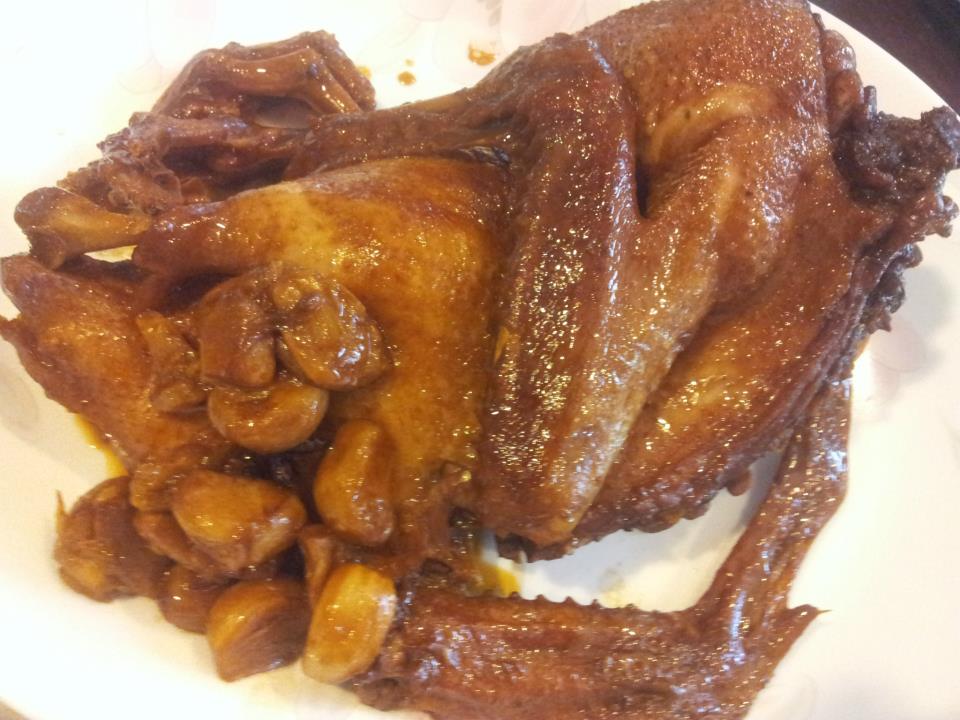
teochew braised duck
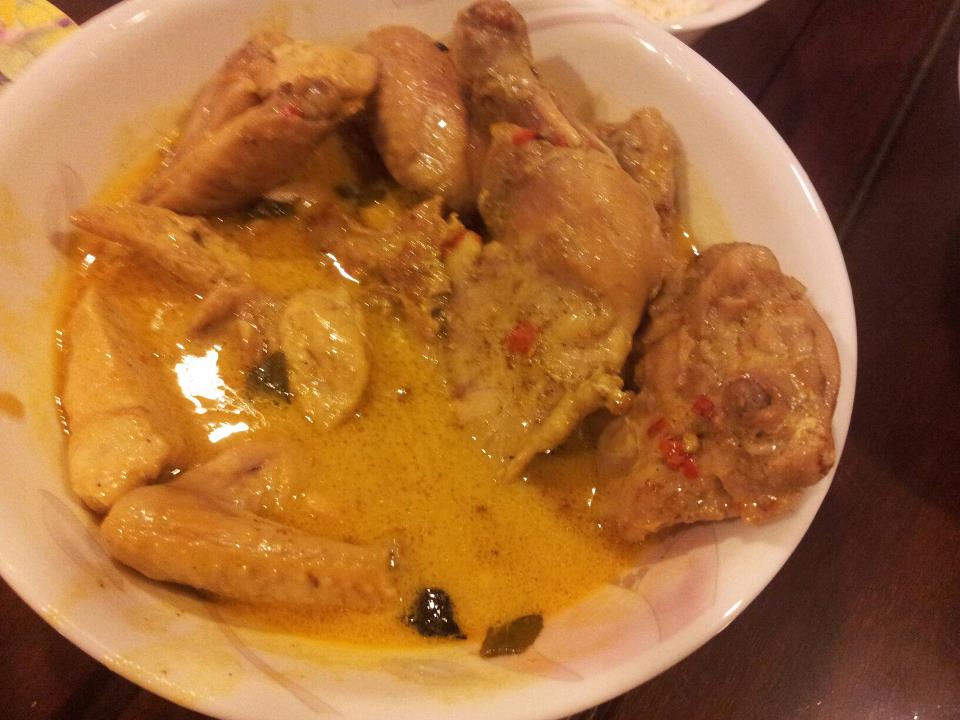
nonya curry chicken made from herbs w/o curry powder
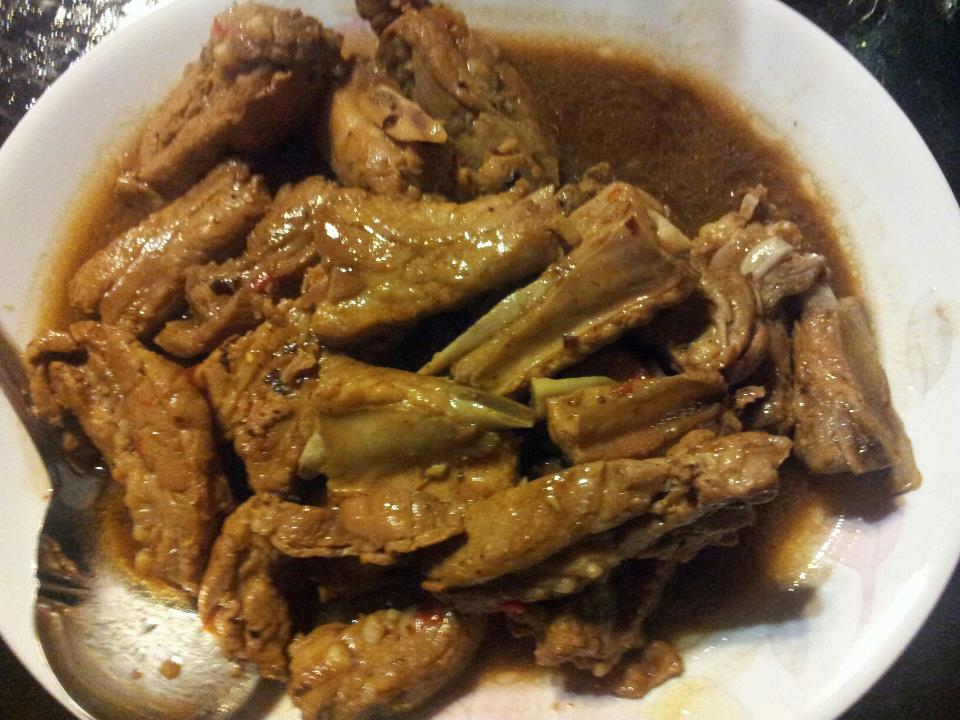
auntie Bes famous black bean sauce pork prime ribs
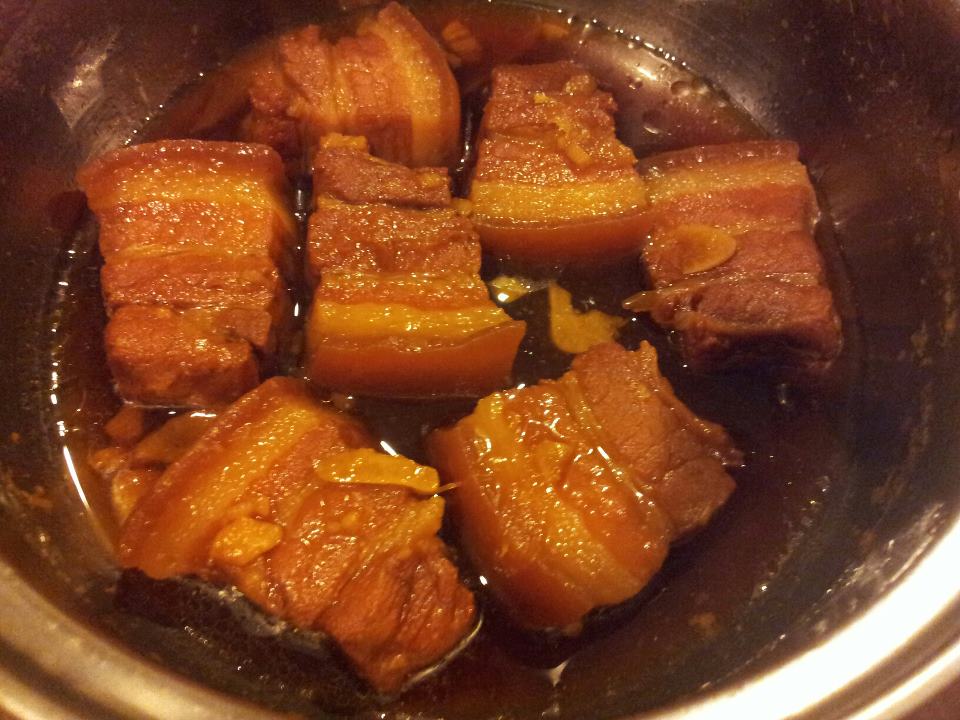
kakauni – Japanese slow-braised belly pork in mirin, sugar & soy sauce
We also had spicy tao jeon (fermented bean sauce) seabass and poached HK kailan with shitake mushrooms prepared by auntie Bes.
Another highlight of the evening was undoubtedly the Cordon Bleu (“call them blur”) “atas” cake PH brought. It was a truly wonderful cake.
Choon Hung, Chong Lee & gang were well-trained in serving the chocolate lava cakes. The newbies Tet Soon & Cheow Ghee looked suitably enthralled.
PH was the undisputed cake taster since she has such classy association of the Cordon Bleu variety.
c.h.e.f andy
Dinner Gathering for 10pax @ Yuanxing Restaurant (Guan Hin) on 19Mar2013
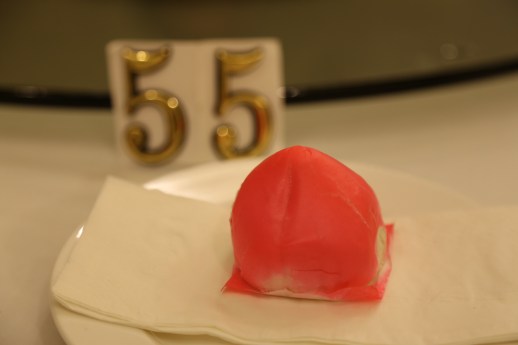
longevity bun for the 55s

the significance of 55
We had a gathering of 10 friends the other evening. One friend did a make-shift “gold-plated” 55 sign and also arranged for the restaurant to serve longevity buns 寿桃 -(a nice touch!) – this being the 55th season of our journey on planet earth – though we could not help speculating which houses and/or shops might have number(s) 5 missing. 🙂
None of us had heard of Yuanxing Teochew Restaurant..it turned out to be Guan Hin, an old street name (老字号) which now uses the hanyupinyin name.
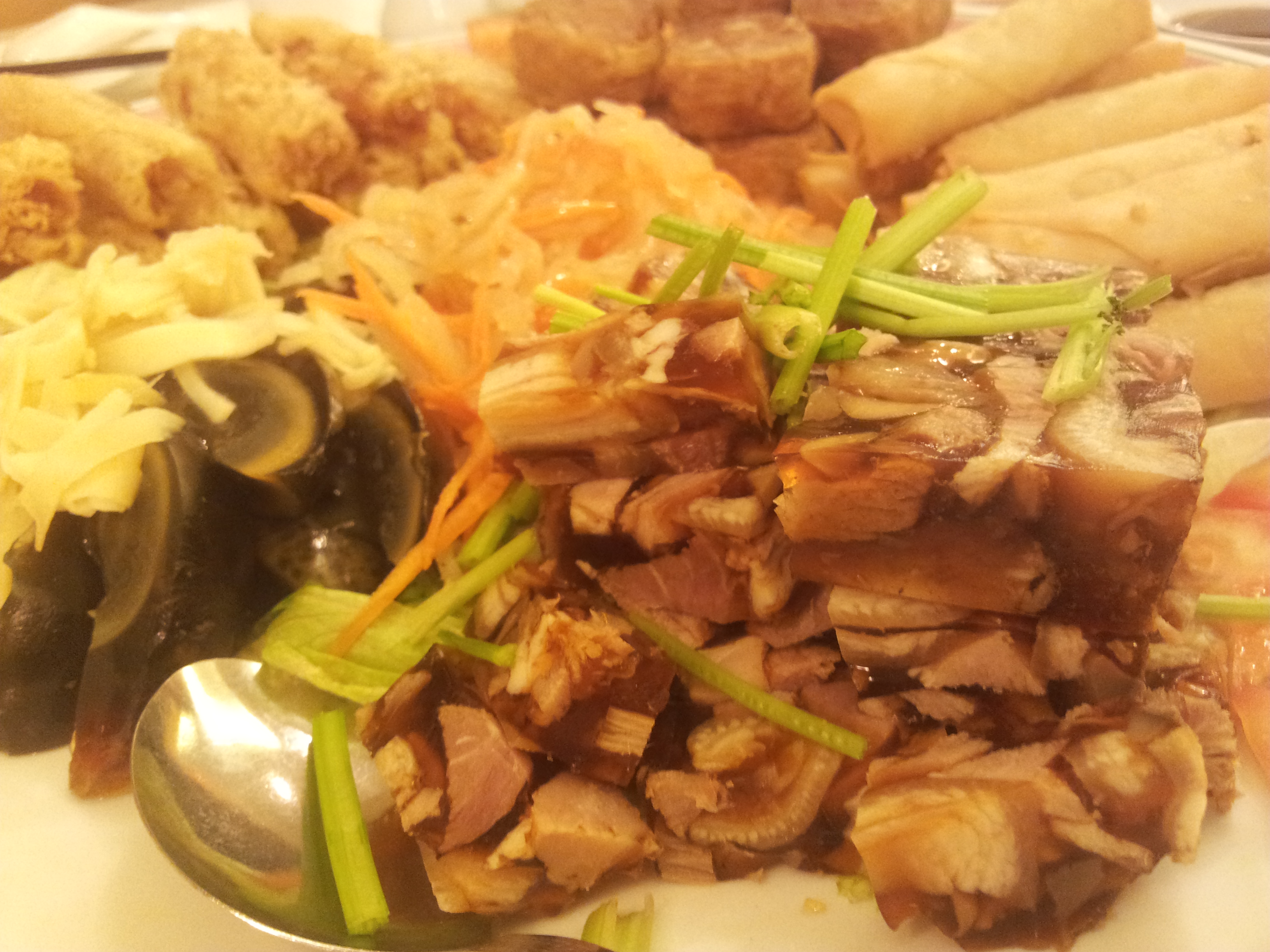
We started off with the usual appetizer platter. The ter kar tan (pork trotter jelly 猪脚冻) was very good here – I reckoned Crystal Jade Paragon standard and better than Chui Huay Lim and a few other teochew restaurants I had tried..The other items – spring rolls, hae jor & another deep-fried item which I don’t know the name – were good too. The jellyfish & century egg were usual fare.
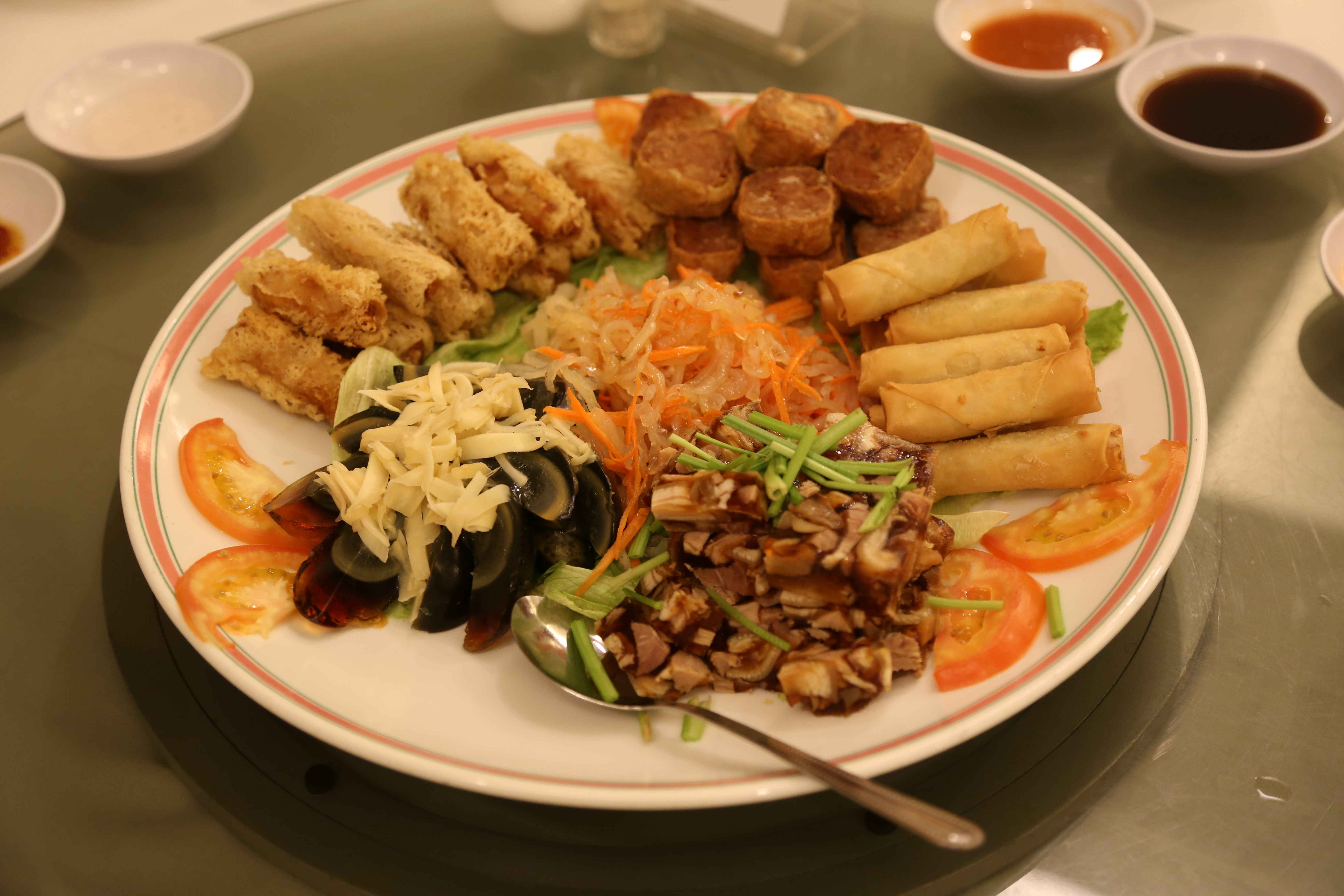
appertizer platter
Next came the ubiquitous yam basket. This is more of a common cantonese restaurant dish – anyway supposedly hailed from the 4 heavenly kings of cantonese cuisine from the sixties, and still being contested by both Dragon Phoenix and Lai Wah each claiming to be the rightful inventor.. 🙂
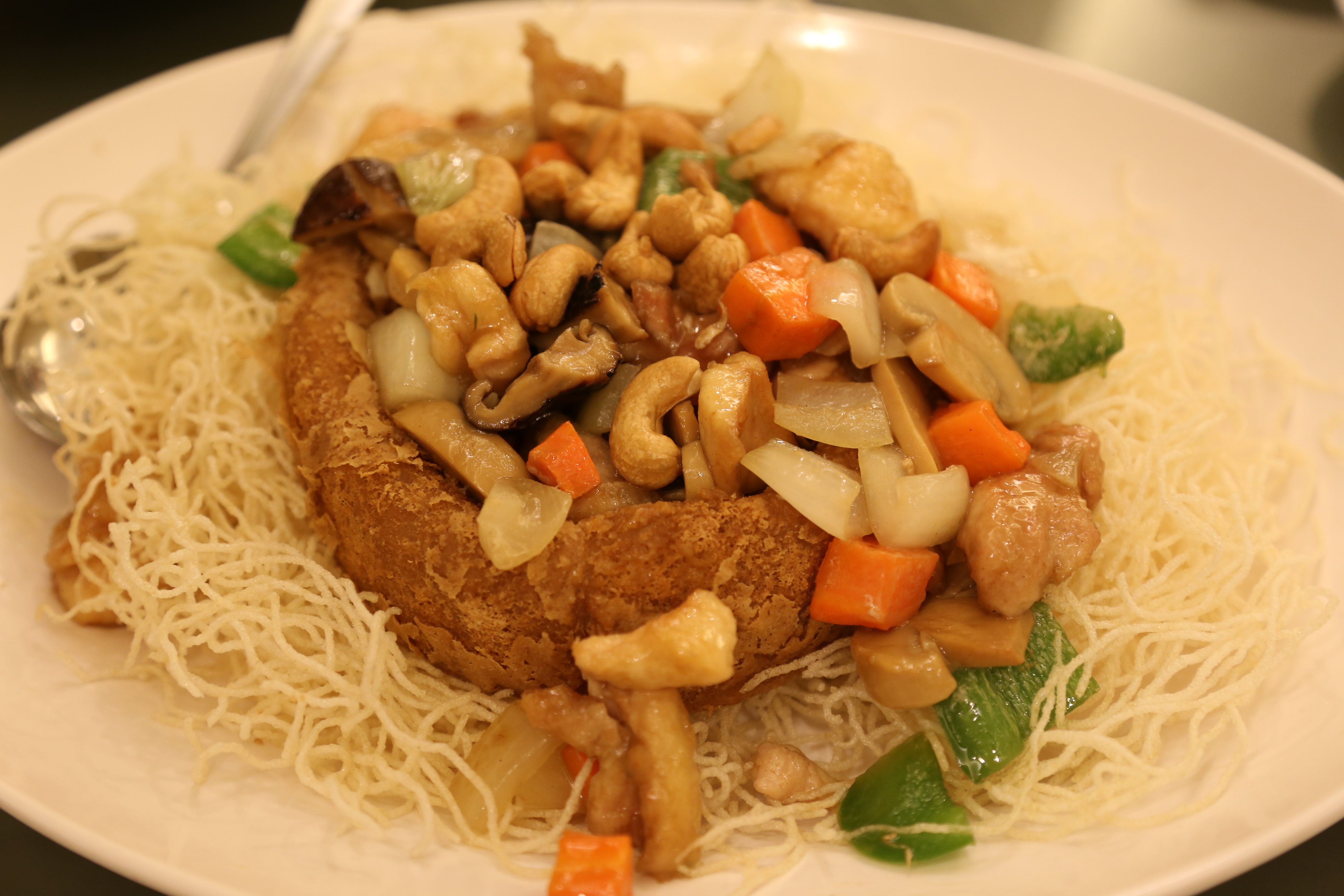
the ubiquitous yam basket
Next came some deep-fried meatballs? – I haven’t a clue what it was – quite good tasting, so ok lah..the garlic fried kailan was quite ok, got some wok hae though not near the best..(the picture on the left below is a close-up of the ter kar tan猪脚冻)
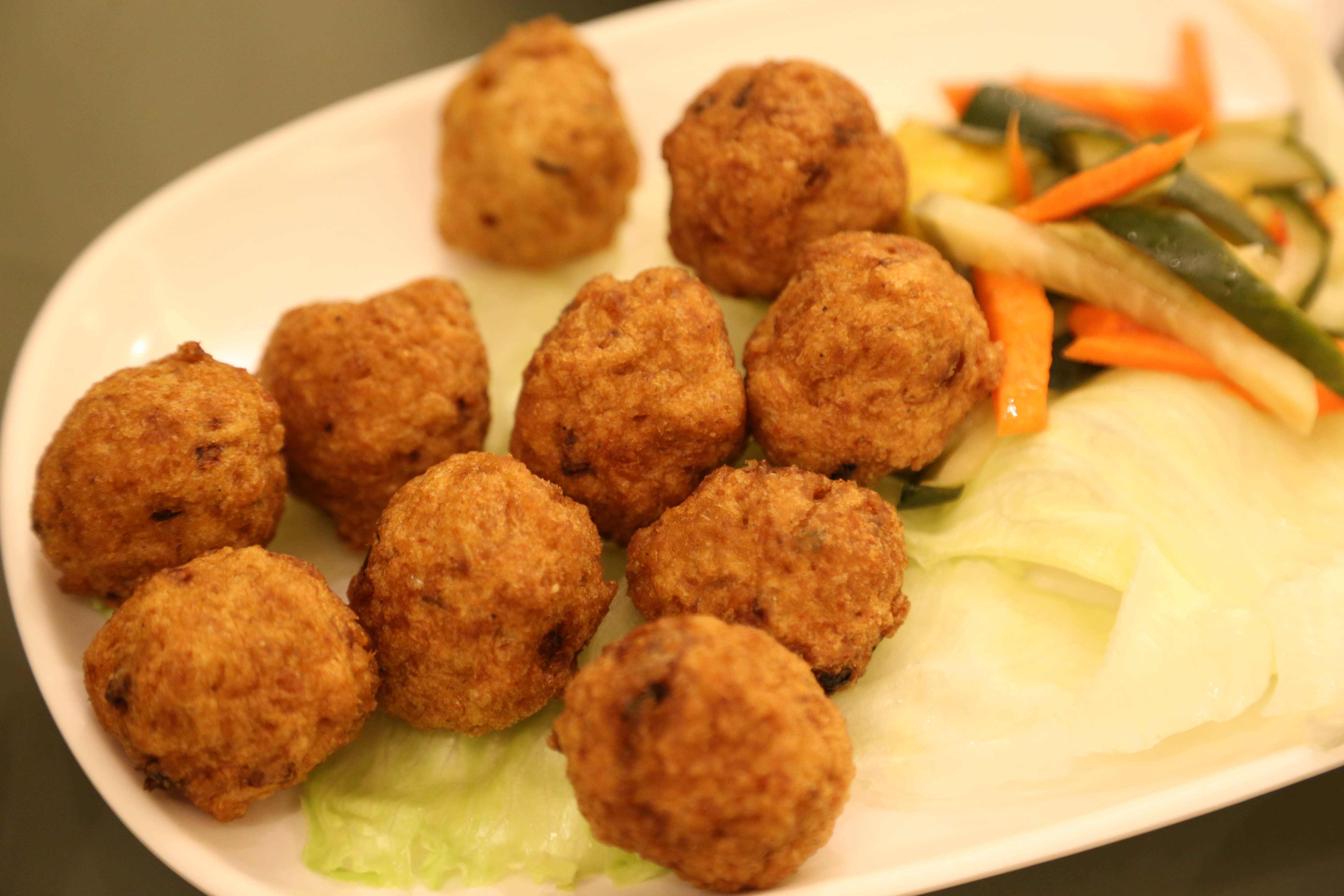
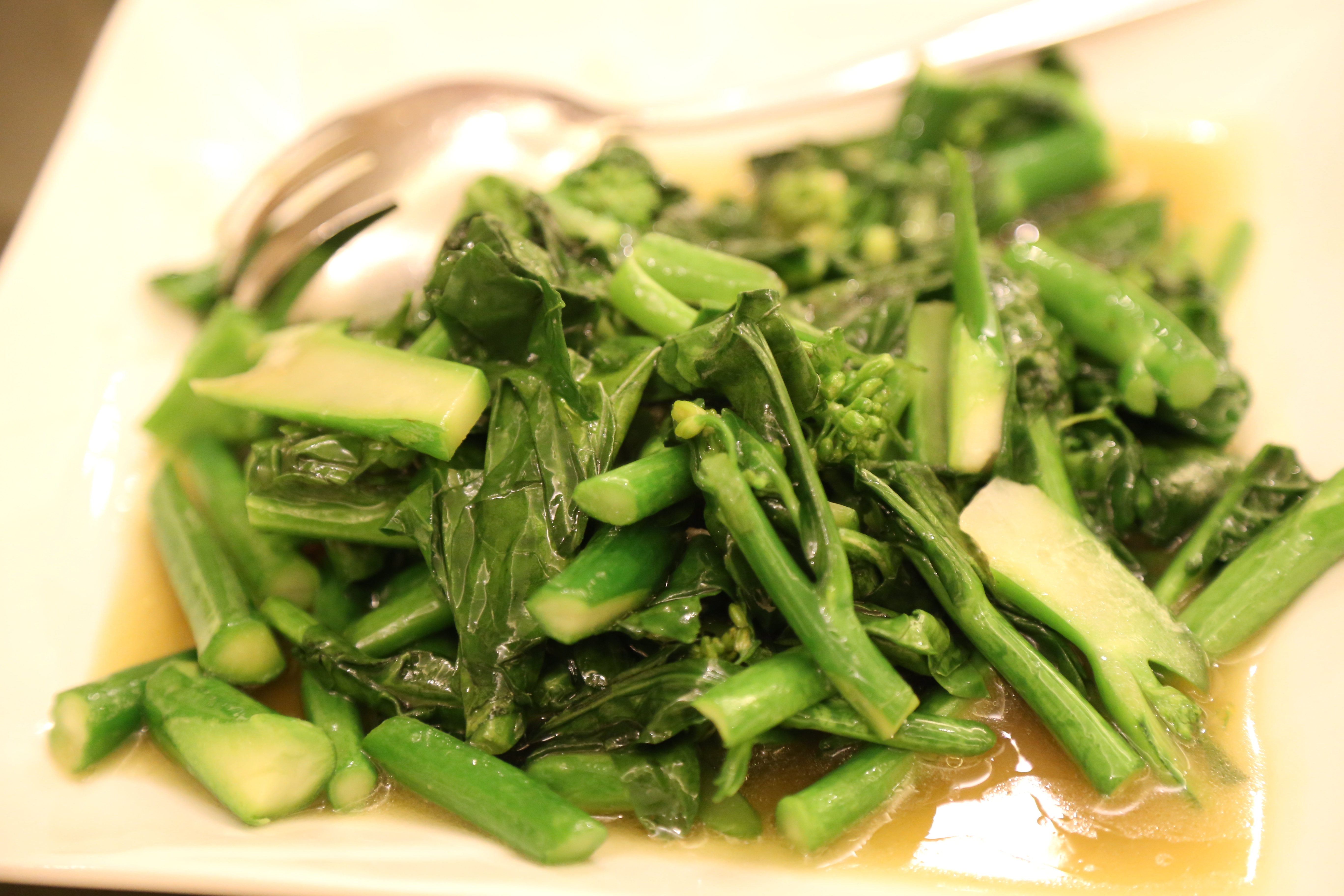
We had braised goose (卤鹅) next. This was very good. It was real goose and NOT braised duck served in most restaurants (unlike Hong Kong where it is everywhere, goose braised or roasted, are not commonly served in restaurants in Singapore). Why is that I wonder? bird-flu? Hongkongers more resistant or tidak apa towards bird-flu?
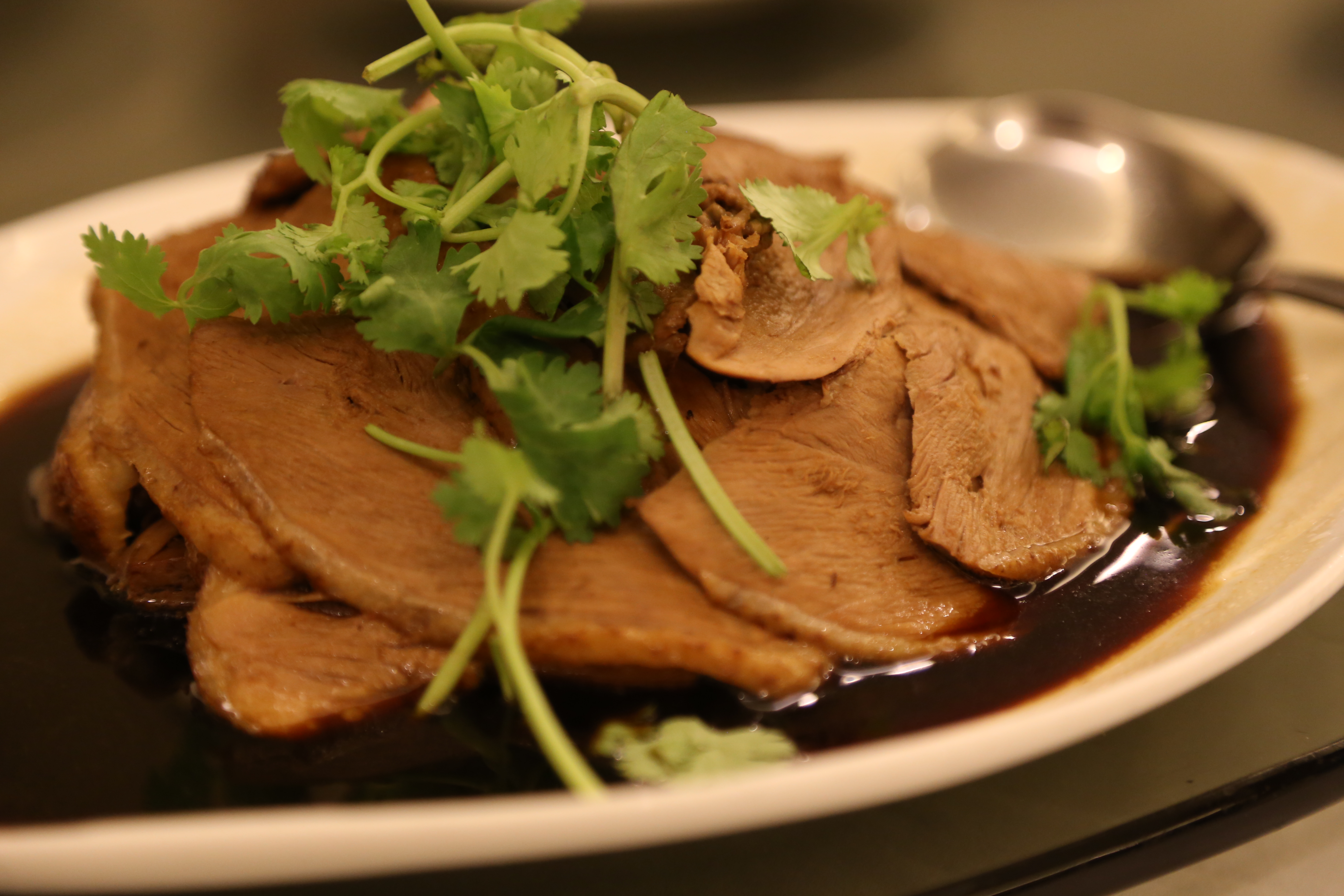
braised goose – yummy!
Next came a deep-fried chestnut prawn. This was their signature dish. hmmm, I wonder..not sure the chestnut added anything to the prawn & might have taken away the fresh, plump, sweet-tasting feel of a usual good prawn dish..
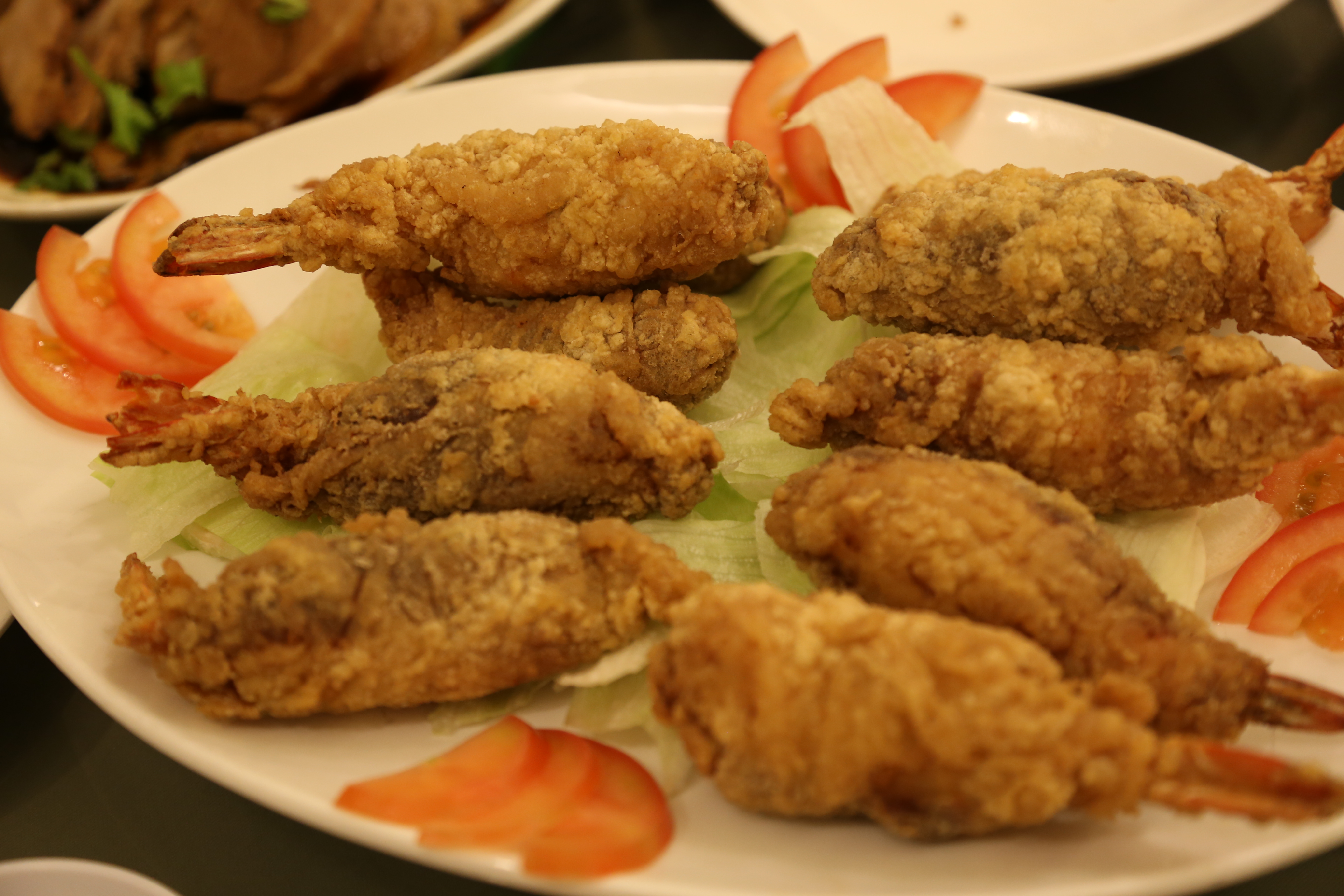
deep-fried chestnut prawns
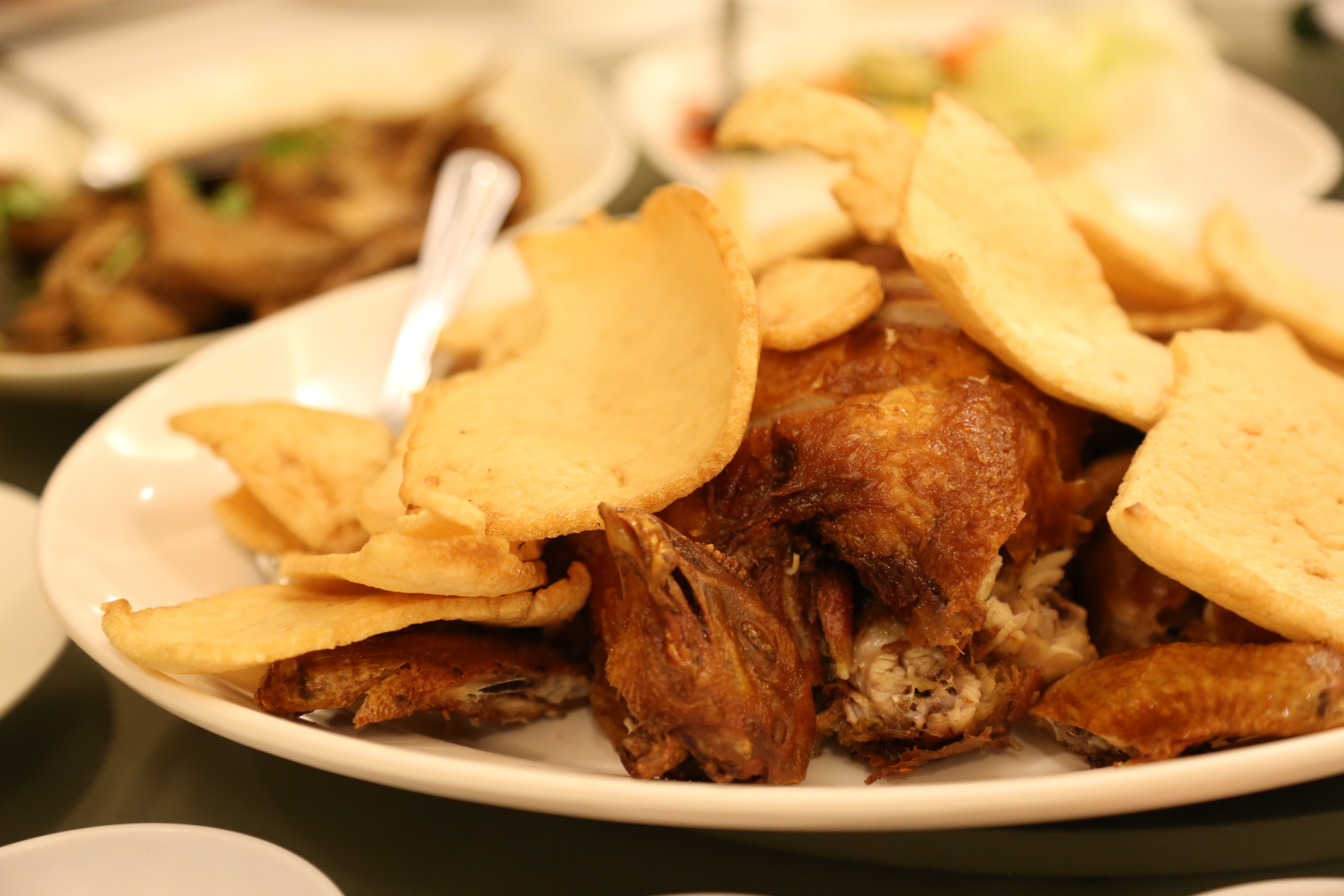
We had the usual roast chicken. and taken with five-spice salt, it was quite nice – though it is rare in most restaurants that serve this dish to deliver one that has moist, tender, sweet breast meat – usually it is on the dry, sinewy side & not s0 tender, and so it was the case here.
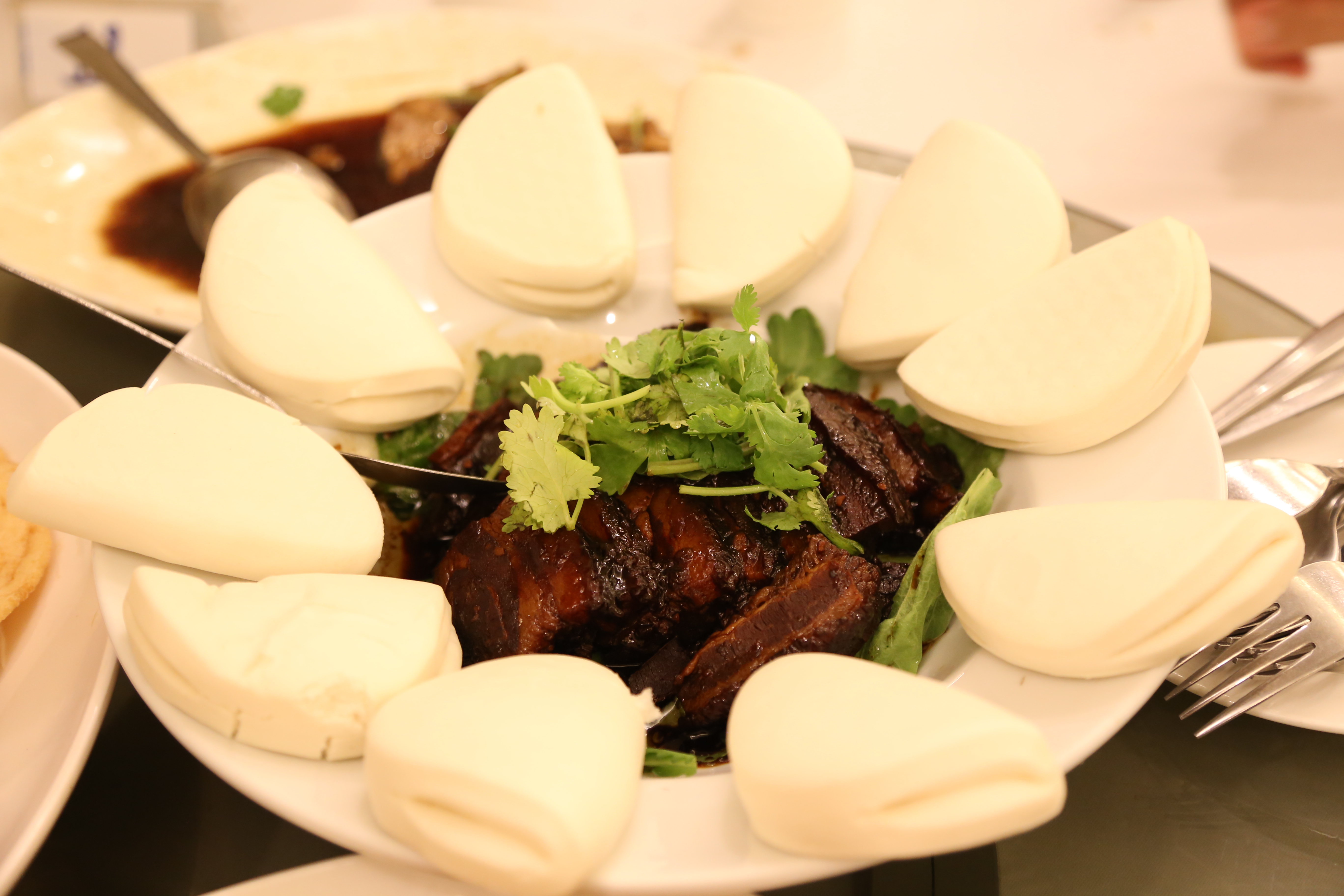
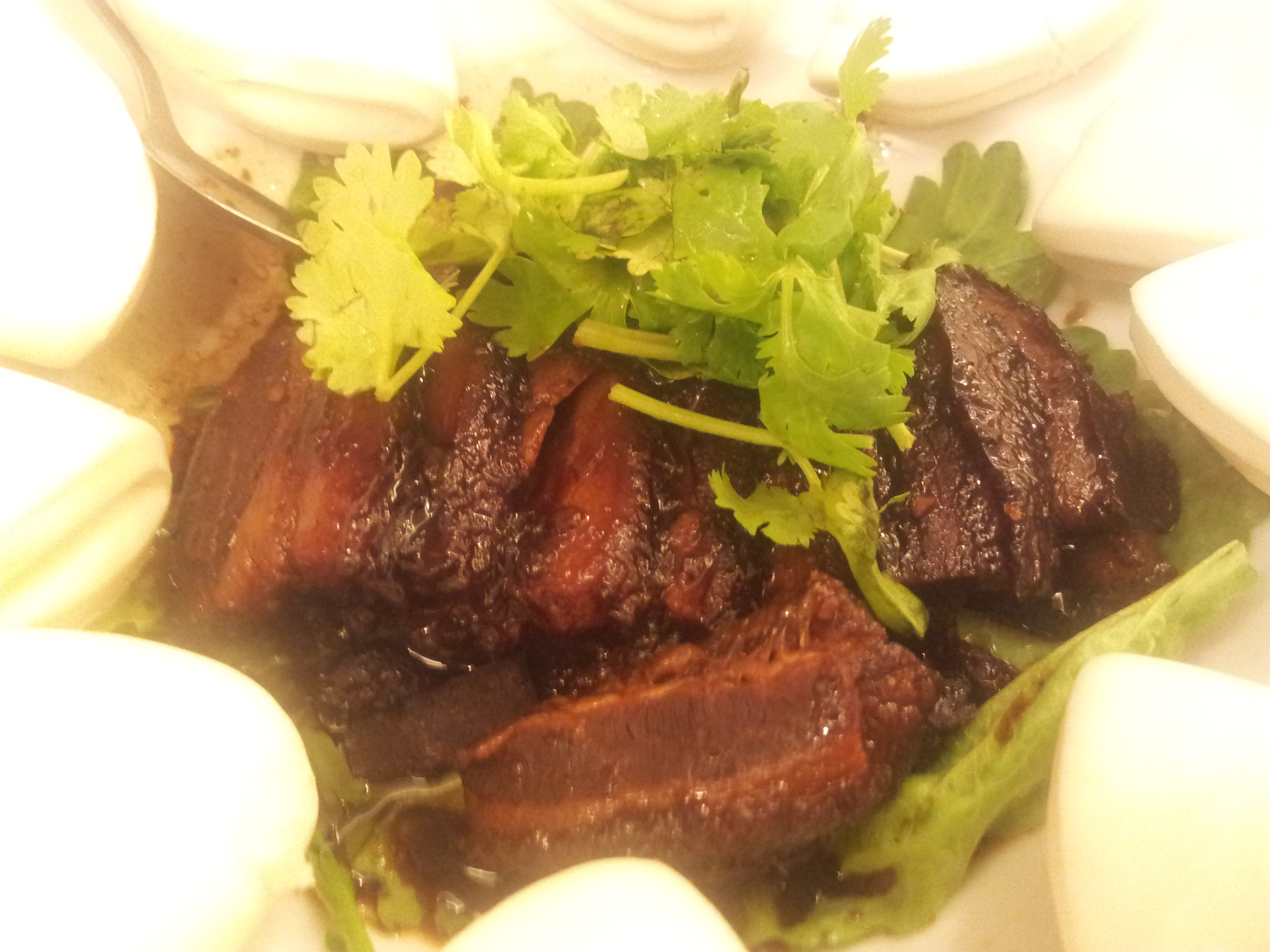
The kong ba pao was quite ok here, the usual and a nice dish to enjoy, if packing high calories & cholesterol.
The mustard greens with chinese mushroom and gluten was a very nice dish, great texture and very tasty indeed. I would certainly order this, as well as the braised goose & ter kar tan 猪脚冻 when I next visit.
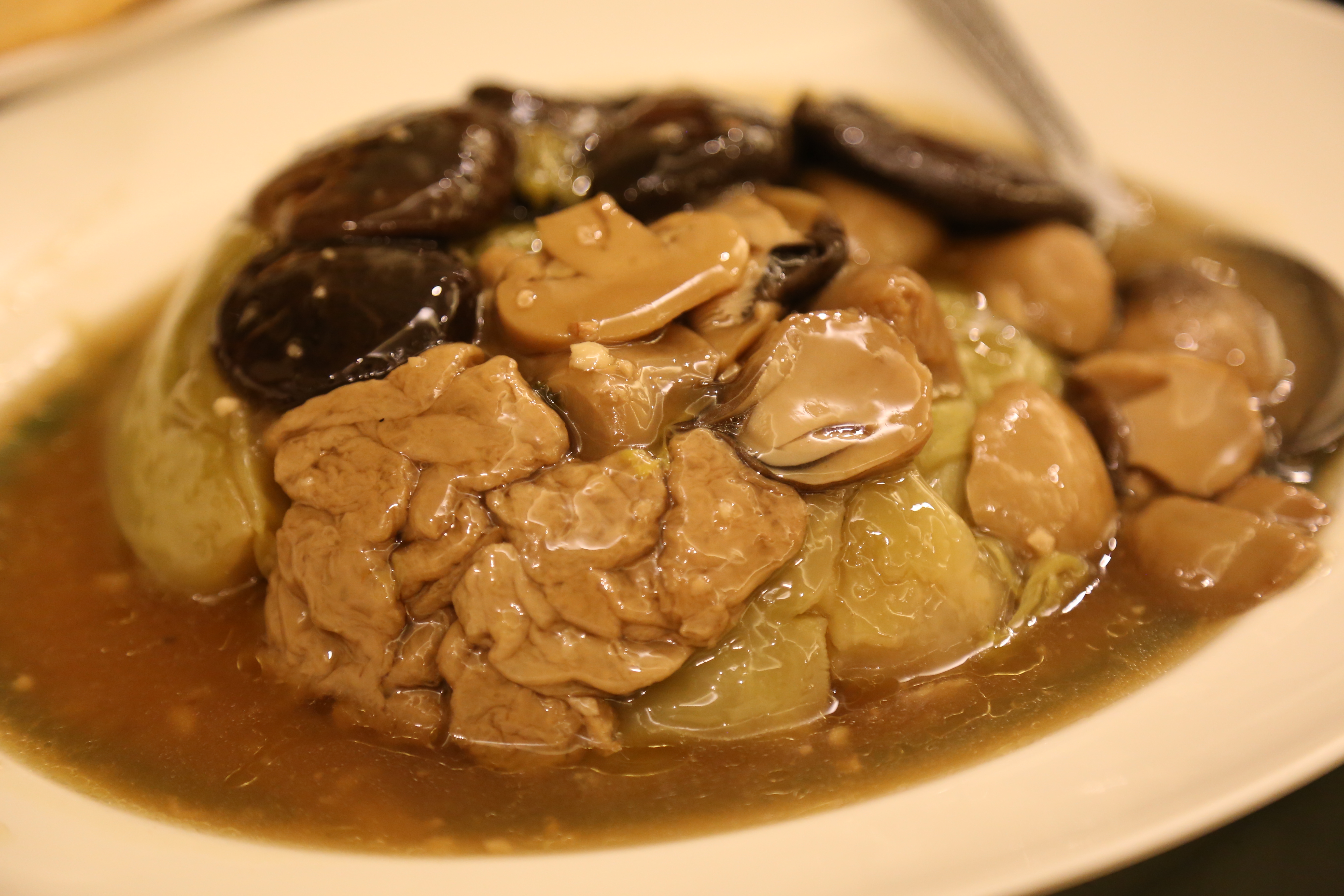
mustard greens with chinese & button mushrooms & gluten
Next we had these huge slipper lobsters (we call crayfish in Singapore). This apparently is also a signature dish here, though I am not a fan of the sauce (which was like a non-spicy chilli crab sauce) – I prefer the one served at Ah Orh which is a more yellowish sauce with lots of yellow onions & egg – and I thought the meat was overcooked and not tender.
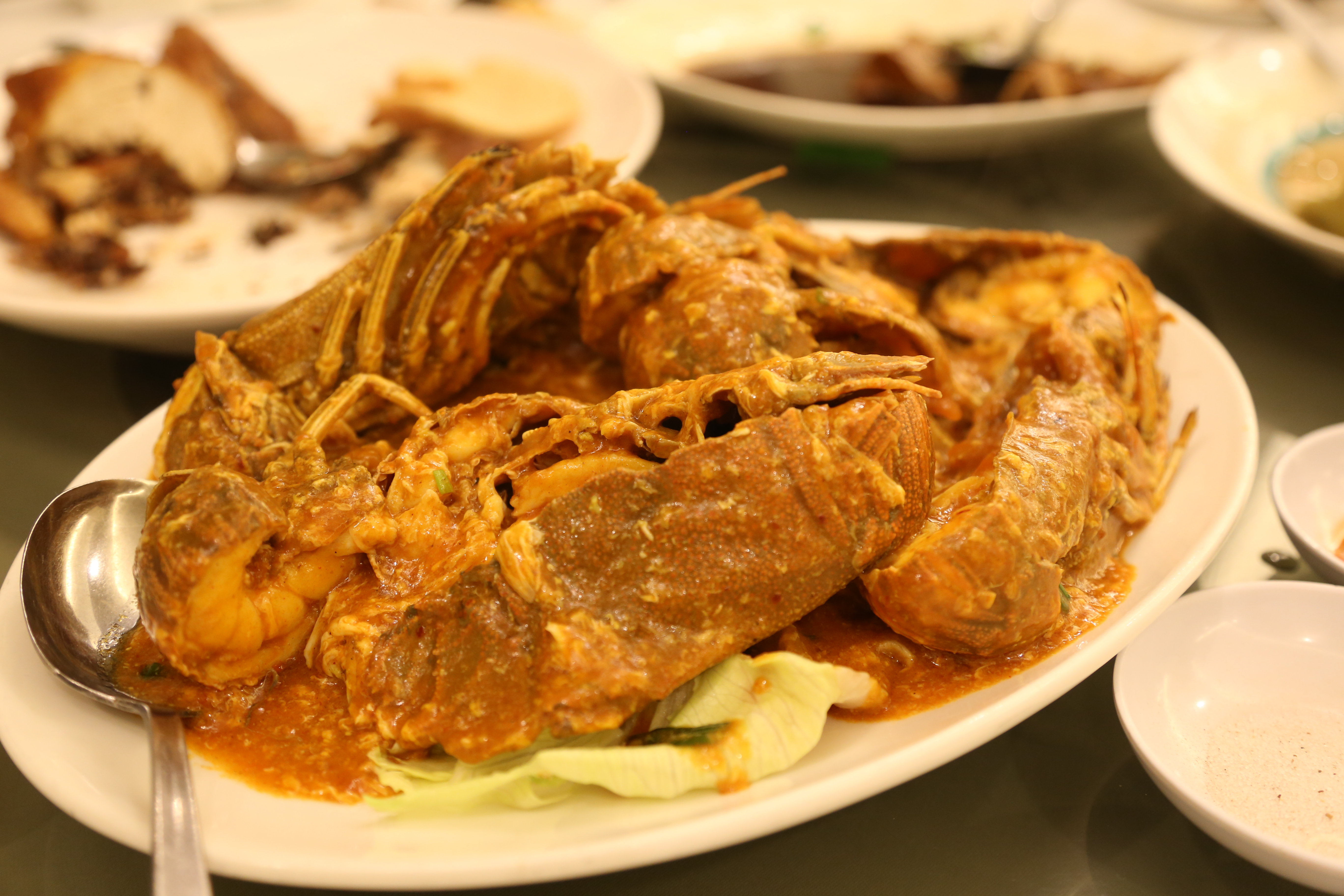
a slipper lobster dish
And to round up the sumptuous meal & an evening of F3=food, fun & feel-good, we had the sea coconut & longans – nice dessert, though the few teochews among us were wondering why we were not having orh nee..hahaha..I guess the friend who organised this great dinner was worrying about our cholesterol & waistlines..lol. 🙂
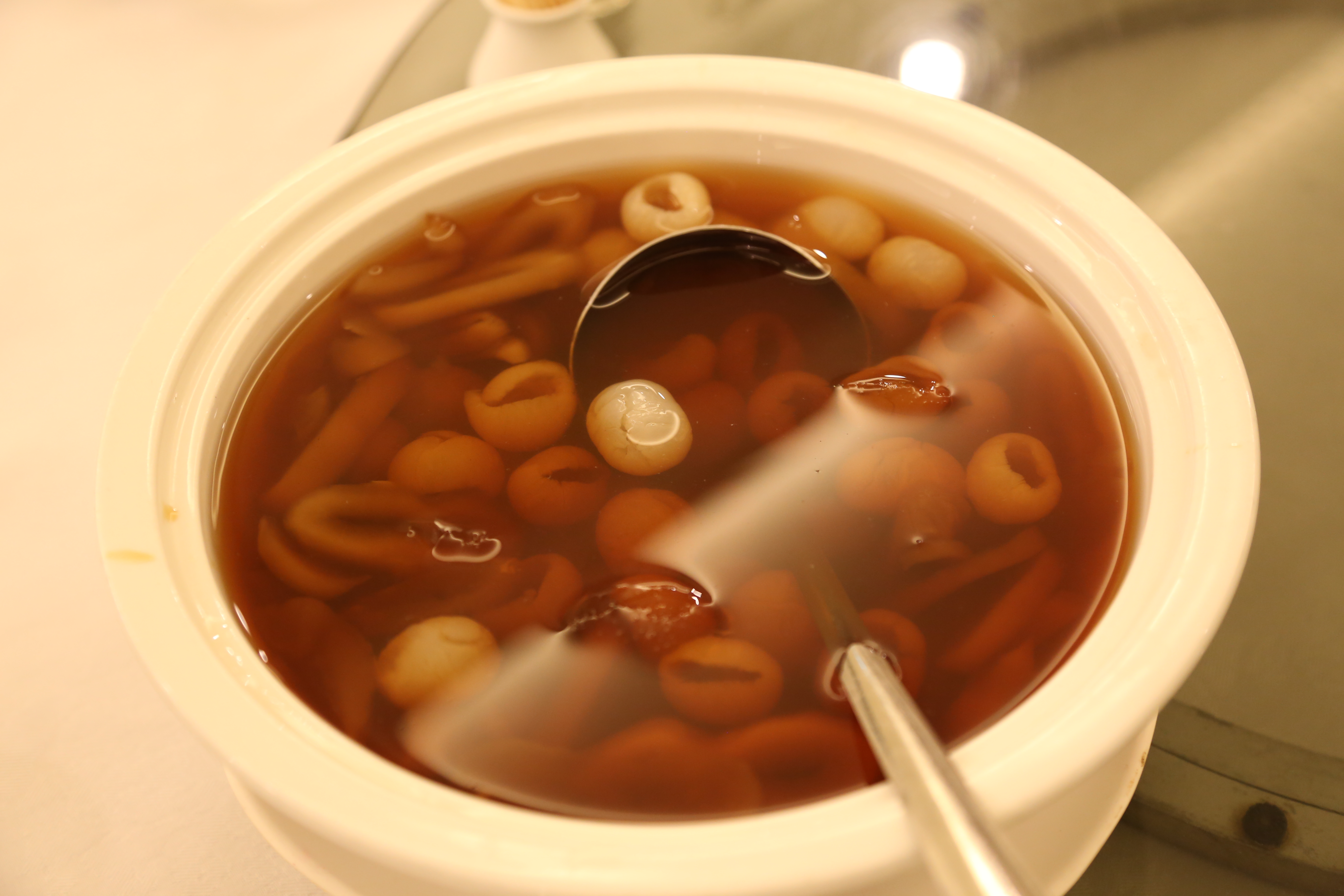
sea coconut with longans dessert
The “damage” came to just $36nett per person, though we were missing some big-ticket dishes like pomfret, soup & cold crab or other crab dishes.
One friend, the teochew expert among us, who never fail to enthrall us with his own remarkable romanised teochew language system, commented afterwards on Facebook that the standard of food here was not consistent. On the face of what was served & the price though, I would still give it another go sometime.
c.h.e.f andy
Lunch @ Tonkichi at Orchard Central on 22Mar2013
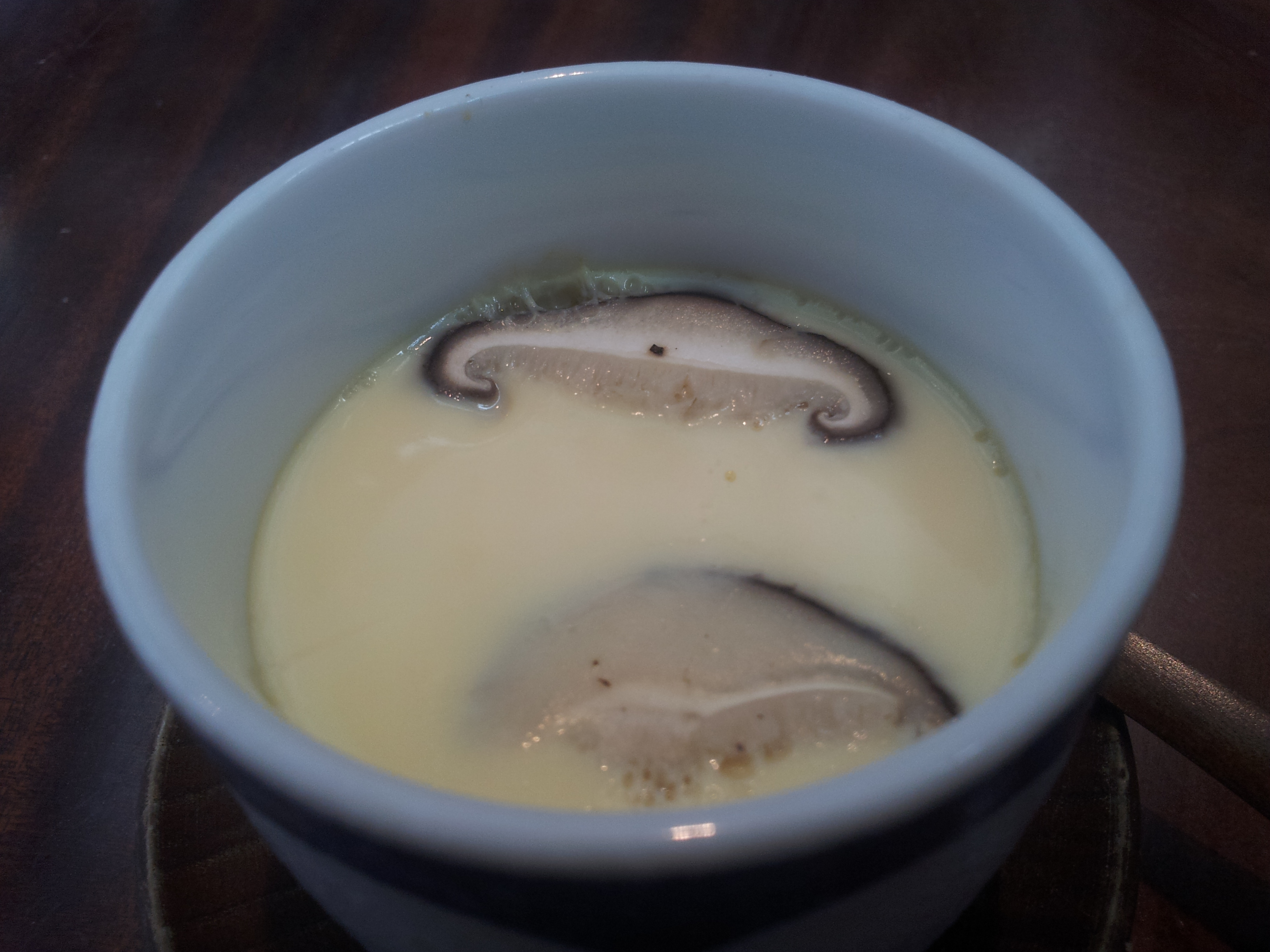
chawanmushi (茶碗蒸)
had a simple pleasant lunch with my sister at Tonkichi @ Orchard Central today.
we were both eyeing the Friday special chirashi don lunch set when we passed by the other day, so we just ordered that – 2 sets.
the shortage of foreign workers is showing up clearly in many economic sectors in Singapore, not least the restaurant service sector. we saw only 2 waiting staff, they were both well-trained and efficient but very busy as there were quite many tables taken up even though it was just 12.30pm – that maybe a good thing actually.
we were quickly given our chawanmushi – to keep us occupied. this was good. texture was very slightly dense but of smooth consistency, sweet-tasting and the chicken was good, no ginkgo nuts.

chirashi don
it was a rather long wait after the chawanmushi starter, just about 1/2hour. luckily we were not in a hurry.
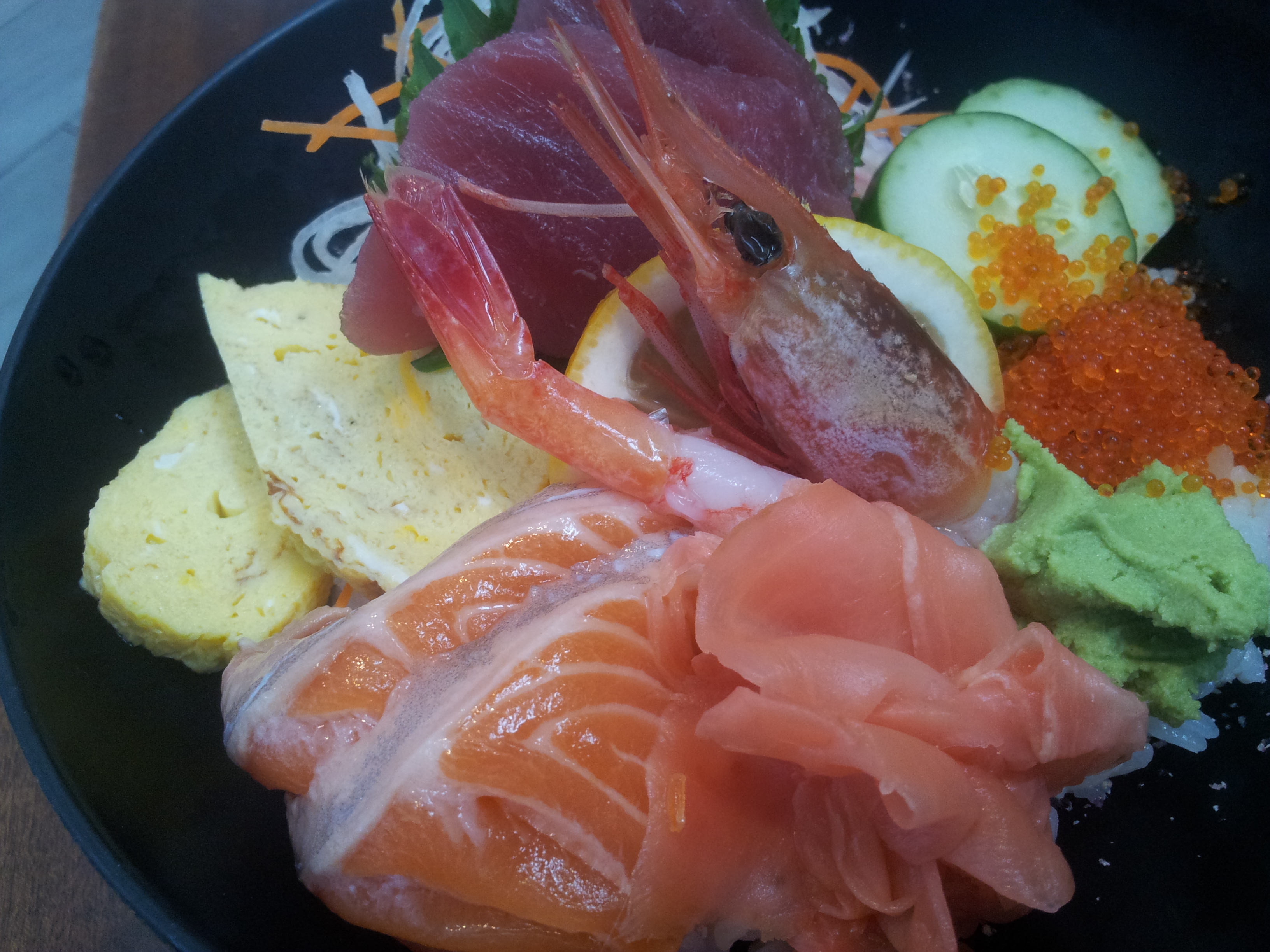
chirashi don
the chirashi don has 7 pieces of sashimi – 2 salmon (good), maguro (ordinary), 2 tamagos (good) & 1 amaebi (good), and the vinegared rice was good too. I would consider it a good quality chirashi don set at S$15.90++ by most comparison. However the S$20++ chirashi don set at Kuroson would beat this hands down in terms of both sashimi quality & quantity & overall set quality which also includes free refillable green tea (hot or cold).
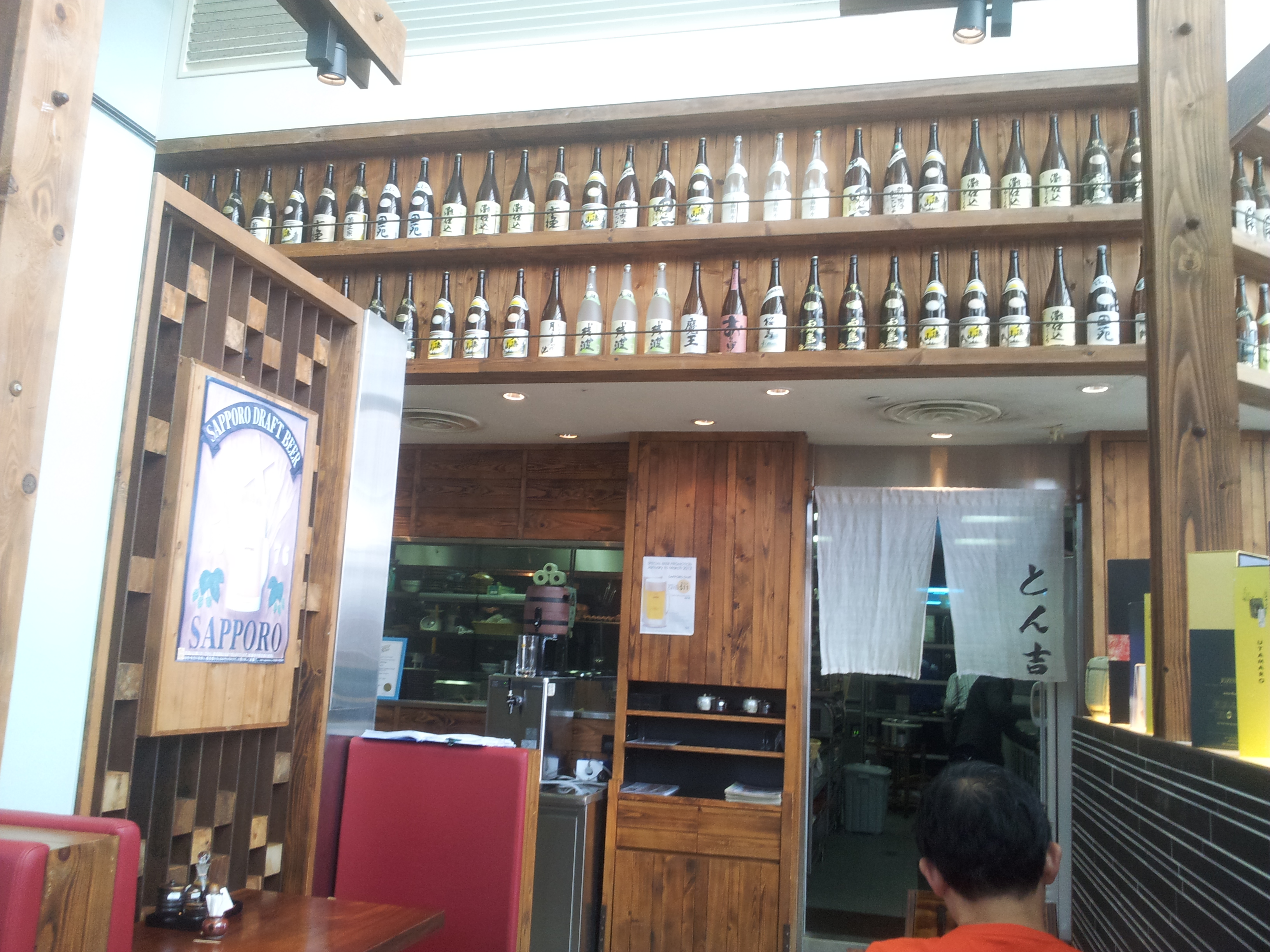
Tonkichi @ Orchard Central
the set also included a tiny soba – quite irrelevant carbo load but no harm having.
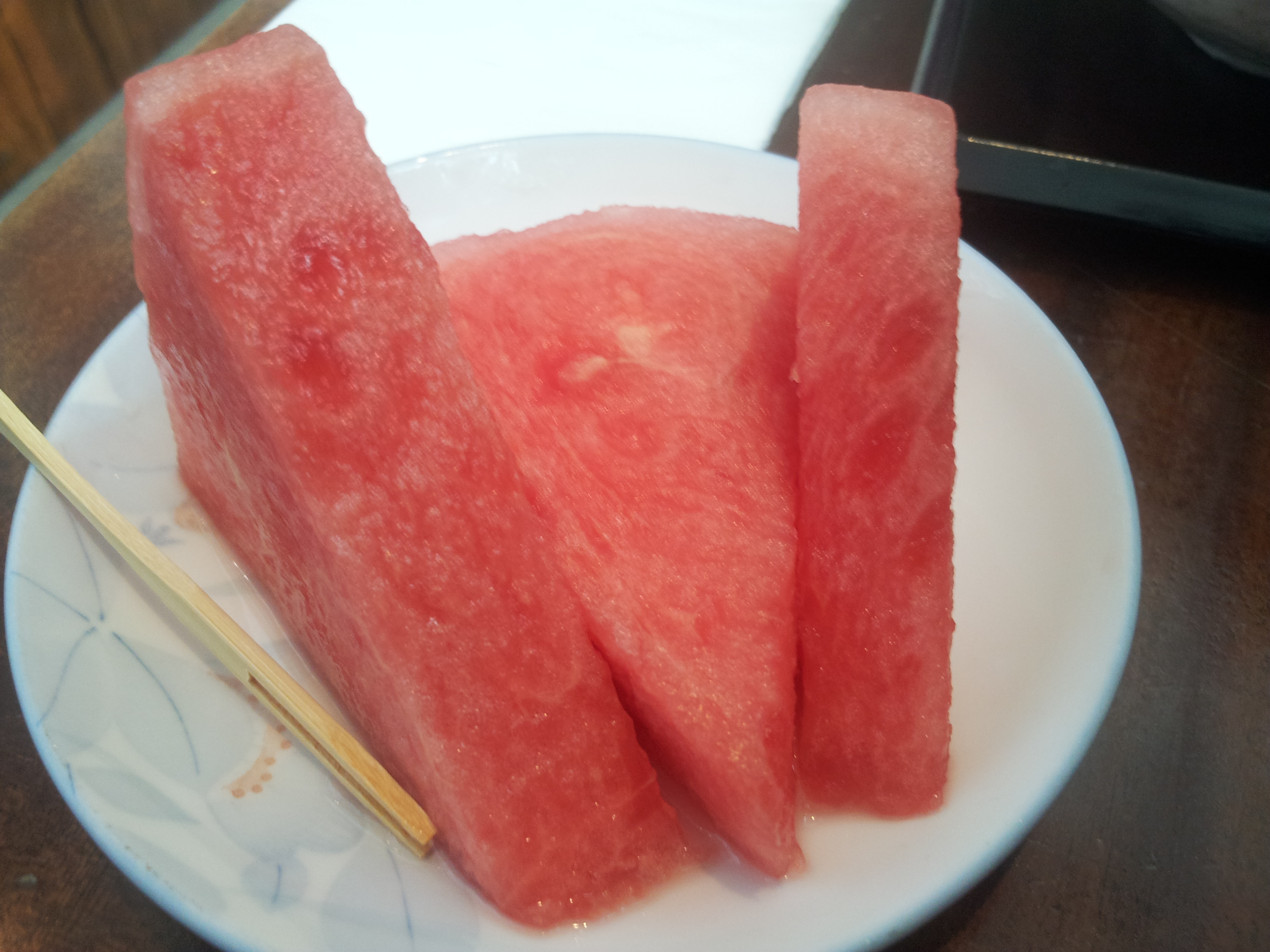
watermelon – looked slight pale but was sweet & juicy
the watermelon was juicy & sweet.
given a choice, I would always go to Kuroson, but if I am in the area (Orchard Central), I might just do this again.
c.h.e.f andy
Protected: G15 Dinner @ Yuanxing Restaurant (Guan Hin) on 19Mar2013
Baked Mushroom Risotto
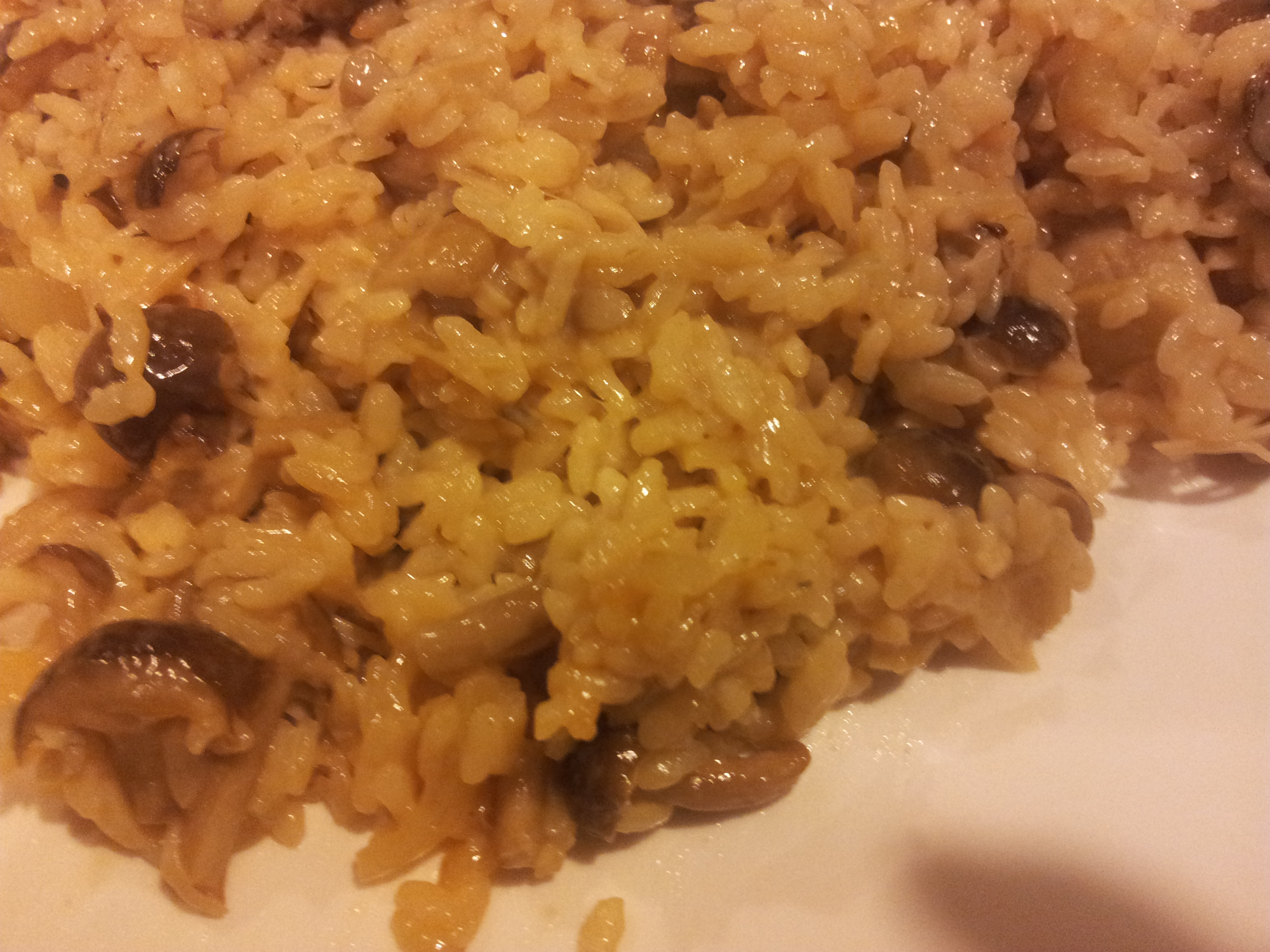
my first risotto – a baked mushroom risotto
cook my first risotto last evening!
It was just so satisfying but also spoke volumes of Foodwishes.com Chef John’s baked mushroom risotto recipe that I could reproduce such a great dish with ease even though this was my very first risotto. 🙂
I have the bulk of a 2.5kg bag of USA 松鹤 (no english name but I guess it is matsutsuru in literal translation?) Shakaku premium rice – which I think is a medium grain rice – lying around. I bought these in Giant hypermarket when I was trying out a paella mixta for a homecooked (kind of Spanish theme) dinner for friends as I didn’t know where to get aborio rice (still don’t!). Though the paella turned out kind of ok taste-wise (quite good tasting) based on the recipe I used, the texture was really quite far out. Anyhow I have not found other use for the rice and I don’t quite fancy cooking paella mixta that often when it is not quite ideal in the visual & texture departments & also it takes a bit of effort to prepare (when c/w this mushroom risotto which requires almost no effort!).
So I actually decided only at very last-minute to cook this & it was done like in 35minutes (only because you needed to put it in the oven for 16minutes).
I cut and washed the only mushrooms I had in the fridge (a packet of 150g shimeji mushrooms and another packet of 100g enoki mushrooms). I put these in an oven-proof skillet with 1 chunk of butter (20g) and a large pinch of salt on high heat and cooked/sweated for 10 minutes on medium heat OR until the liquids evaporated off, then I added chopped yellow onions and cooked for a few minutes until softened. Next I added a cup of the Shakaku rice, stirred to coat the rice completely and then added 1 cup of chicken stock, brought it to boil and dropped to low heat and stirred. When the liquids were evaporated, I added another cup of chicken stock and when it started to simmer, I placed the skillet in a 205degC preheated oven for exactly 16minutes (following Chef John’s instructions to the dot..it had been kind of fool-proof which explained my relative success thus far..no secrets haha!) 🙂
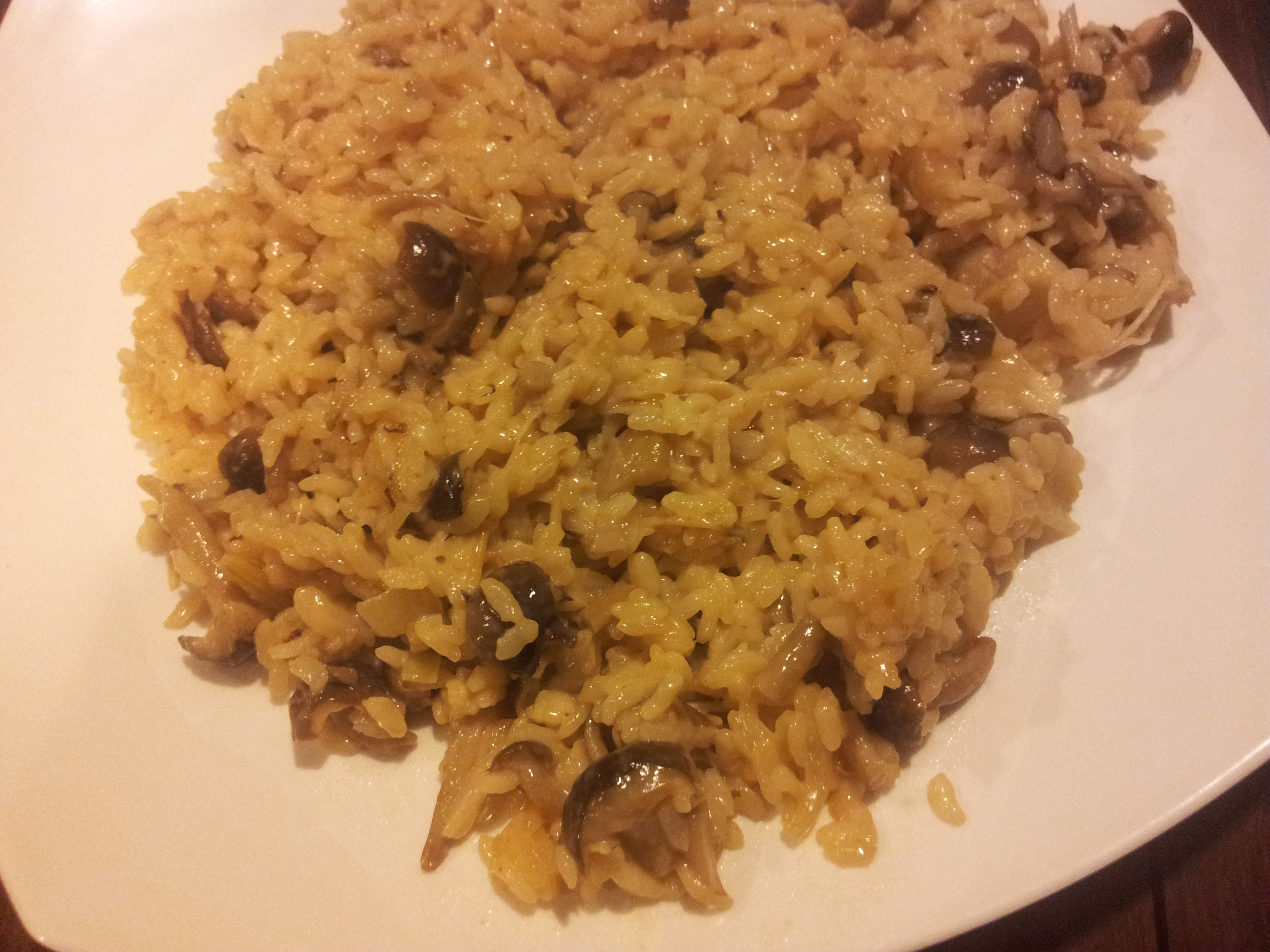
my first risotto – a baked mushroom risotto
I then returned the skillet to the stove, added another cup of chicken stock, brought to boil and stirred on low heat. At this point, as Chef John said, you needed to be your own boss & decide how you wanted the risotto to turn out. I tasted the rice, flavour was great (quite super really!) 🙂 very slightly not cooked-through the centre, so I added another cup of chicken stock and stirred. Last I added 2 tablespoon of heavy cream and sea salt to taste. The result was a truly marvellous dish – creamy but not overly, with very nice infused mushroom flavour, just like any good funghi risotto I would have gotten in a good restaurant. 🙂
It was far better than I expected as I was also not certain whether my Shakaku rice would do for this recipe. So yes it really made my day!
c.h.e.f andy
Ingredients:
- 150g shimeji mushrooms
- 100g enoki mushrooms
- 1/2 yellow onion
- 20g butter
- sea salt & pepper to taste
- 4 cups chicken stock
Directions:
- cut and wash the mushrooms, put these in an oven-proof skillet with 1 chunk of butter (20g) and a large pinch of salt on high heat and cook/sweat for 10minutes on medium heat OR until the liquids evaporated off. add chopped yellow onions and cooked for a few minutes until soften. add a cup of washed Shakaku rice, stir to coat the rice completely and then add 1 cup of chicken stock, bring to boil and drop to low heat and stir. When the liquids evaporate off, add another cup of chicken stock and when it started to simmer, place skillet in a 205degC preheated oven for exactly 16minutes.
- return skillet to stove, add another cup of chicken stock, bring to boil and stir on low heat. taste the rice for texture & flavour to see if it is cooked to your preference, add another cup of chicken stock (if required) and stir. add 2 tablespoon of heavy cream and sea salt to taste. Serve.
Beef Meatballs Arrabiata Spaghetti
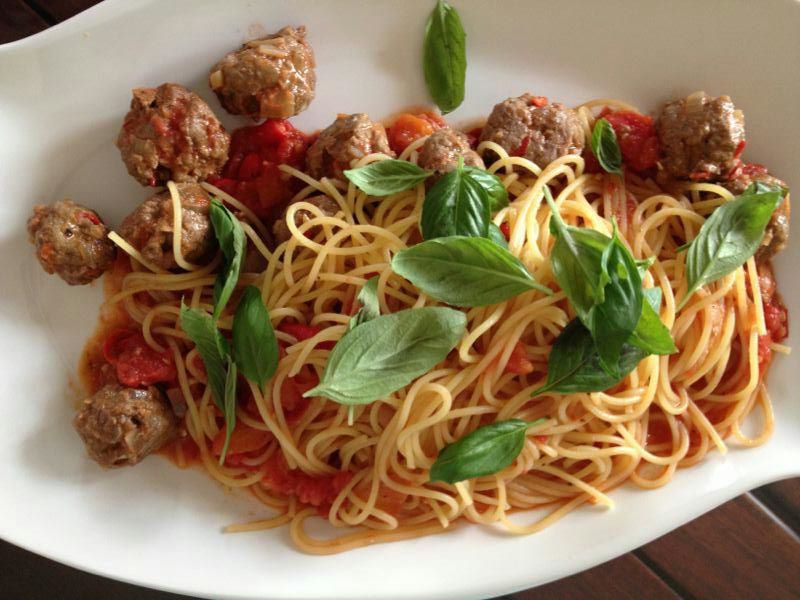
beef meatballs arrabiata spaghetti
I like arrabiata (spicy tomato) sauce though second to alio olio with white wine. So this is an easy variation from the pork rib & belly pork arrabiata but require a decent meatball recipe. I very quickly found a simple one for my use on the internet.
I mix 400g of minced beef, 2 eggs, parmesan cheese, parsley, minced garlic, breadcrumbs in a large bowl, and season with salt and pepper to taste. I heat some oil in large pan over medium-high heat. I roll the mix in 2.5cm balls and fry until golden brown, but not cooked through completely, then remove to a plate lined with paper towels.
For the arrabiata sauce, I fry to soften some chopped yellow onions in a medium saucepan, then add 1 can of diced tomatoes and sauce & add some sugar. I the put in the meatballs and add light soy sauce, and let it slow-cook in low fire for 1/2 hour.
The spaghetti is done in the usual way according to timing instructions. As with my other pasta dishes, I then heat up the browned garlic cloves & olive oil (set aside earlier) in a pan, add 1 cut chilli padi and fry a little, add in the meatballs with the tomato sauce, bring to boil, turn off the fire, mix in the spaghetti and toss, and then add sea salt to taste.
c.h.e.f andy
Ingredients:
- 400g minced beef
- 2 eggs
- 1/4 cup grated parmesan cheese
- 2 tsp minced garlic
- 1/4 cup chopped parsley
- 1/4 cup breadcrumbs
- 1 can (400g) diced tomatoes with sauce
- salt and pepper
- 1/2 chopped yellow onion
- 1 tbsp sugar
- 1 tbsp light soy sauce
Directions:
- Prepare the garlic olive oil – stir-fry whole garlic cloves on low heat to brown the garlic & flavour the oil.
- Prepare the spaghetti – add some salt & oil to water and boil the spaghetti according to timing instructions & drain in a colander.
- Cook – mix 400g of minced beef, 2 eggs, parmesan cheese, parsley, minced garlic, breadcrumbs in a large bowl, and season with salt and pepper to taste. heat some oil in large pan over medium-high heat. roll the mix in 2.5cm balls and fry until golden brown, but not cooked through completely, then remove to a plate lined with paper towels. fry to soften some chopped yellow onions in a medium saucepan, then add 1 can of diced tomatoes and sauce & add some sugar. put in the meatballs and add light soy sauce, and let it slow-cook in low fire for 1/2 hour. heat up the browned garlic cloves & olive oil (set aside earlier) in a pan, add 1 cut chilli padi and fry a little, add in the meatballs with the tomato sauce, bring to boil, turn off the fire, mix in the spaghetti and toss, and then add sea salt to taste.
Lunch @ Sarang Restaurant at Orchard Central on 20Mar2013
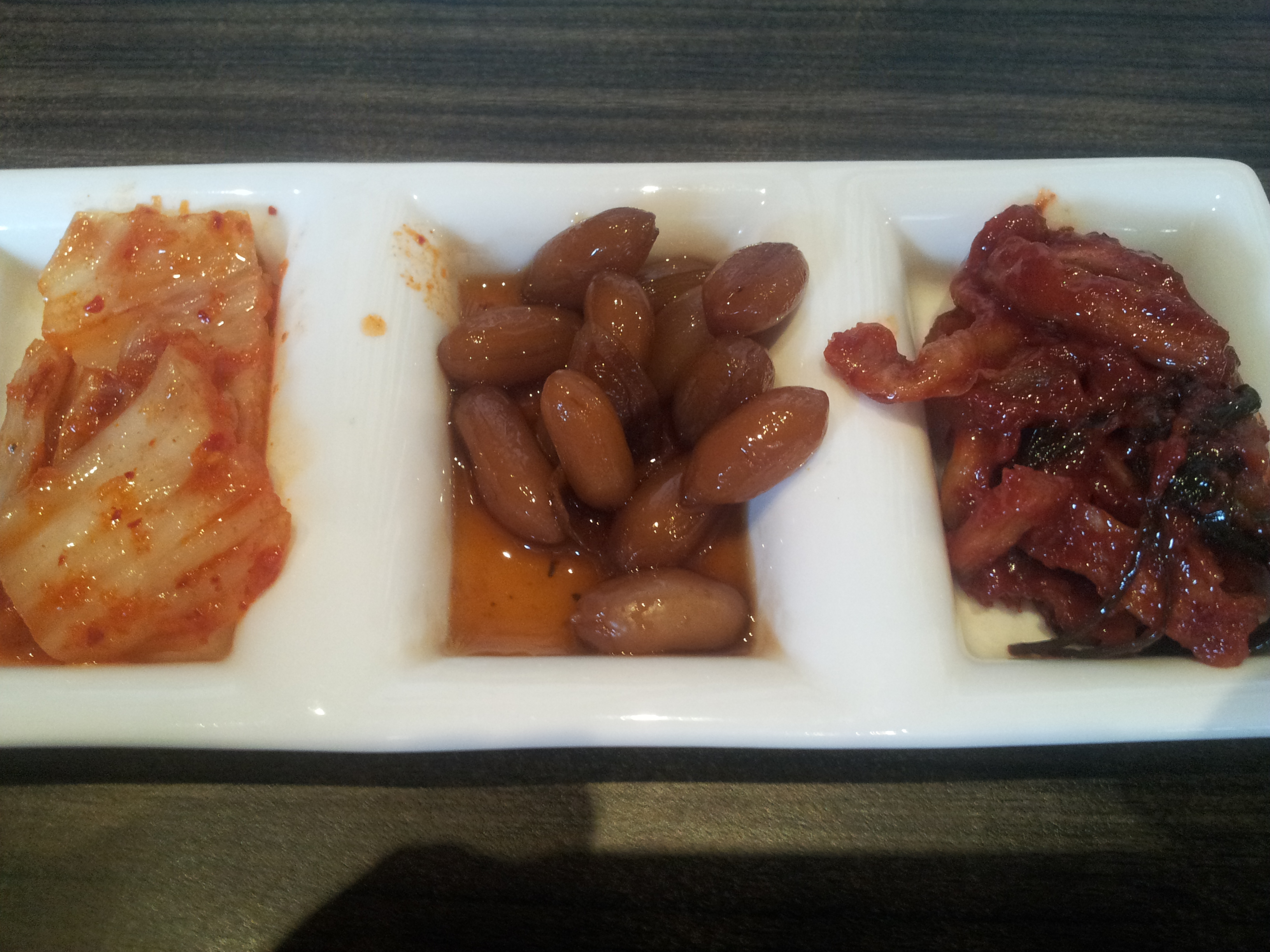
korean banchan (side dishes) comprising kimchi, peanuts & another veg kimchi
had lunch with my sister today. I had 2 xS$30=S$60 deal.com Sarang vouchers (which I paid S$30 for) expiring soon so we decided to lunch there.
I don’t frequent korean restaurants much these days. My family are mostly carnivores aka meat-eaters and for barbeque beef we generally prefer the Japanese-style korean barbeque yakiniku restaurants. One of my wife Lisa’s favourite yakiniku place is Aburiya. We used also to go to Chang & Hyangtogol but find them rather expensive. Though we all like banchan, those very nice free & refillabe korean side dishes, but they cannot be our sole motivation for having korean.
Sarang at Orchard Central served a very small banchan, comprising just peanuts (which was very nice & we duly had our free refill of peanuts), and the usual cabbage kimchi & another vegetable kimchi.
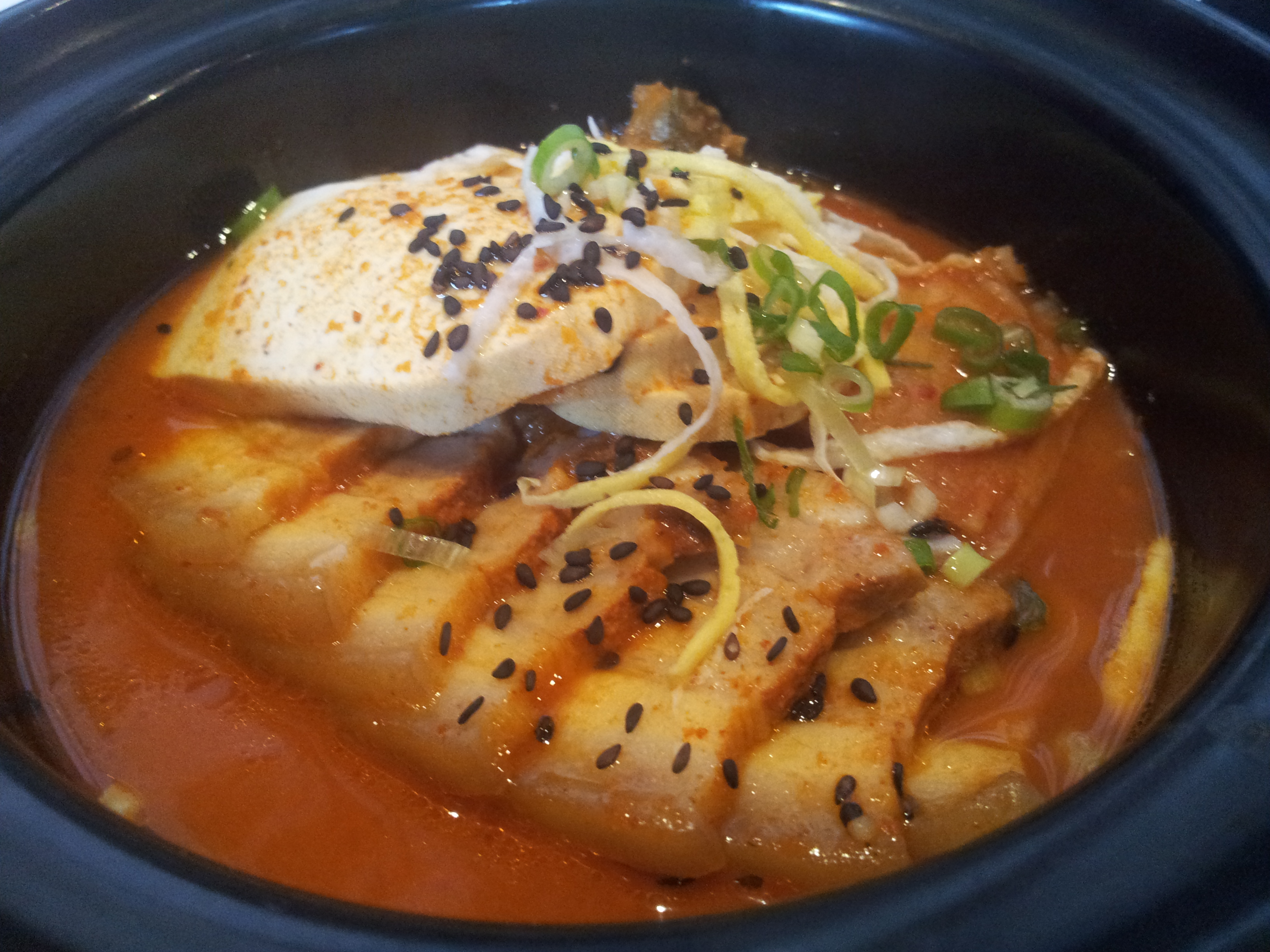
kimchi belly pork with tofu stew – S$15.80
We ordered the kimchi belly pork. Though I would have liked it with a lot more soup (like the kimchi chigae which I always like and order at Aburiya & Watami), this belly pork was differently done (not just boiled like in kimchi chigae to add base to the soup) & very much better, had very good “mouth-feel”(口感) in texture and taste.
spicy sotong (squid) – S$11.80
We also had the spicy sotong (squid) which was a generous helping. It might be too spicy for some but was perfect for me.
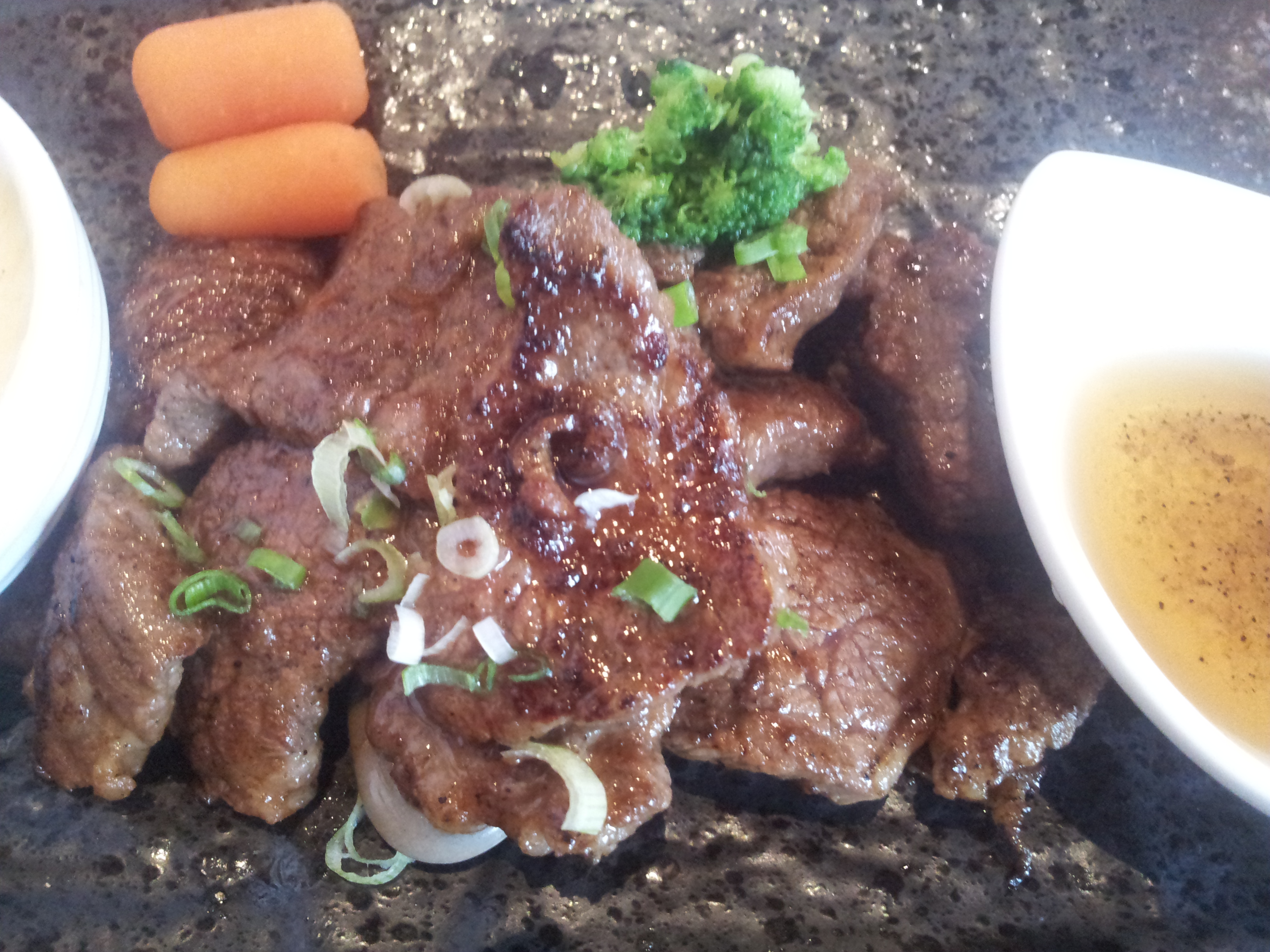
galbi (korean beef ribs) – S$24.80
We also added the usual galbi – korean beef ribs. It did have a bit of fat & tendons but it was a very nice dish which I liked a lot and was as good as that served at Chang (though I would need to confess that was many years ago). I guess the chef was a bit modern in his approach so his banchan was not quite the traditional big spread of side dishes, his sotong (squid) was accompanied by thin white noodles & this galbi dish also came with a cup of smooth potato mash (not in picture).
The meal comprising 3 very good dishes & banchan came to just S$34nett (about S$26++) using the vouchers. I think the prices were actually quite fair for the quality of food offered even though I am unlikely to frequent soon without the discounts.
c.h.e.f andy
Restaurant Week $35nett Lunch @ Kumo Kaiseki Restaurant on 19Mar2013
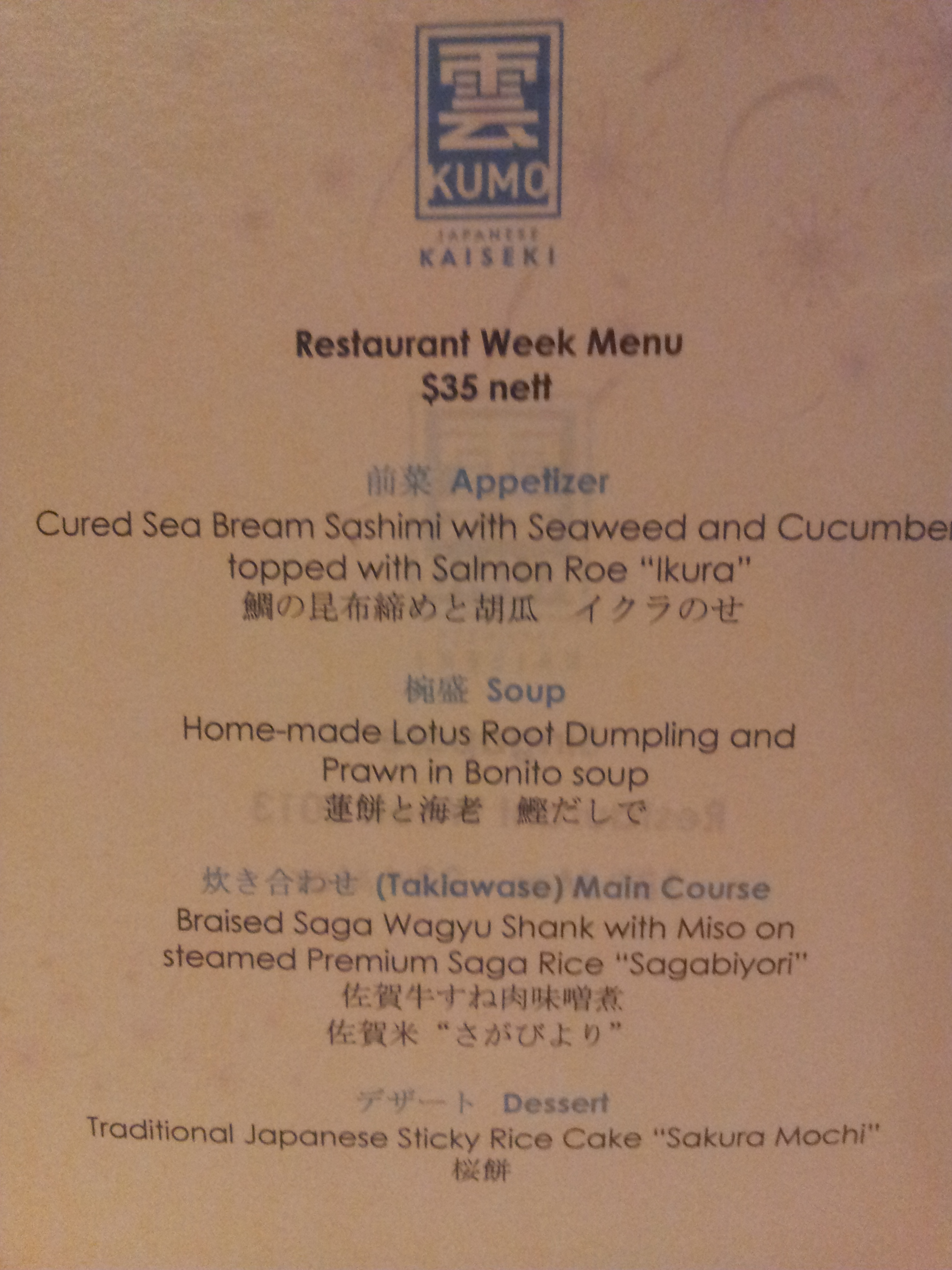
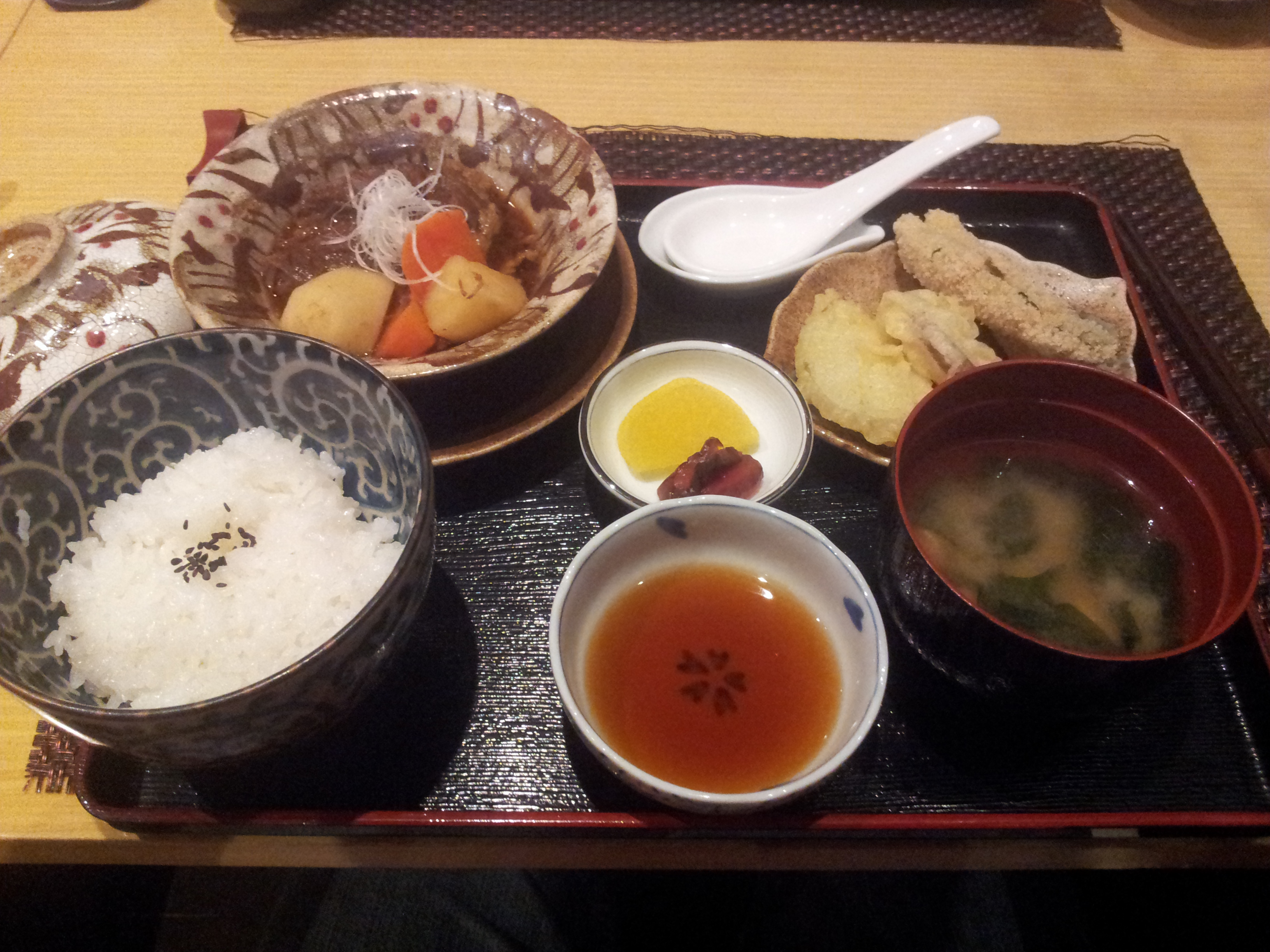
Menu-Restaurant Week $35nett set lunch at Kumo Kaiseki Restaurant
A friend bought lunch today. We had great time chatting about the charity he was actively leading last 25years, travel & food.
As it was DiningCity Restaurant Week (18-24mar2013), I suggested the $35nett lunch set at Kumo Kaiseki Restaurant. There was just a little confusion as many restaurants were awarded DiningCity Star (and Kumo Kaiseki was 1 of them), and this meant they charged additional S$15 & S$20 respectively on top of the standardised S$25++ lunches & S$35++ dinners. Most if not all ‘Star’ restaurants would simply indicate lunches as S$40++ & dinners as S$55++ to avoid confusion but Kumo did not. So we called up to make sure that we would be paying S$35nett and NOT S$50++ & that was indeed the case (good to be certain than have wrong expectations and be disappointed..haha..). 🙂
I have stopped going for Restaurant Week these days as there is nothing much on offer. S$40 lunches & S$55 dinners at the ‘Star’ restaurants like Oso, Gaia, Absinthe etc are not cheap and also usually restrictive on the menu items especially mains c/w their daily lunches. Last year for example, UOB had very good 1 for 1 Young Chef Creation Menu in many restaurants and you get a 4-course S$68 1 for 1 menu at Gaia vs a S$40 3-course Restaurant Week menu at the same restaurant! Even at La Cicala Gastrobar (which has no Star), the usual S$25 set lunch menu is to me better than the same-priced Restaurant Week menu.
This Kumo S$35nett menu looks good though.
I had a kaiseki dinner only once at Kumo using a $50 Kitchen Language (which owns Kumo, Salta, Ochre, Saltwater cafe) voucher. Kumo’s food is good but not great for the price c/w say Hachi, and if you are not overly enameled with kaiseki presentation, I think Kuriya Dining’s monthly sets offer better value. For me, none of them can compare with Mikuni using the Feed@Raffles card with 50% discount for 2pax, so I usually frequent Mikuni, but it is good to have a change once a while.
The first course, tai (sea bream) sashimi topped with ikura (salmon roe), was truly delightful in all departments – taste, colour, presentation! the jelly (can’t remember what it is) went really well with the tai sashimi. every item (broadbean, petals & all) was edible. This dish was very impressive even for a full course kaiseki! 🙂
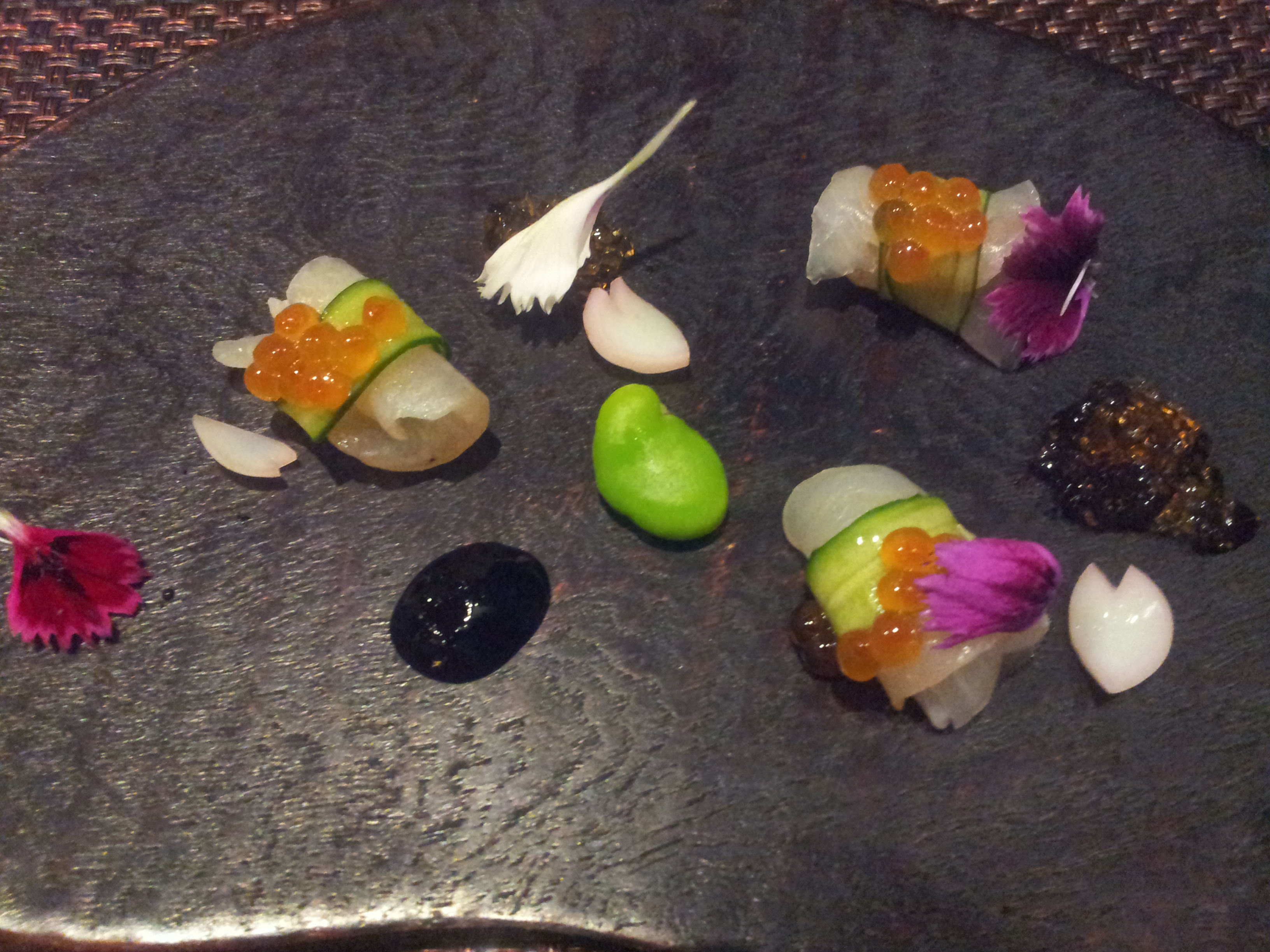
tai sashimi topped with ikura – so pretty (every item edible!)
The lotus & prawn dumpling were ok & tasty, nothing to wow about. the bonito soup was also ok with a nice after taste.
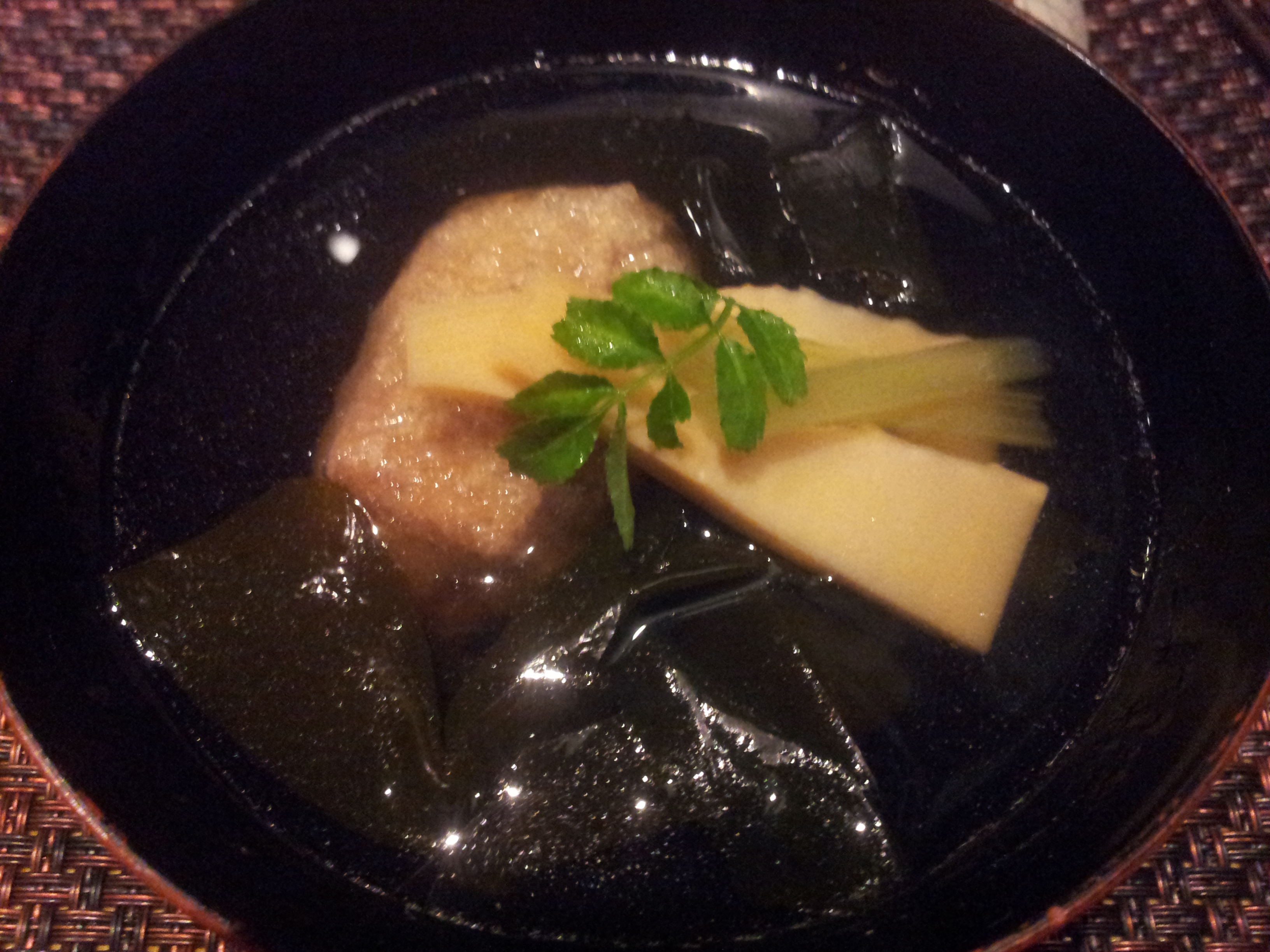
lotus & prawn dumpling in bonito soup
The main course comprised a braised saga wagyu shank & some vegetable items in batter & the usual gohan set of rice, pickles & miso soup. This really was quite so-so, very average taste wise. As a braised item, one could not tell much between wagyu (& Japanese wagyu at that!) & normal beef.
braised saga wagyu shank & yasai furai
also done this way it is more commonly served as an appertiser item (eg Dozo serves a japanese braised beef as an appertiser item in their 6-course lunches which maybe tastes same or better), and is no comparison with the modern european braised lamb shanks served in many restaurants here.
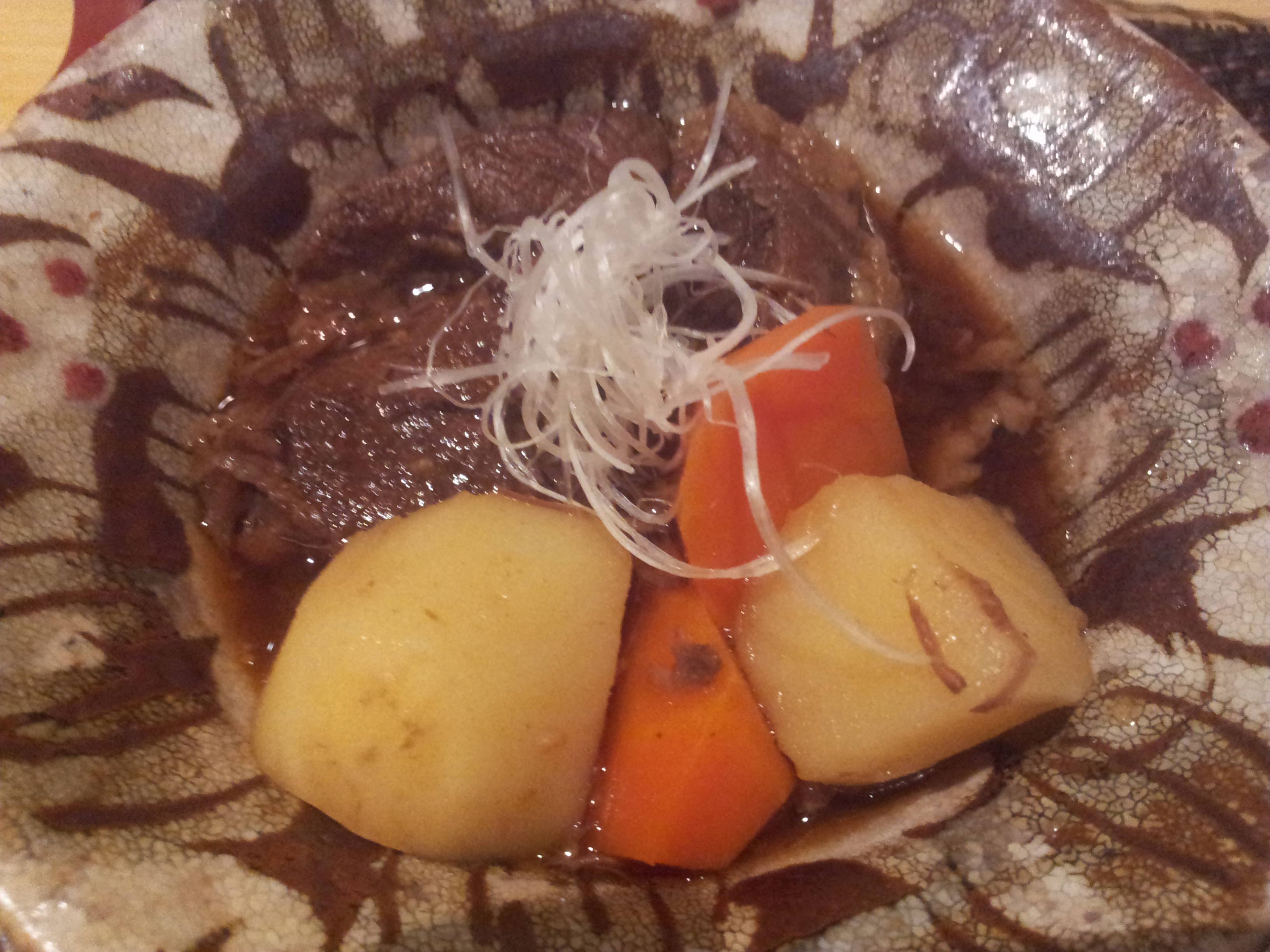
braised saga wagyu shank in miso
The yasai (野菜) furai (not a tempura batter) was a good complement to the braised beef.
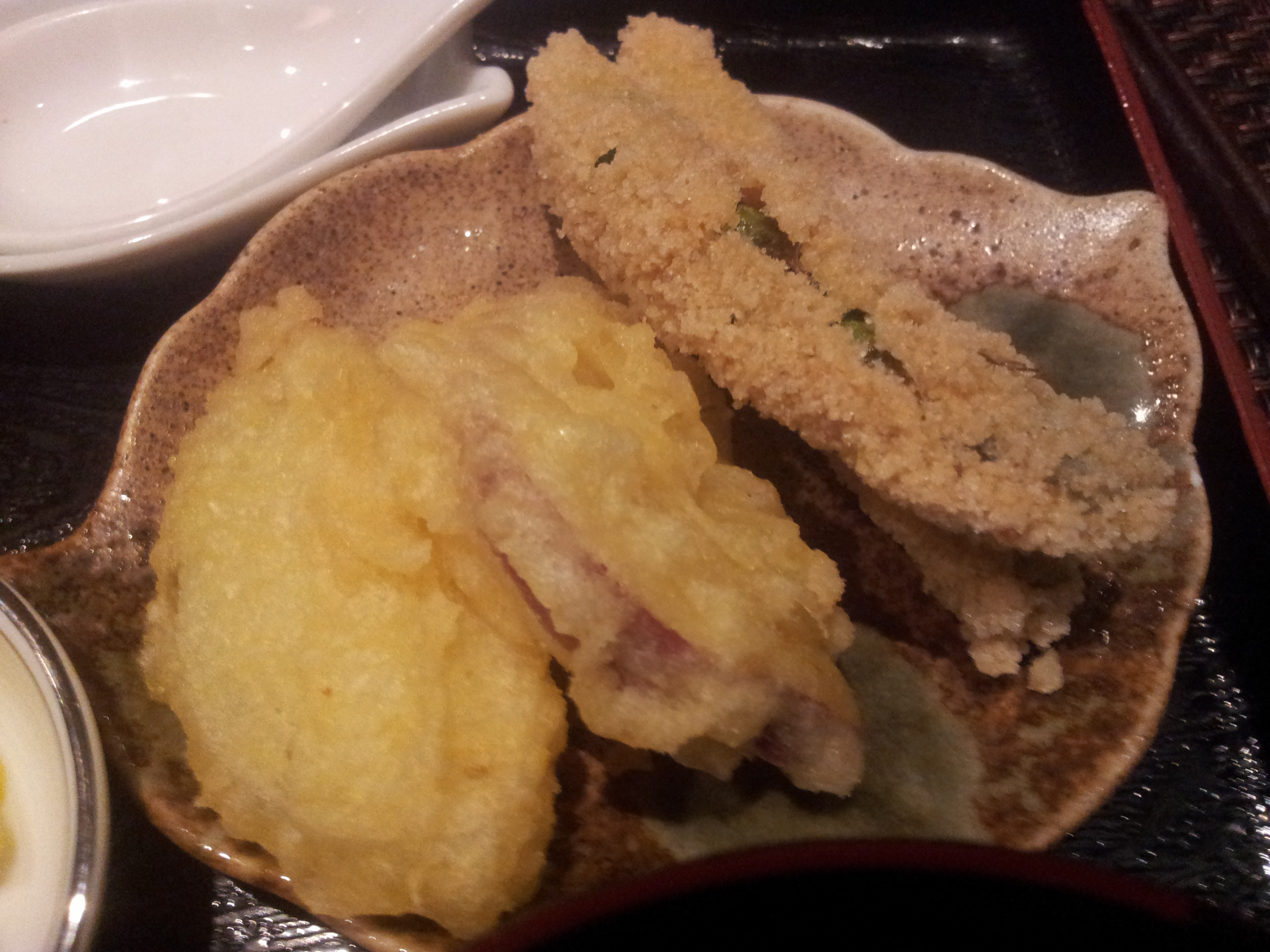
yasai furai
Well at S$35nett (S$30++ just for comparison though Kumo actually does not charge 10% service) for such a lunch, I guess there was little to complain about except for the parking costing S$10 at neighbouring Amara Hotel. 🙂
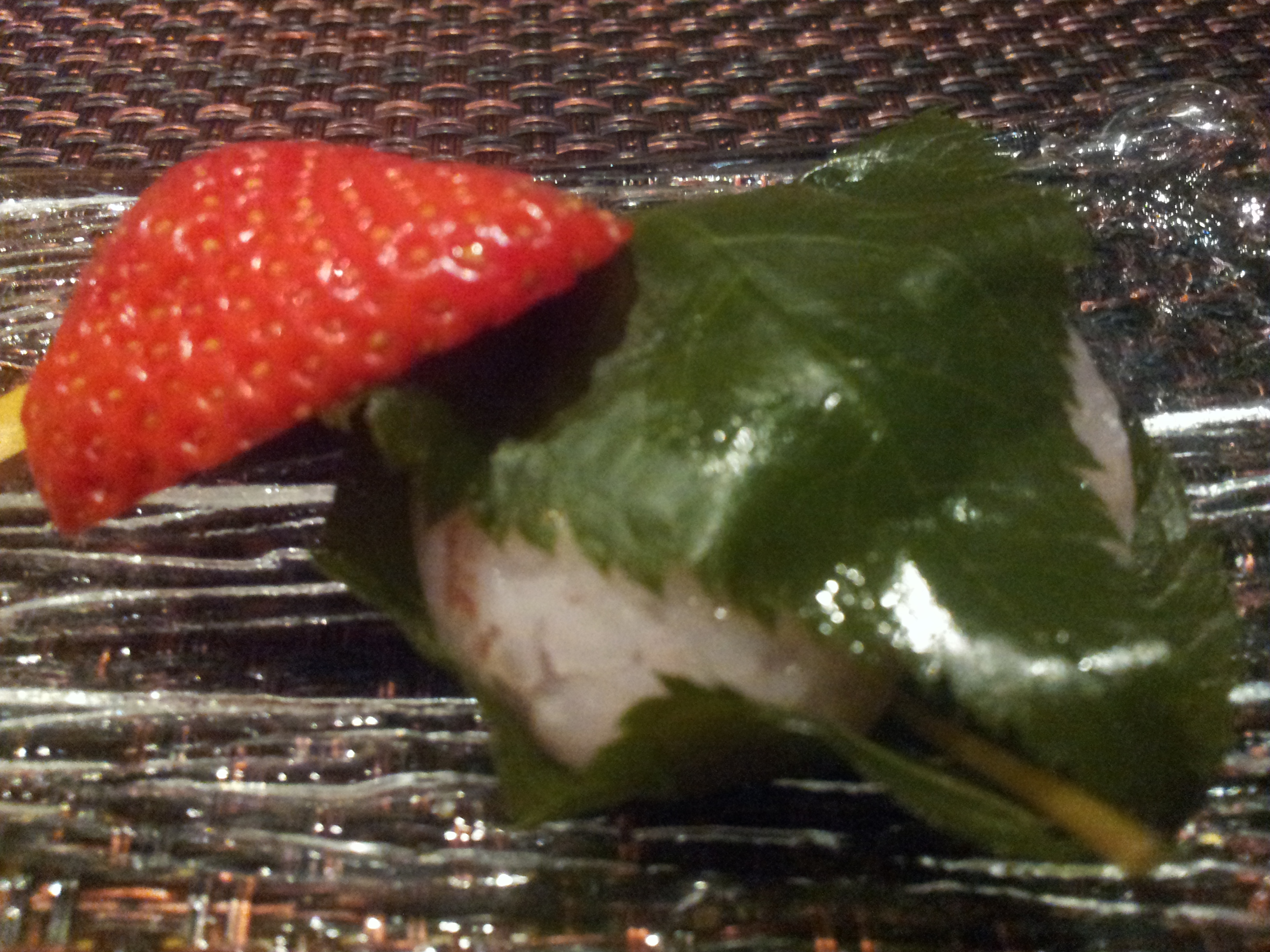
sakura mochi with Japanese strawberries
The dessert was a nice red bean mochi which I liked & 1/2 a strawberry.
Overall, it was a very pleasant meal and also nice way of keeping up with a friend.
c.h.e.f andy
Crabmeat Spaghetti in Pink Sauce (Creamy Tomatoes)
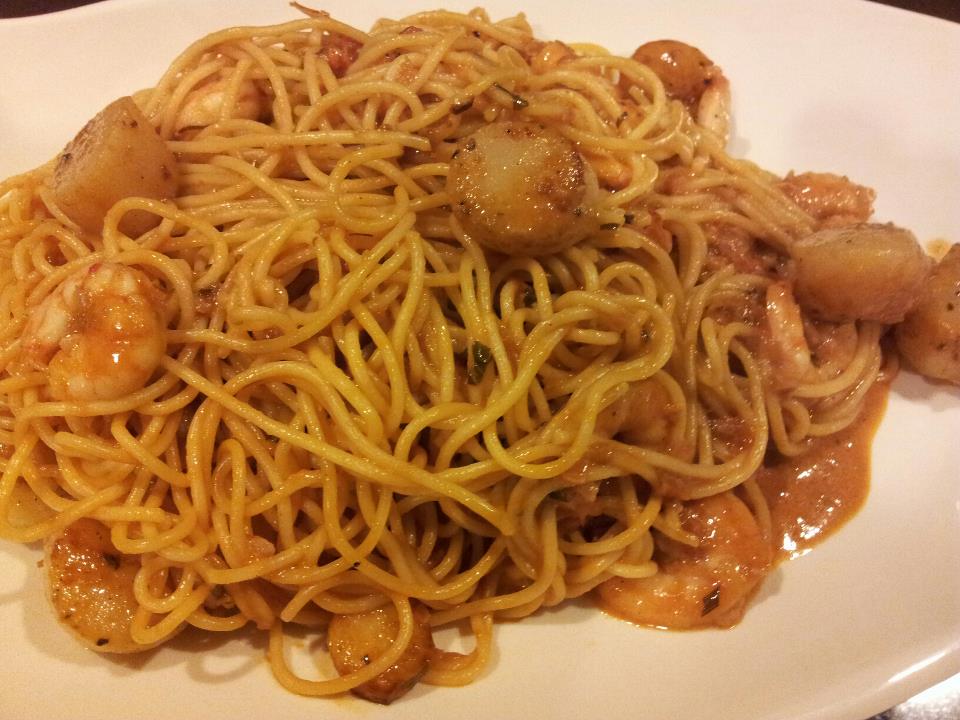
crabmeat spaghetti with prawns & scallops in pink sauce (creamy tomatoes)
N.B. = did an excellent crab linguine in pink sauce with medium prawns & pan-seared scallops using this recipe on 11.1.2014. 🙂
One of my favourite pasta is the crab meat linguine in pink sauce. Many moons ago, when Chef Valentino was still working (I guess he was a partner) in Cantina which was a short stone-throw from my place, we dined there a few times and also “da bao” (take-out) his crab meat linguine in pink sauce.
The good Chef left & set up his own Ristorante da Valentino at Jalan Binga and later shifted to the much larger premises it is currently located at Turf City. Some months back, a friend & his wife invited me for a lunch there, and I enjoyed immensely the burrata cheese and also relished my old-time favourite – but this time a squid-ink seafood linguine in pink sauce.
I thought I would give it a go myself, so I googled and assembled this recipe, tried it and was ok the first time, and I was able to repeat the dish w/o difficulty. The result is in the picture above, which I made for my friends at one of my homecooked dinners. It is nothing even close to what Valentino serves, but still it is a pretty nice pasta. 🙂
To make the sauce, I saute minced garlic and 1 small onion (diced) in olive oil on medium heat. I then add chopped basil (I have fresh basil from the garden), 1 can of diced tomatoes with sauce, sugar, dried oregano, sea salt & coarse black pepper, boil for about 5 minutes. I then turn off the fire and mix in the heavy cream & butter.
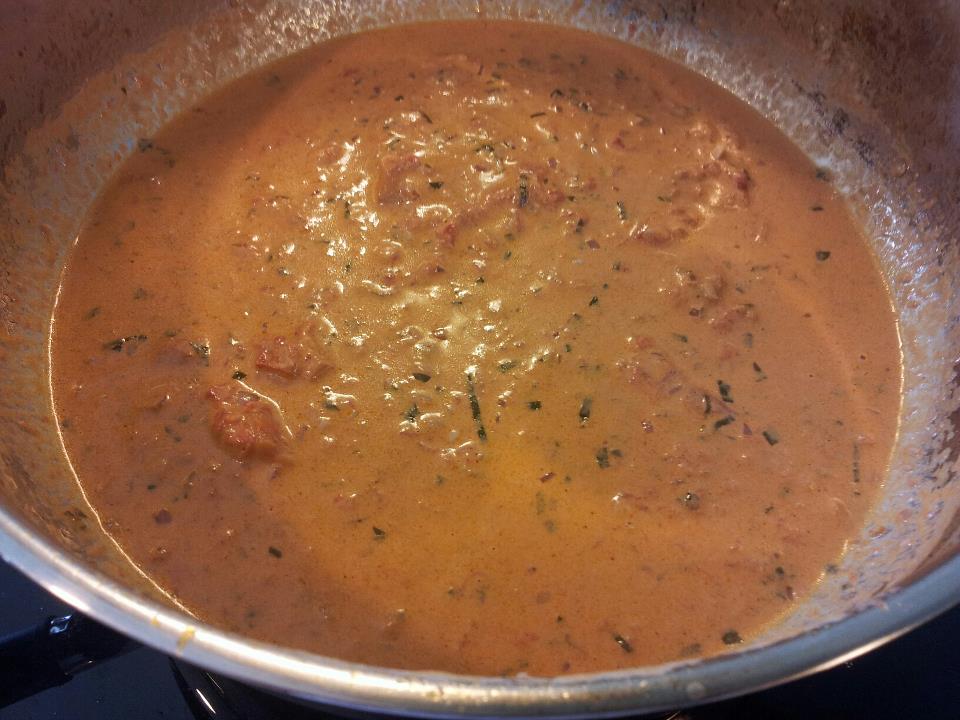
pink sauce (creamy tomatoes)
The spaghetti is cooked in the usual way following the timing instructions. For the scallops (optional), I pan sear them first (see recipe); and likewise for the prawns I stir-fry them in olive oil first to almost cooked. All these can be set aside first and toss together when ready to serve the dish. I heat up the pink sauce, add the prawns & drained crabmeat, cook for few minutes, then turn off the fire, add the spaghetti & toss, and then add the seared scallop, and serve.
c.h.e.f andy
Ingredients:
- 250g crabmeat drained (I use frozen crab claws from NTUC Fairprice)
- 12 Hokkaido scallops (I use frozen scallops from Sheng Shiong)
- 15 pieces of medium prawns (shelled)
- 2 tbsp olive oil
- 1 clove minced garlic
- 1 small yellow onion diced
- 1 can diced tomatoes
- 1/2 cup chopped fresh basil
- 1 tsp sugar
- 1/4 tsp dried oregano
- 1/2 cup heavy cream
- 1 tablespoon butter
- sea salt & coarse black pepper to taste
Directions:
- Prepare the pink sauce – saute minced garlic and diced onion in olive oil on medium heat. add chopped fresh basil, 1 can of diced tomatoes with sauce, sugar, dried oregano, sea salt & coarse black pepper, boil for about 5 minutes. turn off the fire and mix in the heavy cream & butter.
- Prepare the scallops (optional) – see pan-seared scallop recipe.
- Cook the dish – stir-fry the prawns (shelled) in olive oil first to almost cooked. cook the spaghetti in the usual way following the timing instructions. heat up the pink sauce, add the prawns & drained crabmeat, cook for few minutes, then turn off the fire, add the spaghetti & toss, and then add the seared scallop, and serve.
Steamed Razor Clams with Garlic Oil

steamed razor clams with garlic oil – beautiful pic taken by Jeanette at 6.10.2012 homecooked dinner
See also Chef=cookhangouteatfun.
Steamed razor clams is a common dish served in many seafood restaurants. I had many times very good ones at Ah Yat Turf City and couple times at Long Beach Dempsey. These days, cooking methods & processes are quite precise and I seldom come across a live fish that is not steamed just right (in older times we get undercooked & overcooked fish). The same with razor clams.
No recipe is needed to cook this dish really. It is just a matter of getting the razor clams, cleaning them (which is a big hassle) and then steaming PLUS doing the lightly browned garlic oil to drench over them.
I get my IQF (Individual Quick Freeze) razor clams from Giant hypermarket & Shop n Save (these days you get IQF everything – mussels, scallops, fish fillets etc). Normal price is S$11.95 for one 500g packet containing 8 to 11 large razor clams. Sometimes I get them during sales and it can be S$8.95, so just about $1 per clam. At the restaurants, you get live ones & will on average pay S$8++ (about $9.40) per clam.
Cleaning as I said is a hassle. I use kitchen scissors to cut away the blackish sag of innards & clean each clam thoroughly in slow running water (there will be a lot of soil & you will feel like you are eating sand if you don’t clean them). For the garlic oil, I just fry minced garlic on low heat with oil to brown them & then set aside the lightly browned garlic with oil in a bowl.
To steam the clams, you can use the usual steamer for about 6 minutes (just make sure you are able to remove the plate holding the clams out of the steamer when it is very hot). I find it easier to just poach the clams (w/o the shell) with the garlic oil & add 1 tablespoon light soy sauce in a covered saucepan for a few (about 4) minutes. Then I remove the steamed clams, place each on an individual cleaned 1/2 shell on a serving dish, and then spoon the garlic oil over the clams.
The result is the beautiful dish above. I would say it is 95% as good as the restaurants that do them well, and better than those that can’t do them properly.
c.h.e.f andy
Ingredients:
- 1x500g packet IQF (Instant Quick Freeze) razor clams – OR if you can get fresh ones that are not too costly
- 3 tbsp minced garlic
- 5 tbsp oil
- 1 tbsp light soy sauce
Directions:
- Prepare the clams – defrost, cut/remove from shell, cut away the blackish sags of innards & clean thoroughly, airdry in fridge. clean enough 1/2 shells to place the clams on.
- Cook the clams – lightly brown the minced garlic so you have the garlic oil ready in a large saucepan. add the clams & drizzle 1 tablespoon light soy sauce over it. Turn the fire to high to heat up & then quick lower to medium & cover for 4 minutes until the clams turned a white opaque colour (as in above picture). Turn off the fire, remove the clams & place each on cleaned individual 1/2shells on a large serving dish. spoon the garlic oil over each clam & serve.
Great Family Lunch @ Imperial Treasure Teochew Restaurant Ngee Ann City on 17Mar2013
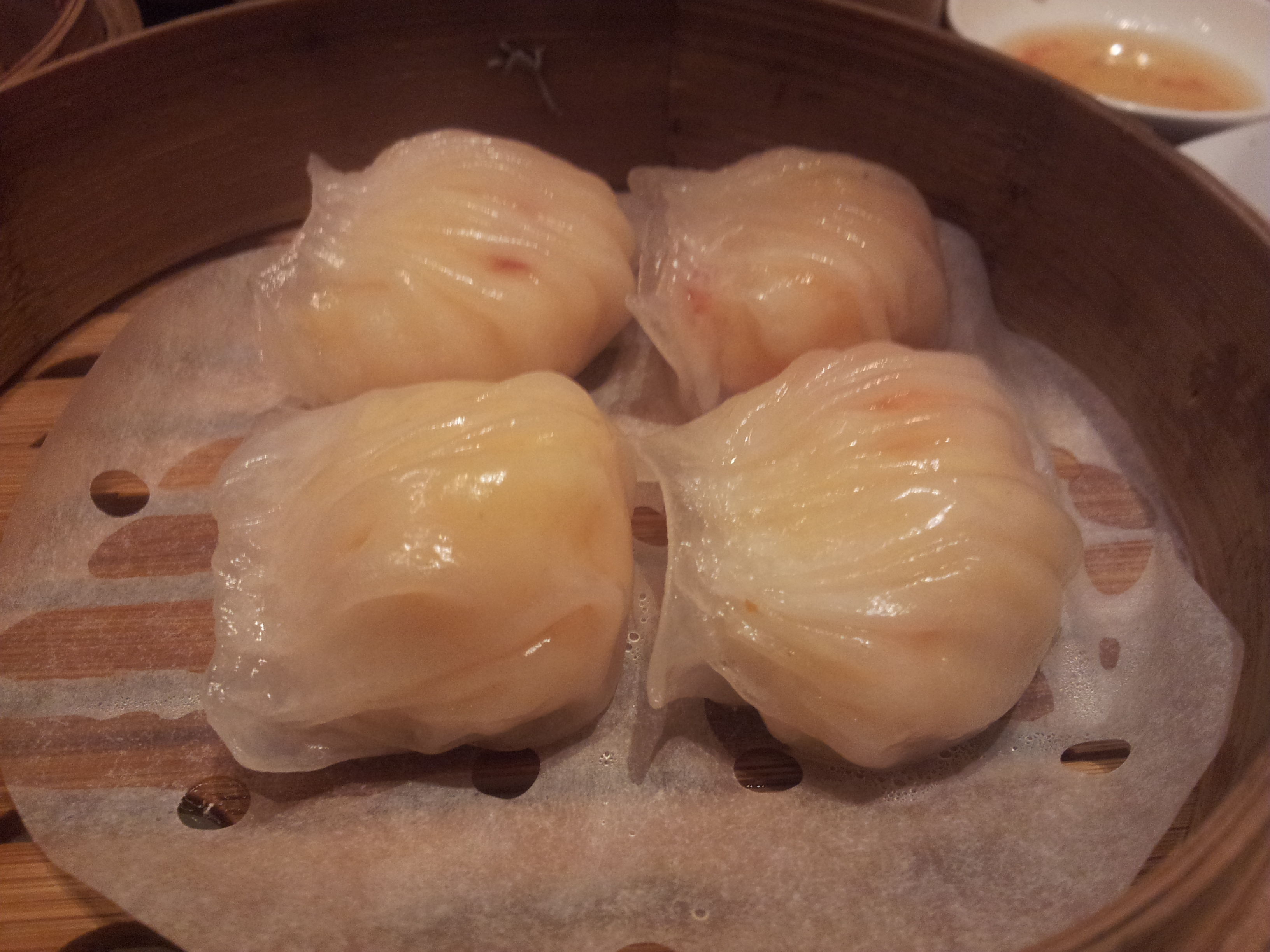
har gau (蝦饺)
See also my review on imperial treasure teochew on 1.9.2013. 🙂
had a really nice family dimsum lunch today @ Imperial Treasure Teochew Restaurant at Ngee Ann City today.
They are really packed. We managed to book 11.30am and supposed to clear out before 12.30pm. The food came really fast, and though we did not feel rushed at all still we did not have any problem leaving before 12.30pm after a very satisfying lunch indeed. 🙂
We ordered Su Min’s favourite har gau & fun cheung with prawns (or har cheung), pork neck char siew, braised duck, steam pork ribs, a teochew dumpling, and 2 deepfried dumplings. The entire lunch came to $79 for 4pax – a really great lunch, good food, good friendly if speedy service, and very enjoyable meal. 🙂
The har gau was very good, skin not soft or soggy, prawns fresh & firm. The steamed pork ribs were very tasty & have good pieces of meat, not too fatty.
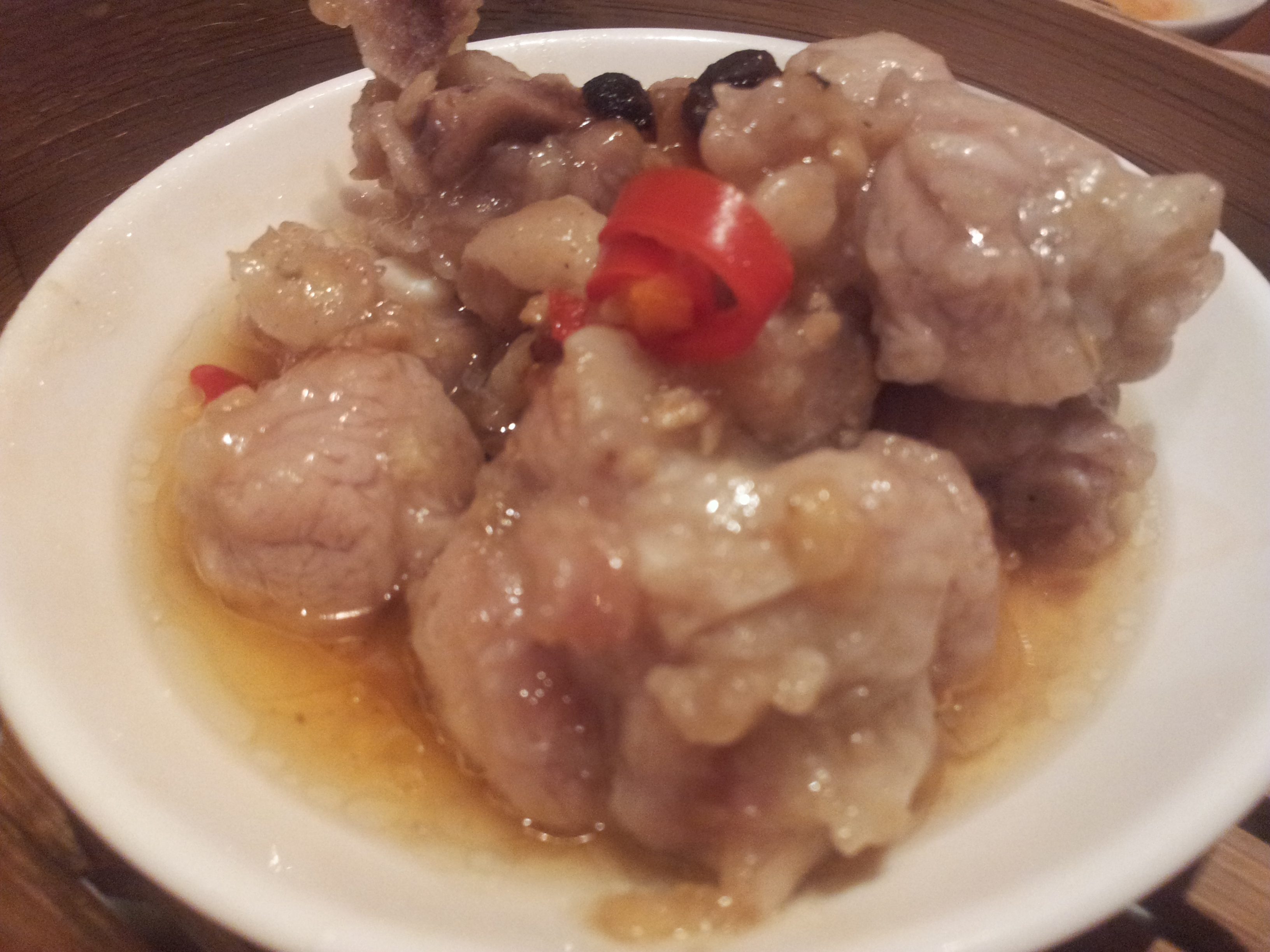
steamed pork ribs
The har cheung was one of the better ones, though still could not compare with the very good smooth ones we had in Hong Kong.
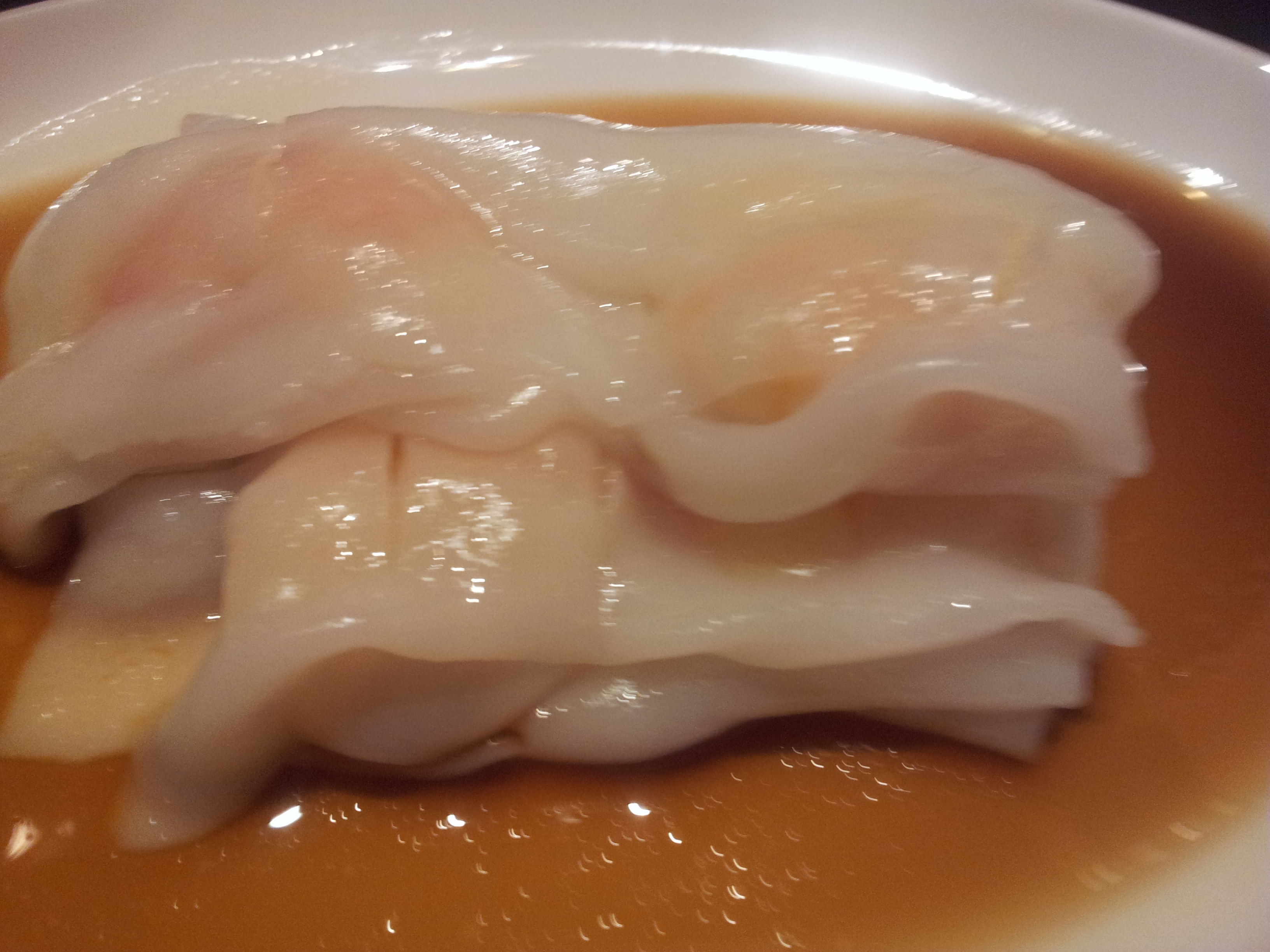
har cheung (虾肠粉)
The hum sio gok was also very good, fillings were tasty & the dough nice & little sticky too (as it should be).
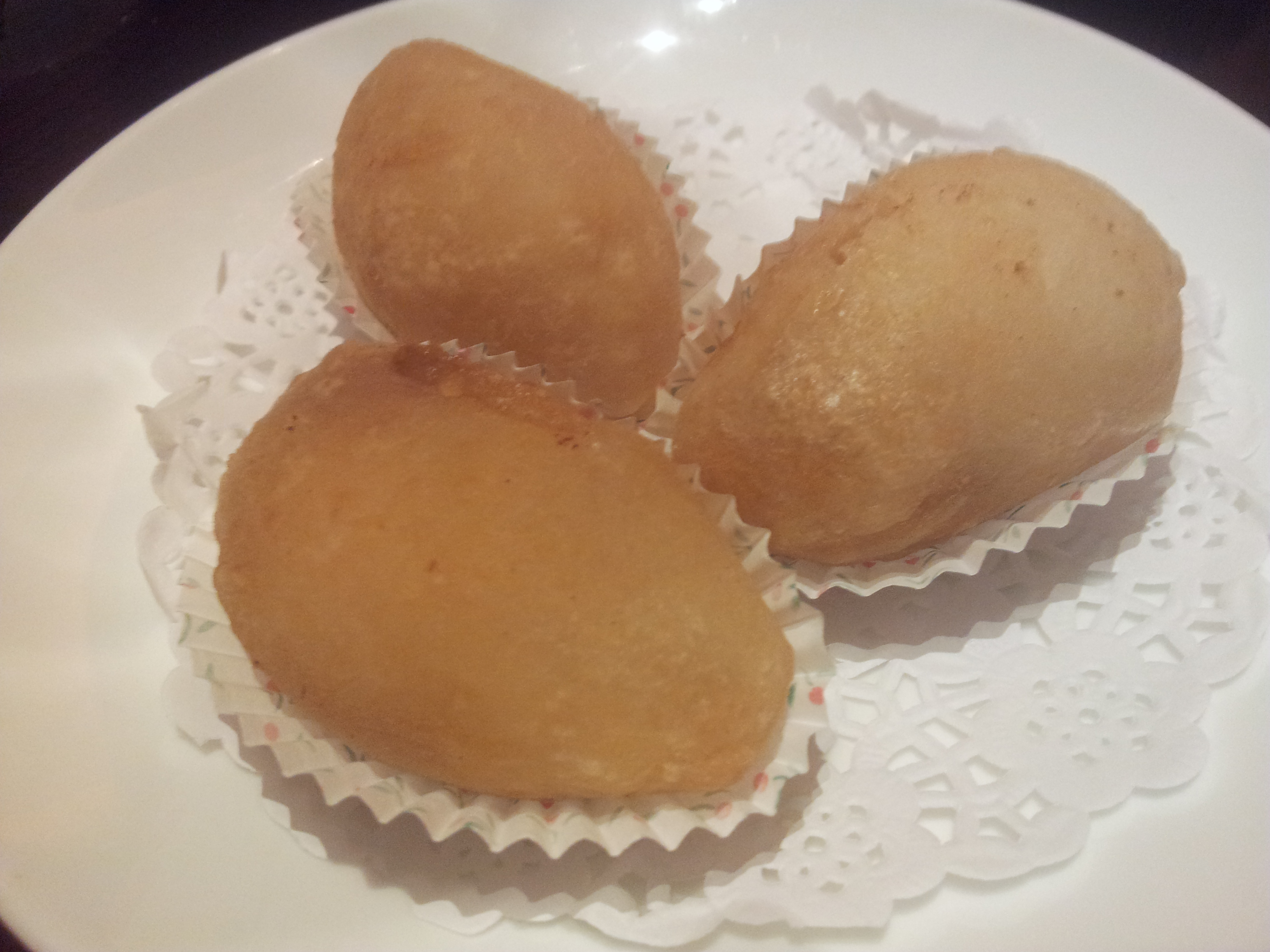
hum sio gok (咸水饺)
And the teochew dumplings were actually better than I expected. I had some not so great ones previously.
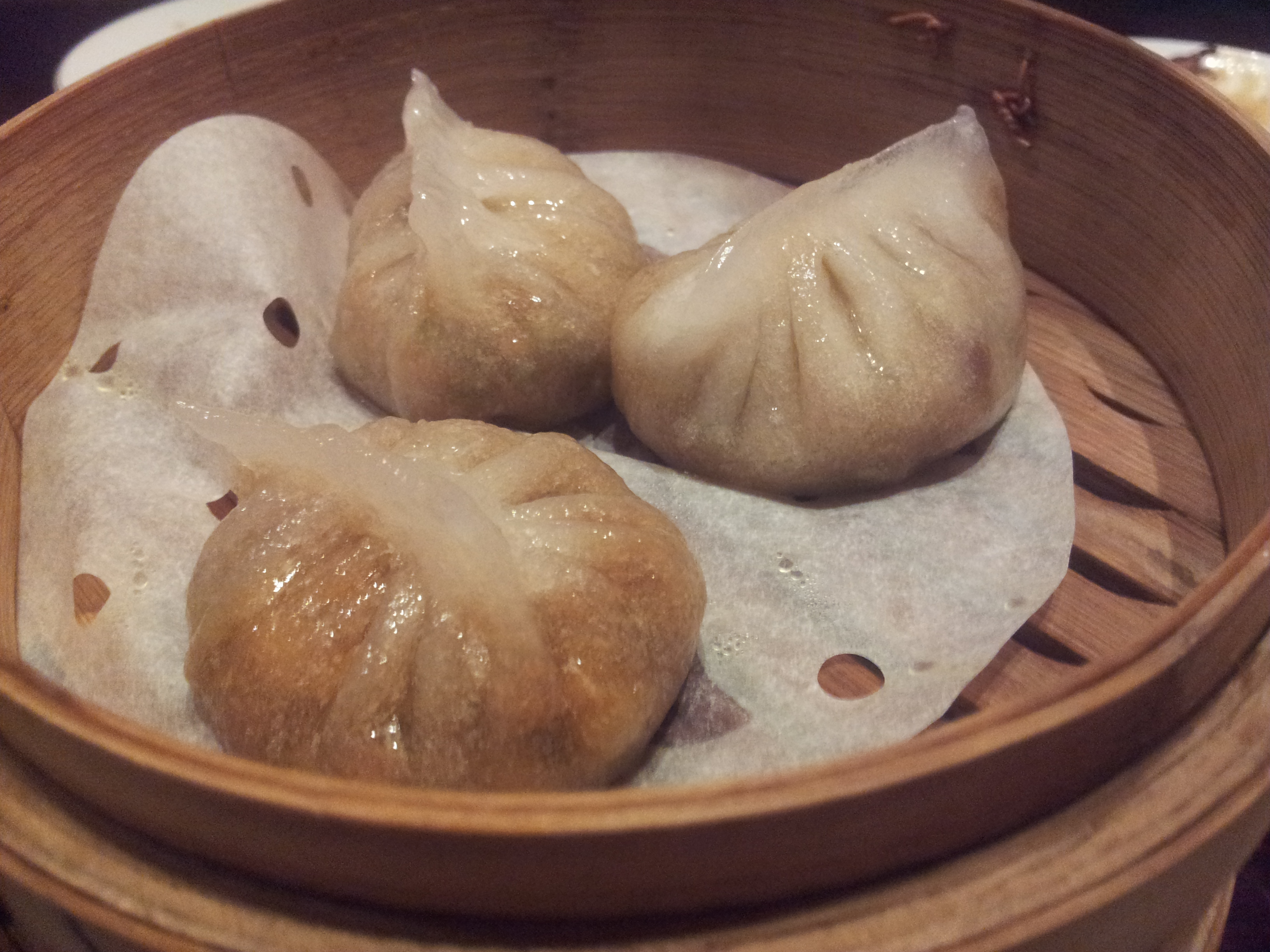
teochew dumplings (潮州粉果)
The pork neck char siu was slightly sweet but overall very good, portion was small but it was only S$8. I have tried cooking this before & I know pork neck is really the best part for char siu, much better than the loin or belly. 🙂
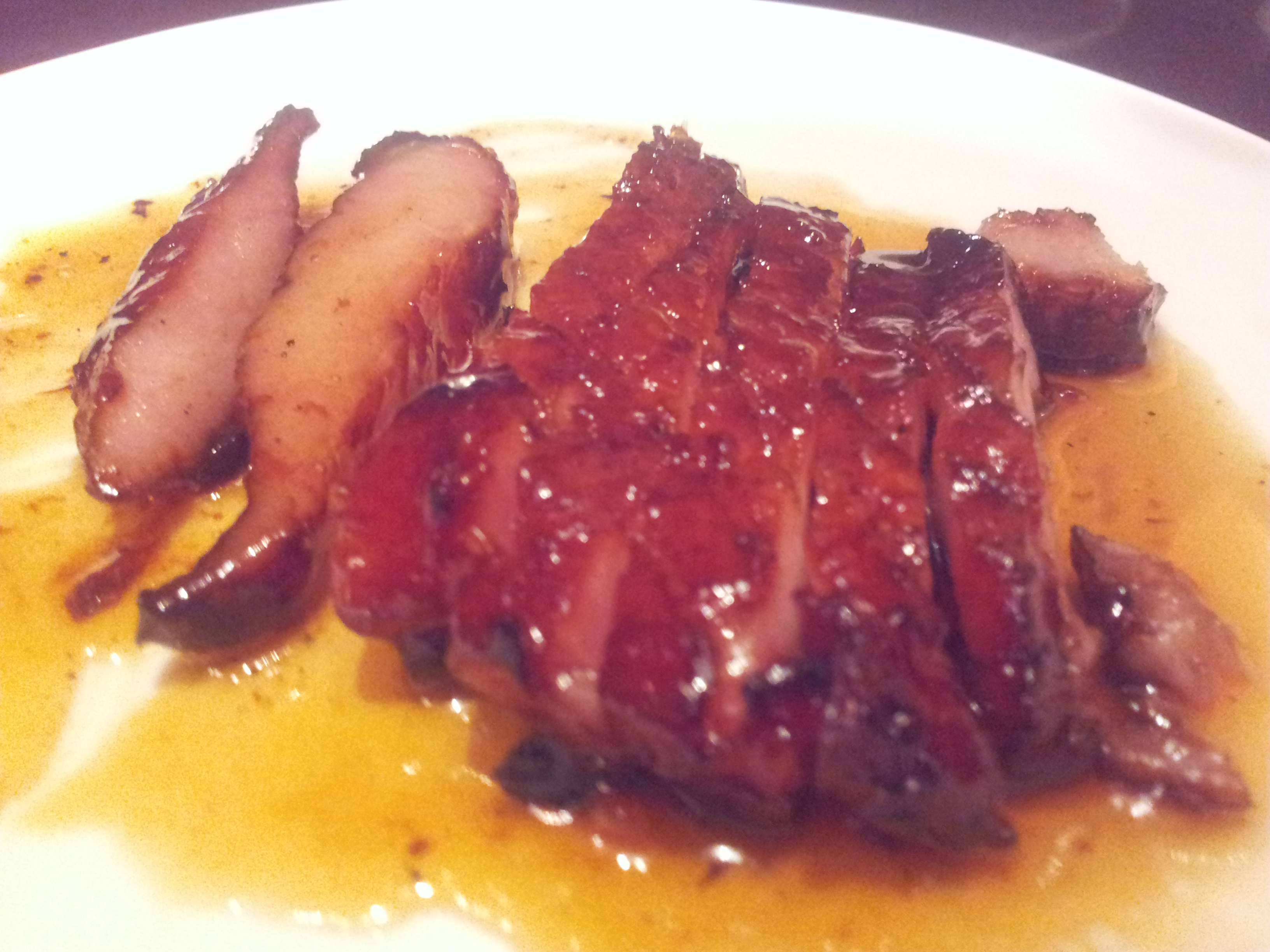
pork neck char siu (炭燒猪项肉) – S$8
I could not remember the name of this crispy dumpling, it was something I used to like much before but did not take often lately. It was still good.
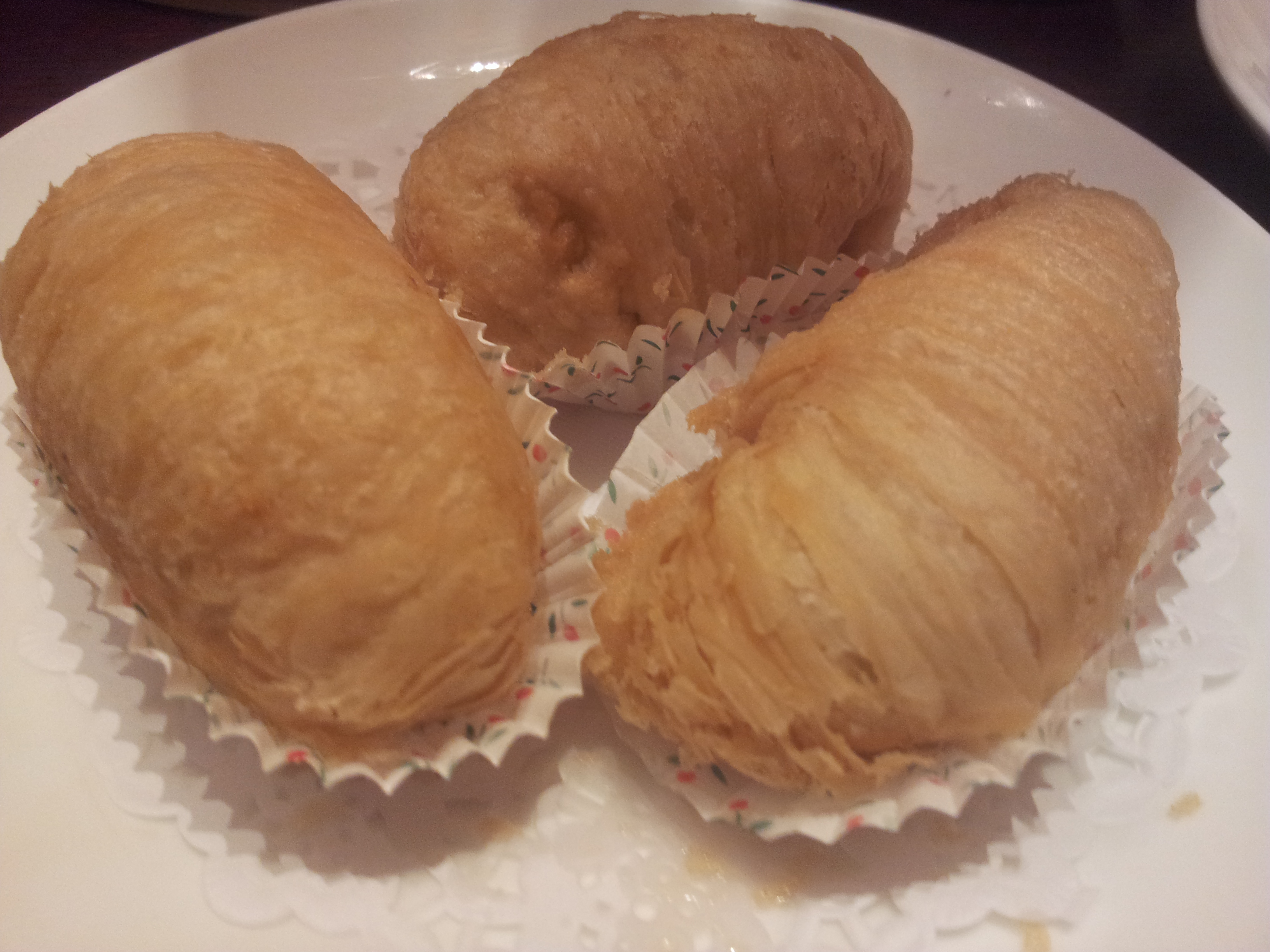
crispy dumplings
The braised duck here & in Crystal Jade were always good. The portion (partially eaten already in the poorly focused photo below) was good for the price – just S$14.
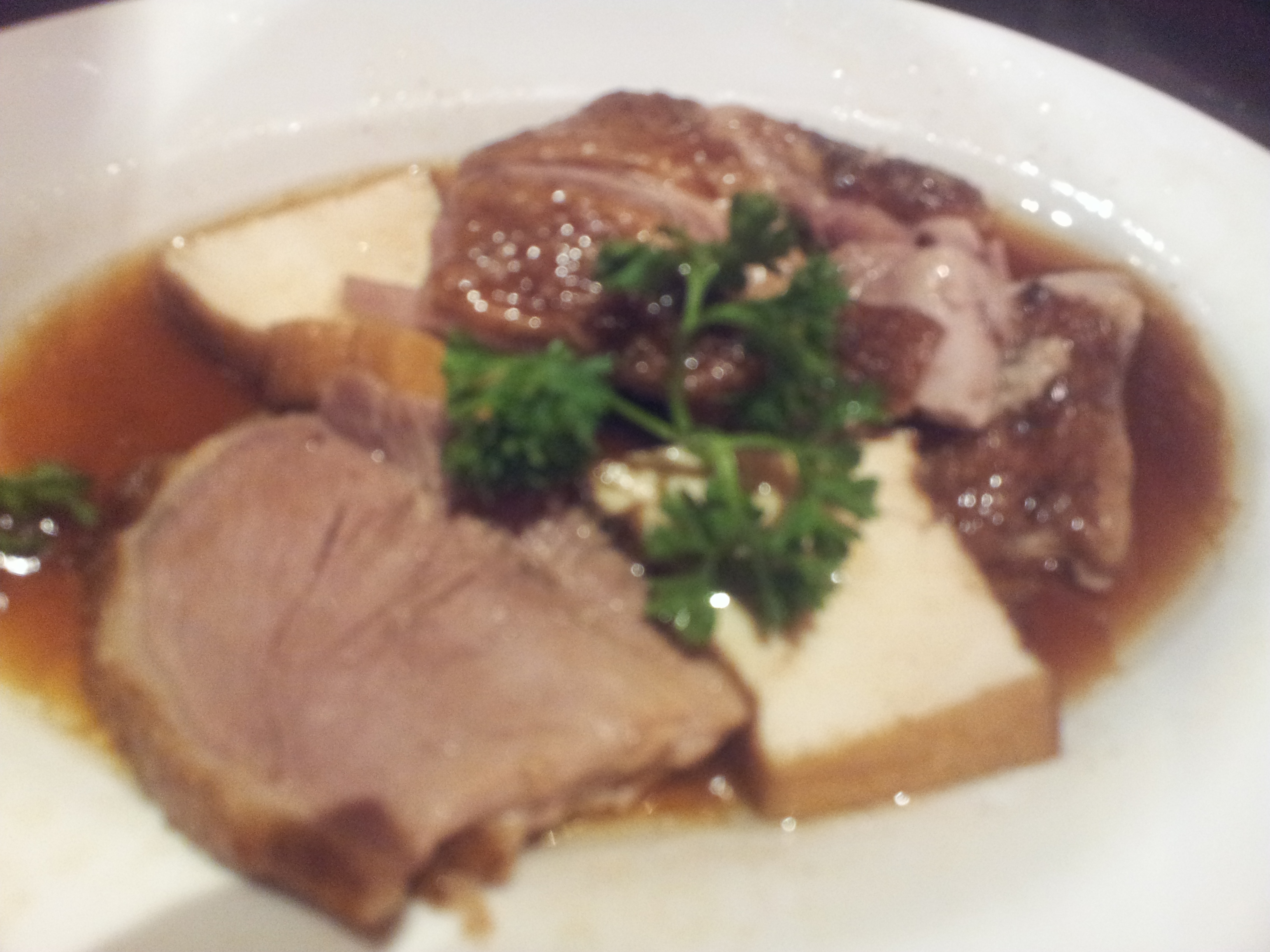
teochew braised duck – S$14
We ended with the salted egg buns which we all liked. This was very good here. The salted egg taste was strong but not overpowering & it was not too sweet. One of the best I had – I liked this a lot.
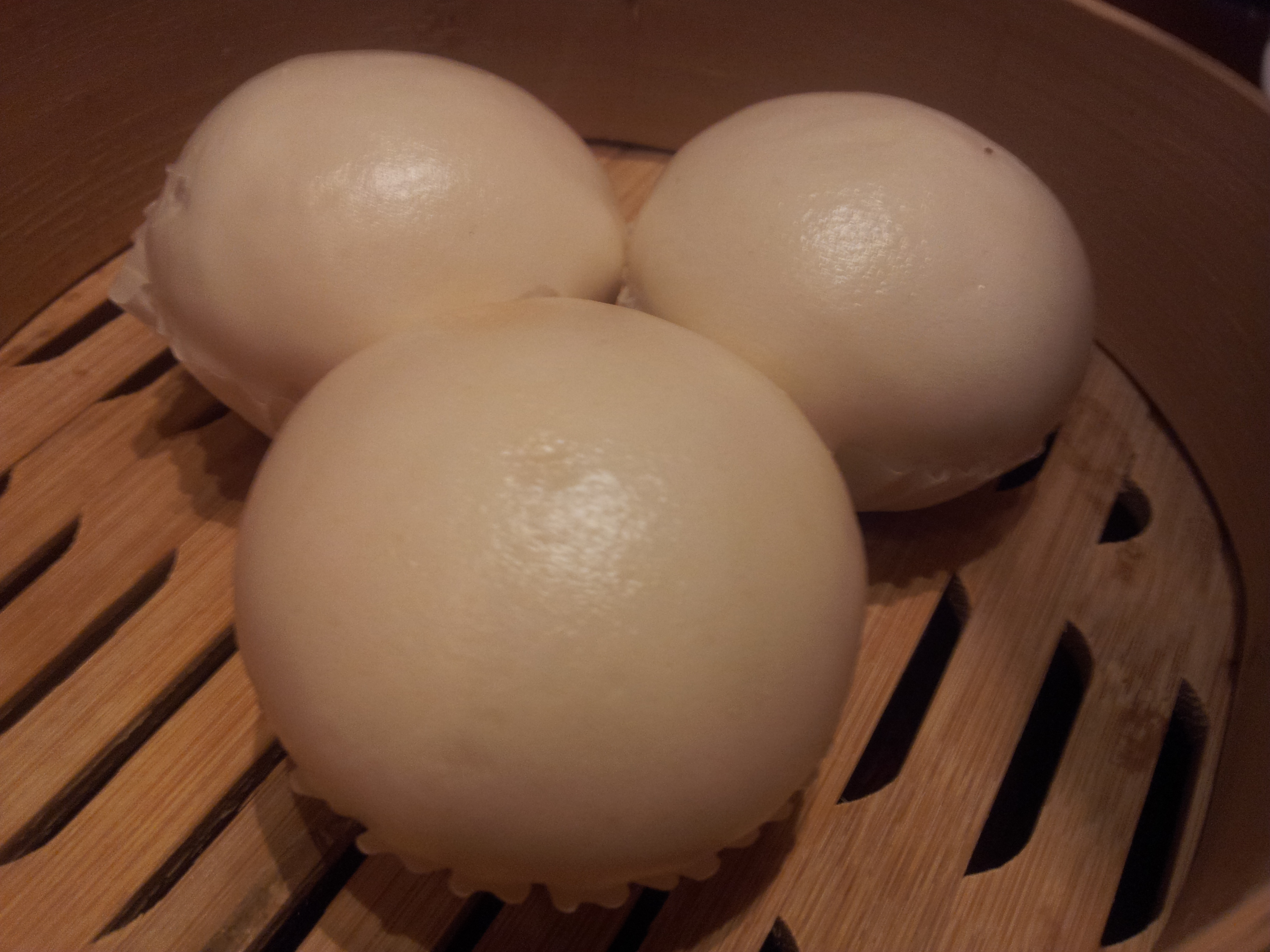
salted egg buns (咸蛋流沙包)
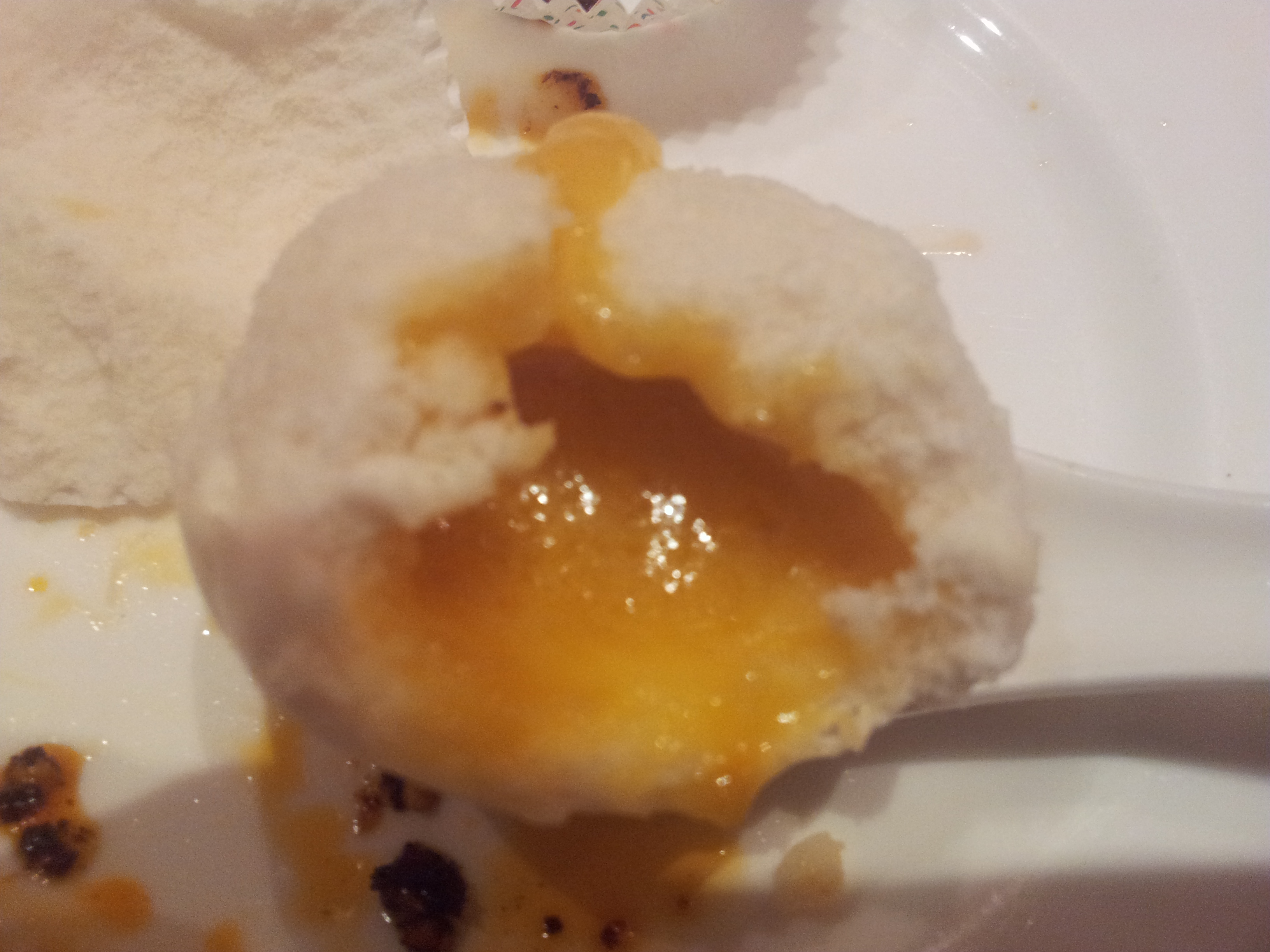
salted egg buns (咸蛋流沙包)
I think Crystal Jade & Imperial Treasure have really improve Singapore’s dimsum & restaurant food quality at affordable price over the last 10 years, and now we have really good eats at prices that do not burn a hole in the pocket. 🙂
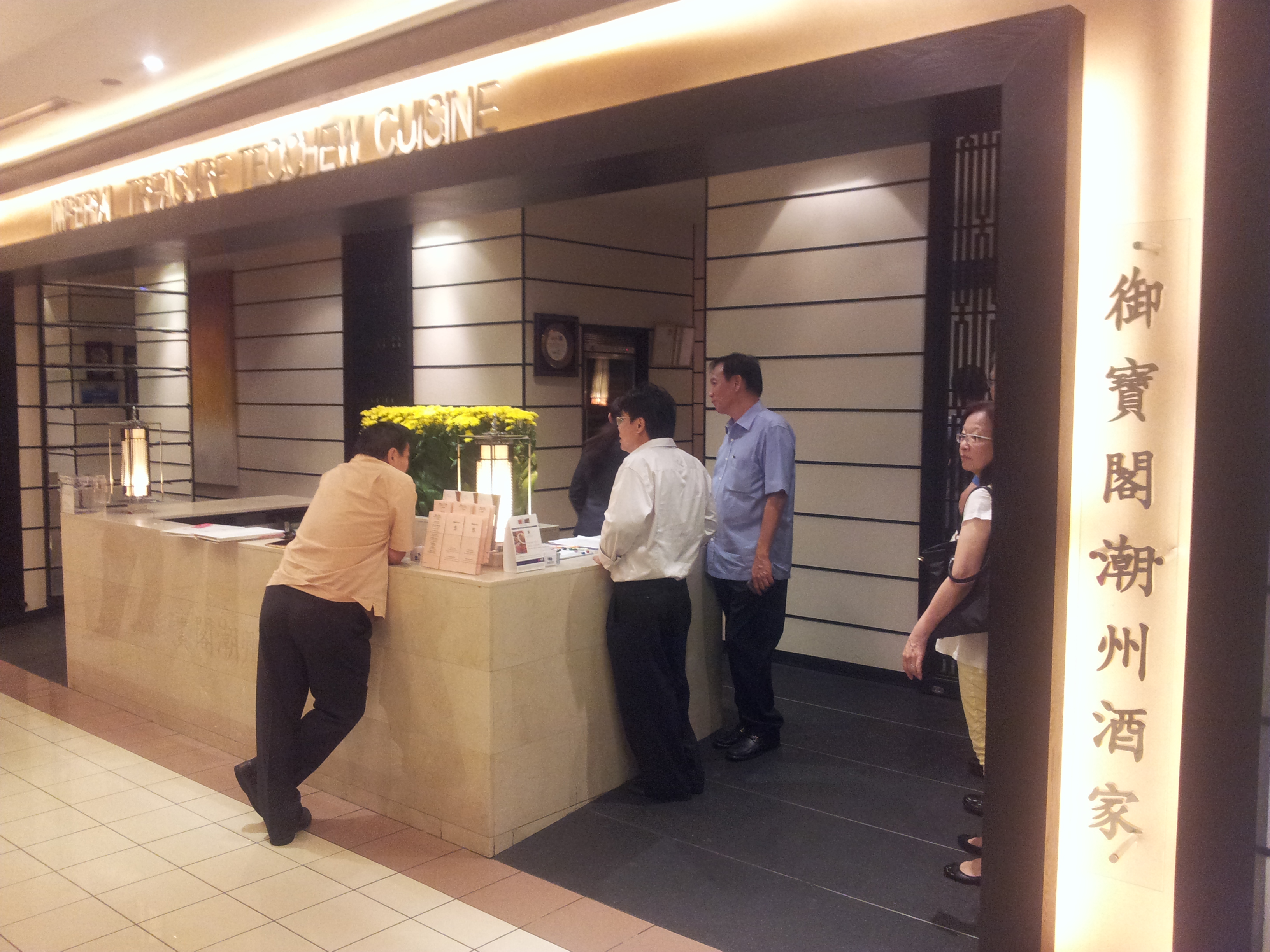
Imperial Treasure Teochew Restaurant @ Ngee Ann City
c.h.e.f andy
Oven Slow-roast Pork Belly
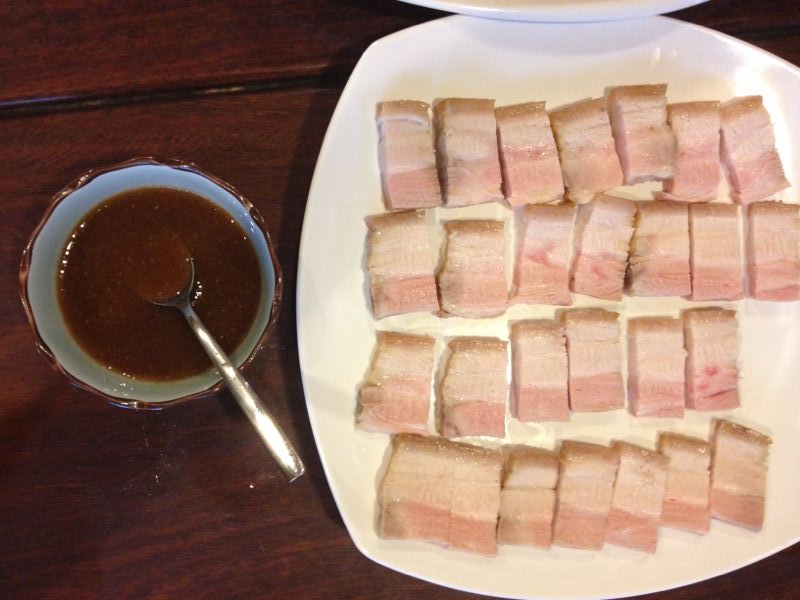
oven slow-roast pork belly
I have NOT been too successful when it comes to cooking belly pork. First, it is really not so healthy to be eating belly pork often & my family members are not really crazy over it. The more successful pork belly dish I have made is kakuni – Japanese slow-braised pork belly.
Anyhow I wanted a wider selection of dishes for my homecooked makan (meal) gatherings, so I still somewhat doggedly try out different cooking methods for pork belly. I find GR (Gordon Ramsay)’s crackling skin pressed pork belly too difficult to make, so I try out various slow-roast to get a dish that is good enough for my purpose.
The best version I have created is in the top picture. I did that when my youngest 19-year old daughter invited 14 friends to the house for lunch on the 3rd day of the recent Chinese New Year, 2013.
I use a square-cut block of belly pork, place it in boiling water for like 10seconds, then place it in cold water, wipe it clean & dry with kitchen towel or airdry in fridge. I then rub the belly pork with white sugar (but not the skin), place it in a baking dish skin-side up, drizzle Chinese old shaoxing wine (陈年绍兴酒) & then olive oil over it. I cover the baking dish with aluminium foil & place it in a preheated 175degC oven for 1/2 hr. I remove the dish from the oven, turn over the belly pork so it is skin-side down & drizzle 1 tablespoon light soy sauce, & letting the oven cool. I then preset the oven to 90degC on the low heat function and leave it for 3/4hr, turnover once again for another 3/4hr. So the total time is 2hrs.
The end result is the picture above, though the belly pork is looking pretty with a nice pink, it is fully cooked. That is my best production with this method so far.
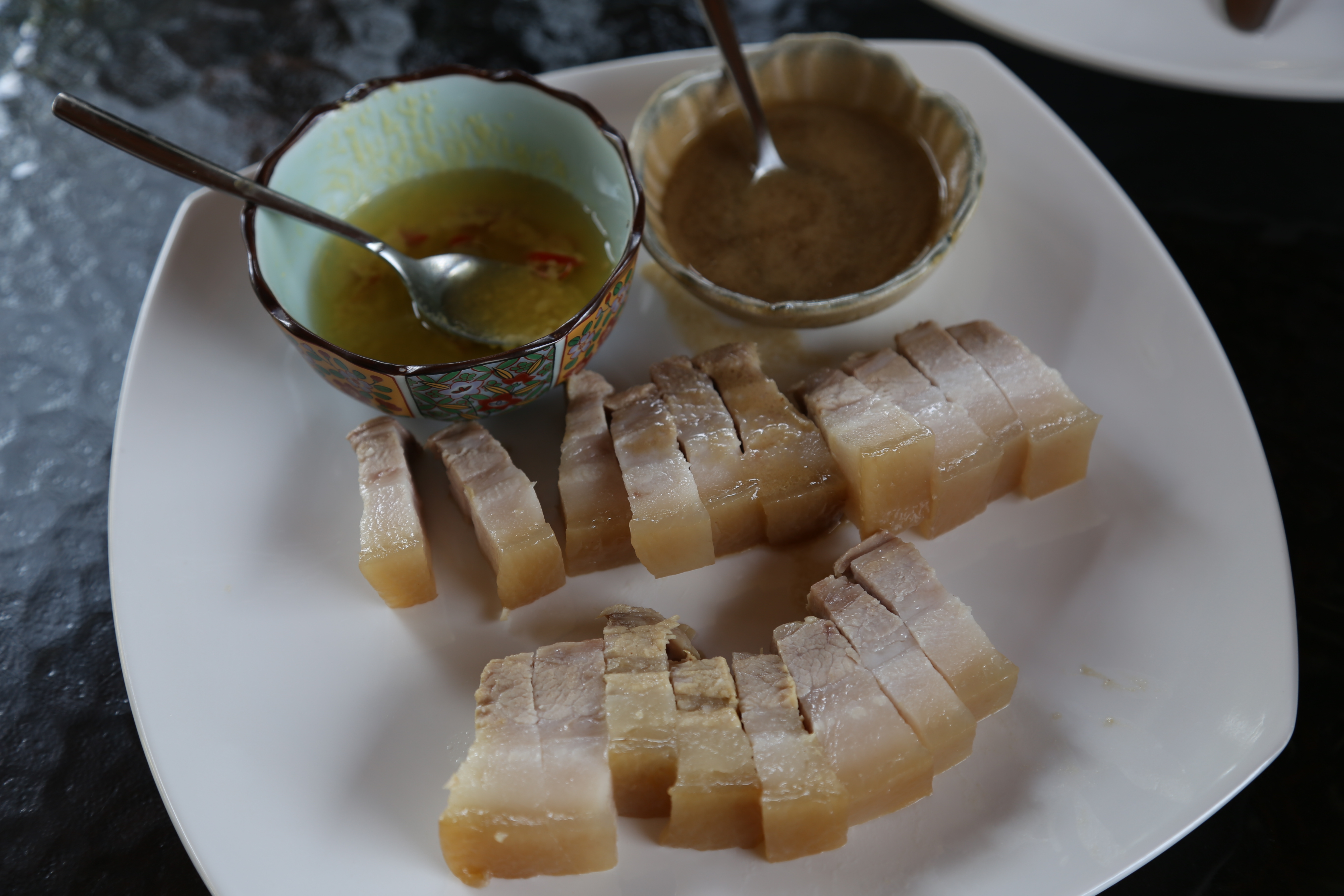
oven slow-roast pork belly
I tried it again for my recent gathering of friends, with a slight variation. Instead of the low heat function, I use the normal function still set to 90degC. The result is the one below. The texture of the fat & meat is still as good & soft, the skin is just very little bit tougher. One addition I made is the Spanish spicy mustard sauce. This is a really nice concoction & together with the original sauce from the belly pork (after passing through a sieve) made 2 very nice dipping sauce for the belly pork. 🙂
c.h.e.f andy
Ingredients:
- 1 block square cut belly pork (about 350g)
- 2 tbsp sugar
- 1 tbsp Chinese old shaoxing wine (陈年绍兴酒)
- 1 tbsp olive oil
- 1 tbsp light soy sauce
For spicy Spanish mustard sauce:
- 1 tsp dijon mustard
- 1 tsp red wine vinegar
- 1 cut chilli padi
- 2 tsp olive oil
Directions:
- Prepare the belly pork – place it in boiling water for like 10seconds, then place it in cold water, wipe it clean & dry with kitchen towel or airdry in fridge. rub the belly pork with white sugar (but not the skin), place it in a baking dish skin-side up, drizzle Chinese old shaoxing wine (陈年绍兴酒) & then olive oil over it.
- Cook the belly pork – cover the baking dish with aluminium foil & place it in a preheated 175degC oven for 1/2 hr. remove the dish from the oven, turn over the belly pork so it is skin-side down & drizzle 1 tablespoon light soy sauce, & letting the oven cool. preset the oven to 90degC on the low heat function and leave it for 3/4hr, turnover once again for another 3/4hr. total time is 2hrs. remove from oven, rest & serve.
- Make spicy Spanish mustard sauce – put a teaspoon of dijon mustard in a small bowl, add 1 cut chilli padi, 1 teaspoon red wine vinegar, and 2 teaspoon olive oil. mix well.
Oven Roast Chicken
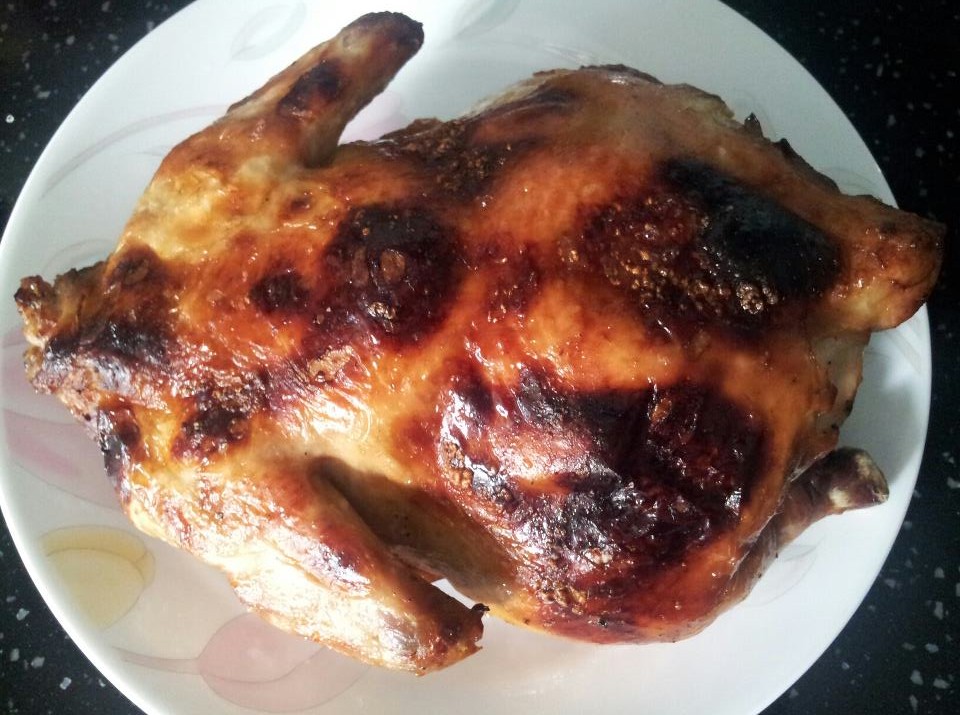
oven roast chicken
Before I discovered the brining technique (& now use often) for pan-roasted brined chicken breast, I was doing a rather good oven roast chicken. 🙂
It is really easy to do & require very little preparation effort.
First, I cut away the head & feet, wash clean thoroughly & fold in the wings. I usually leave the chicken on a rack to airdry in the fridge but you can dry it with kitchen towels.
Then I prepare a rub comprising seasalt, coarse black pepper and a dry herb mix (rosemary, basil, parsley flake etc). Of course you can use fresh herbs if you have them. Next I rub all over the chicken & the inside cavity. I then lift the skin (carefully w/o tearing) & rub below the skin. I also inserted peeled garlic cloves under the skin. You can skip this if you like a nice skin as the garlic will made dark patches on the skin after roast as in above picture. Finally I rub oyster sauce on the chicken & then drizzle/rub olive oil over the skin (olive oil helps the skin not to get burnt). 🙂
I place the chicken breast-side up on a aluminium foil-lined baking tray in a preheated 175degC oven using the grill function for 25minustes. I then turn over the chicken and grill for another 20minutes.
I have been able to consistently reproduce very moist, tender & sweet roast chicken. 🙂
c.h.e.f andy
Ingredients:
- 1.1kg chicken from Giant hypermarket (if you sue a 1.4kg chicken or other size you will have to try out the ove timing or I guess use a meat thermometer which I have not yet learned to use!)
- 2 tbsp oyster sauce
- 1 tbsp olive oil
- 1 bulb of peeled garlic cloves
make a rub comprising:
- 1.5 tbsp seasalt
- 1 tbsp coarse black pepper
- 2 tsp rosemary flakes
- 2 tsp basil flakes
- 2 tsp parsley flakes
Directions:
- Prepare the chicken – cut away the head & feet, wash clean thoroughly & fold in the wings. leave the chicken on a rack to airdry in the fridge (or you can dry it with kitchen towels). Apply the rub all over the chicken skin & inside. lift the skin (careful not to tear) and rub under the skin. Insert the peeled garlic cloves under the skin (or you can skip this if you don’t want to have dark patches on the skin).
- Cook the chicken – place the chicken breast-side up on a aluminium foil-lined baking tray in a preheated 175degC oven using the grill function for 25minustes. turn over the chicken and grill for another 20minutes. remove from oven & let the chicken rests, and then debone or carve & serve.
Beef Hotpot @ Budaoweng(不倒翁) at iSquare, Tsimshatsui Hong Kong on 9Mar2013
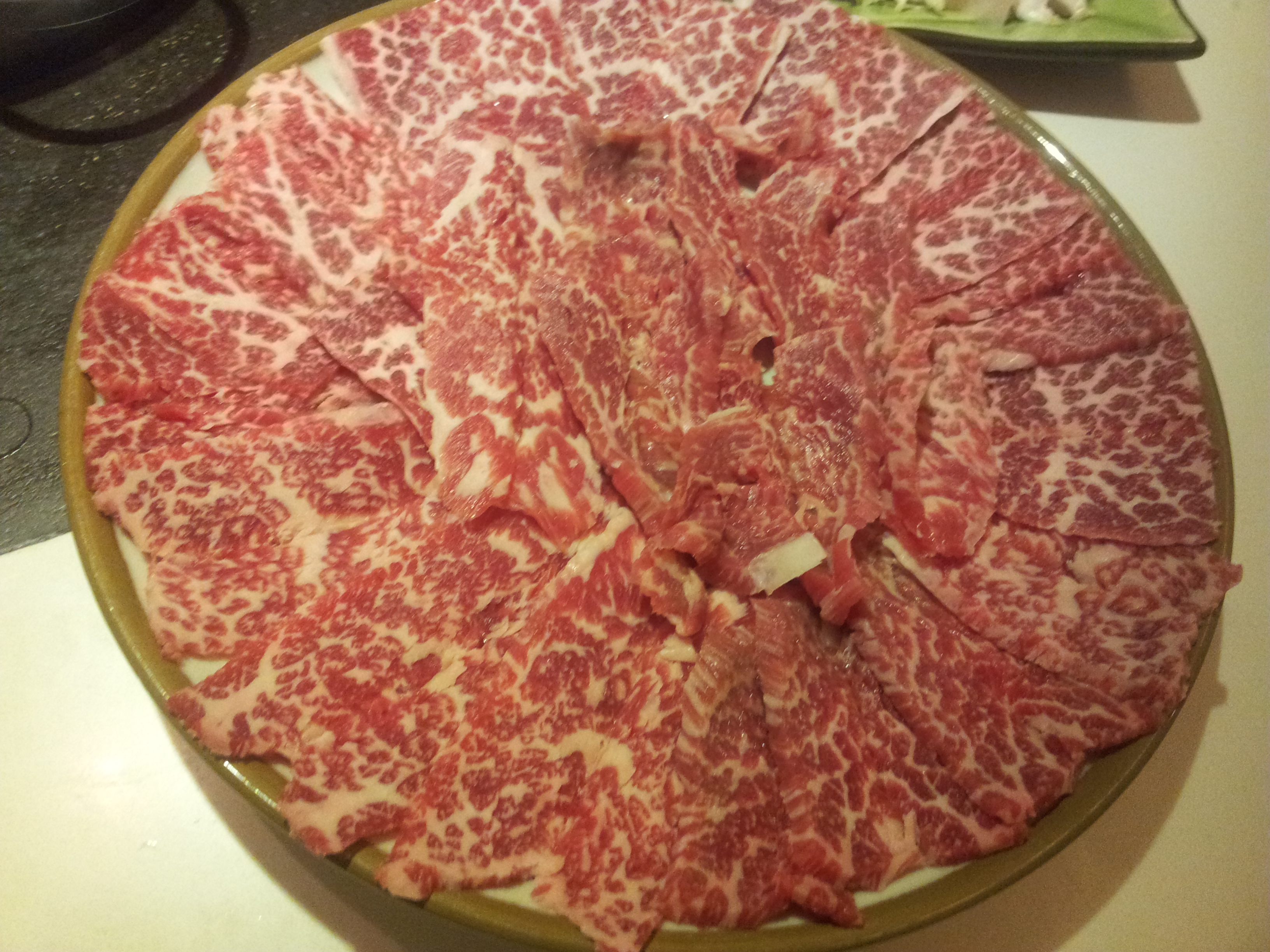
handcut US angus marbled beef (肥牛)
The beef hotpot at Budaoweng(不倒翁) is favourite with my wife Lisa (& with me too!). Everytime she is in Hong Kong. she will go for a late supper (宵夜-there is a 40% discount after 9.30pm during weekdays & after 9.45pm during weekends), sometimes twice during her stay. This time is no exception.
During our recent trip to Hong Kong, we arrived & checked-in to Marco Polo Prince Hotel about 8.15pm, so timing was quite perfect. 不倒翁 was just a short walk to iSquare and there was no need to pre-book. We did this again on the evening of 11.3.2013, before flying back Singapore the next day.
We ordered the usual large portion of specially selected handcut US angus marbled beef (特选手切肥牛)- HK$168 after 40% discount. You can see the marbling, and this is really flavourful & tender, melting in the mouth. I thoroughly enjoyed this even though we ate exactly the same thing the second visit. Both times we were greedy and ordered another small portion of beef – HK$138 after 40% discount. Our daughter Su Lin was with us, so there were 3 of us. I could just eat the beef & vegetables and nothing else.

very nice prawn dumplings, each with 3 very fresh big prawns
We also ordered a plate of prawn dumplings – 8 for HK$58. You could also order a 1/2plate – 4 dumplings for HK$30. This was really good too. Each dumpling had 3 very fresh large prawns, the skin was smooth, and it’s super tasty.
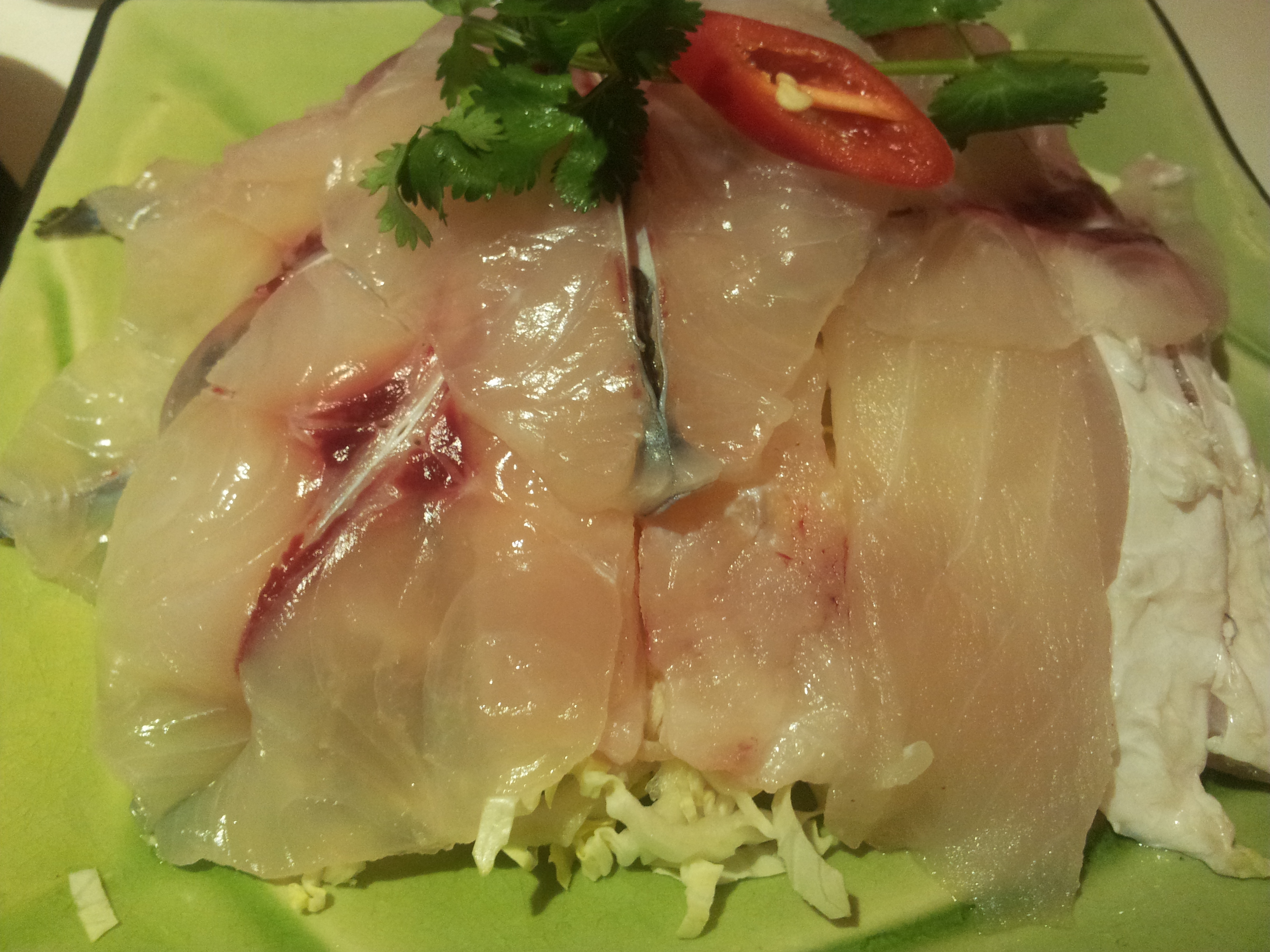
脆鲩鱼骨腩 (grass carp bones & belly)
I also added a 脆鲩鱼骨腩 (grass carp bones & belly) – HK$38. I like fish so I quite enjoyed it, but though 脆 means crunchy, it can mean tough & also several pieces have bones, so not everyone will like. We did not order that the second time we visited.
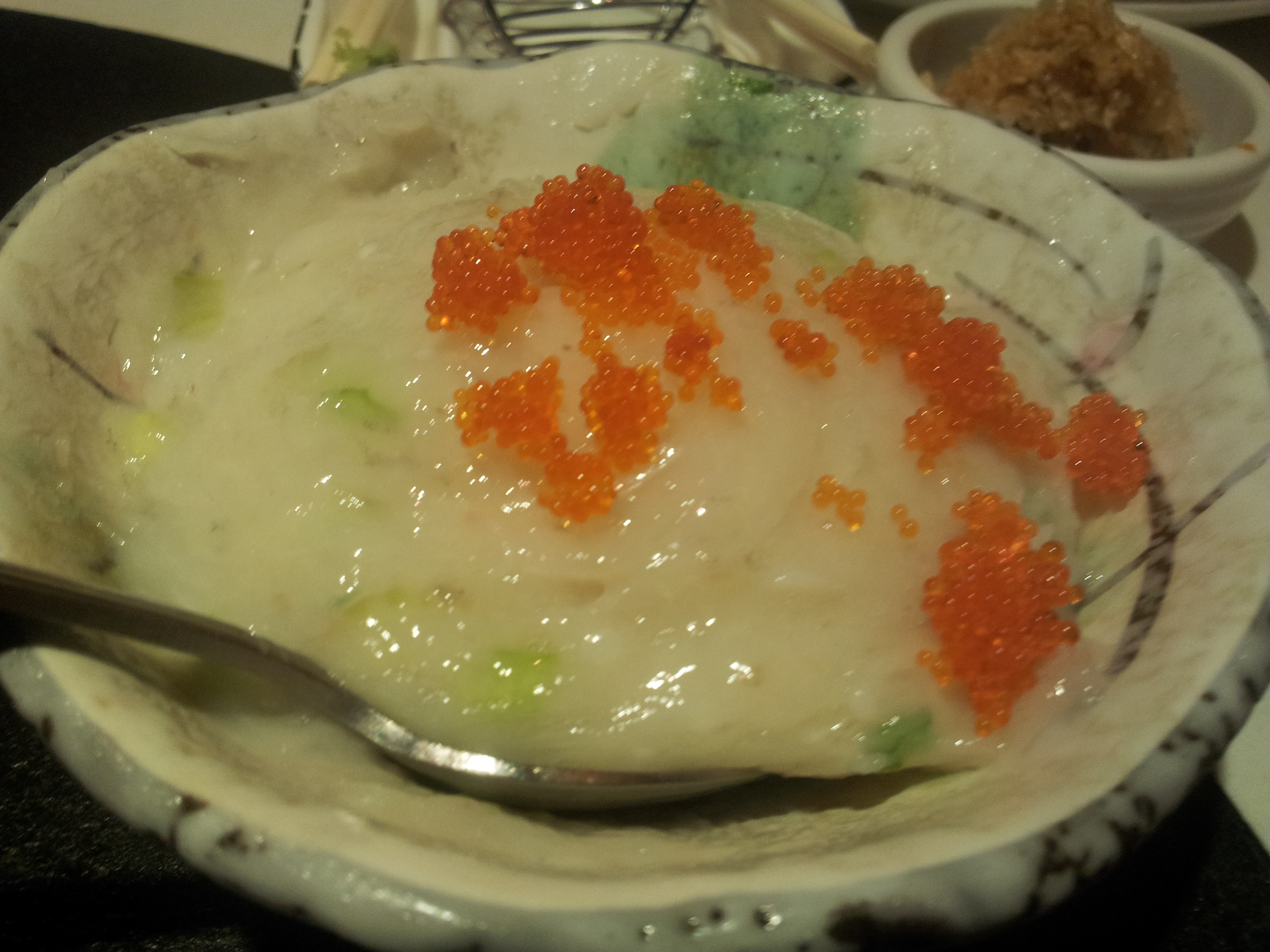
prawn paste (虾滑)
Lisa also ordered a prawn paste (虾滑) – HK$58 – which is nice too, though we don’t really need to have that, and we did not order it the second time we visited.
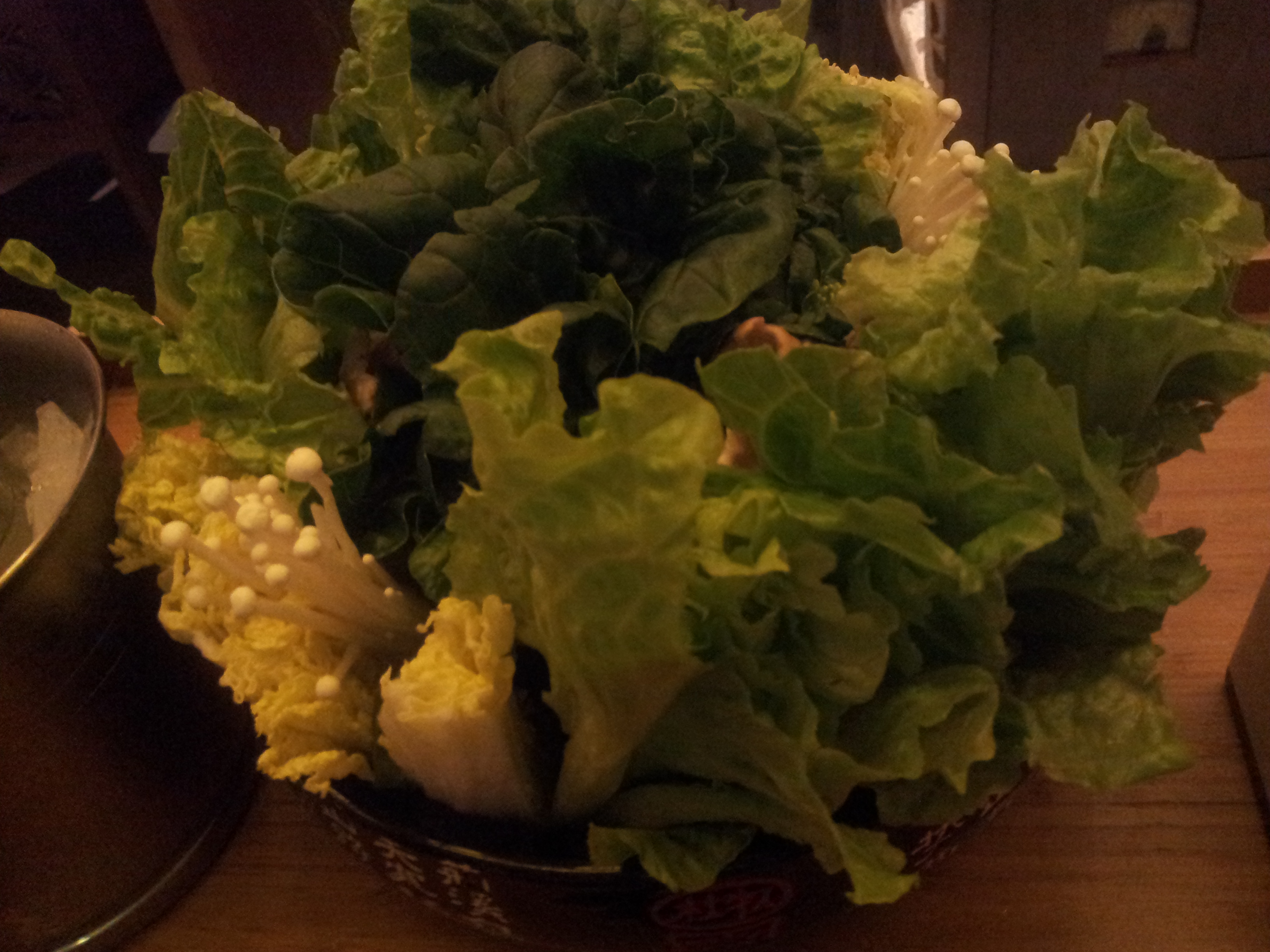
vegetable basket
We also had the vegetable basket. I cannot remember the price but it should be like HK$88 of HK$108. You must have vegetables for balance for a meat steamboat and Hong Kong vegetables are fresh & nice. On the second visit though we ordered just the Chinese lettuce for HK$48 & that was really quite sufficient.
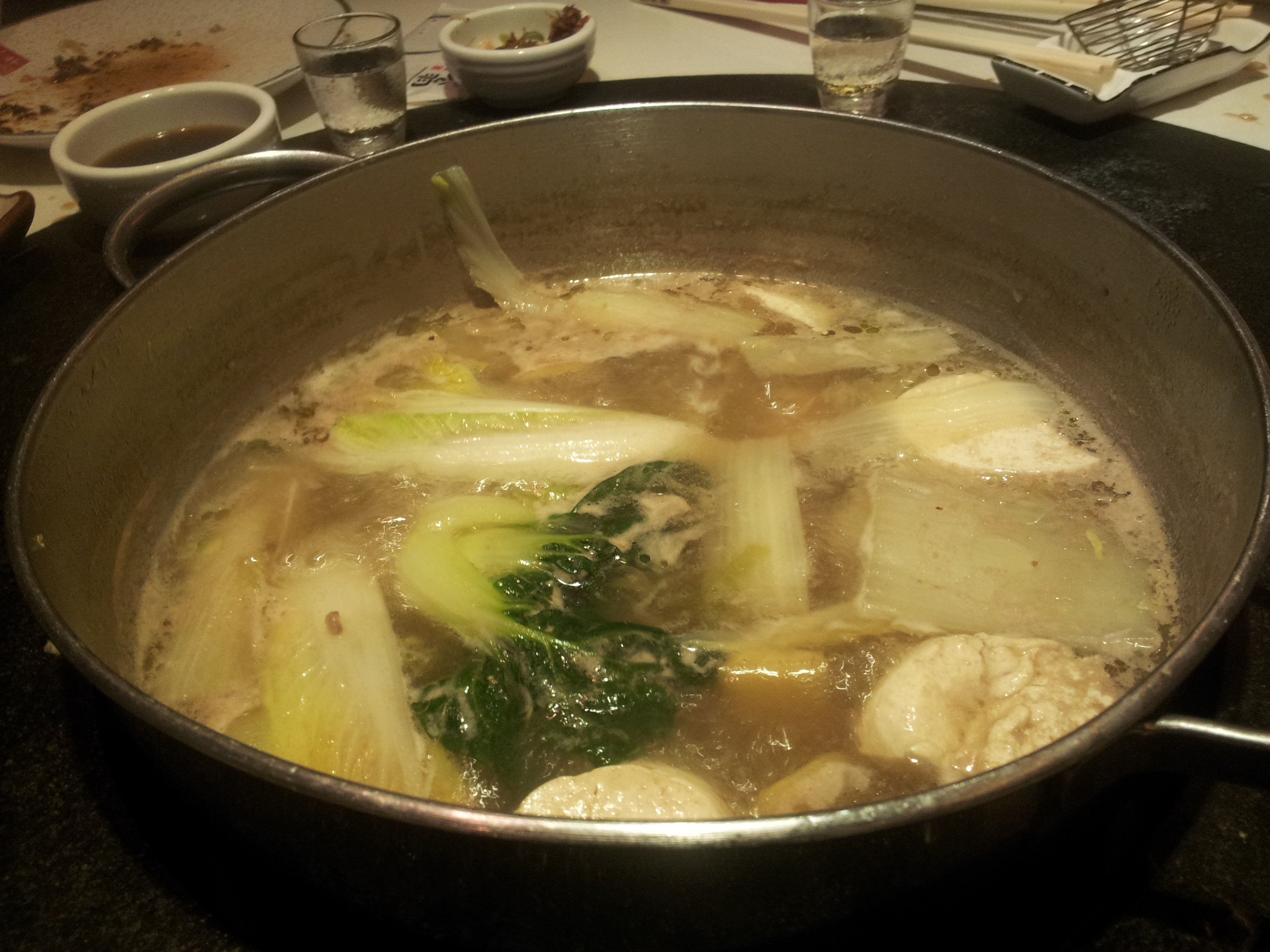
hotpot soup base (汤底) – we had the HK$88 clear vegetable soup
There was a wide range of hotpot soup base, but since we went there primarily to take the beef, we opted for the cheapest HK$88 clear vegetable soup. There was also a HK$20pax charge for the condiments (调料) – haebeehiam, garlic, spring onions, chilli, chilli oil, wasabi, soy sauce etc (most hotpot restaurants in Hong Kong charged this also).
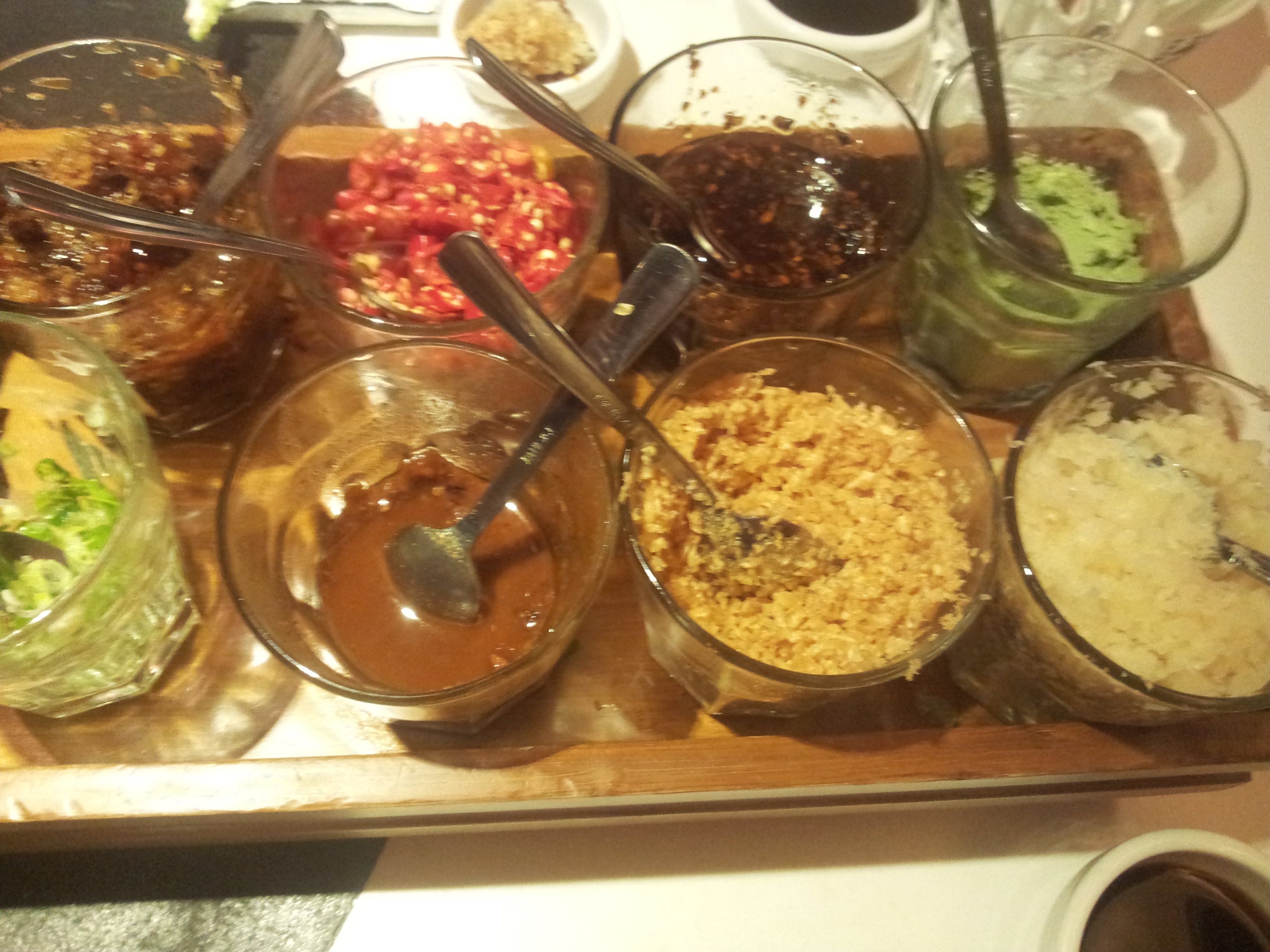
condiments platter – haebeehiam, chilli, chilli oil, wasabi, spring onions, sesame sauce, garlic etc
The entire meal, if you were to say order for 2pax 1 plate of beef, 1 plate dumpling & 1 Chinese lettuce + the plain soup base, it will set you back by HK$442 (inclusive of HK$20pax for the condiments & 10% service on top), and if you add a bottle of 350ml sake, that will be another HK$300+, so it is not really that cheap even after 40% discount. But to me the food quality & the enjoyment of it is well worth the price! Service is efficient, and they will bring hot water & ice, which are free (they don’t serve cold water only mineral water, I did not check the price but it should be ok to order it if you need to have mineral water..), we don’t really have any complaint about that.
c.h.e.f andy
Drunken Mussels with Orange Zest
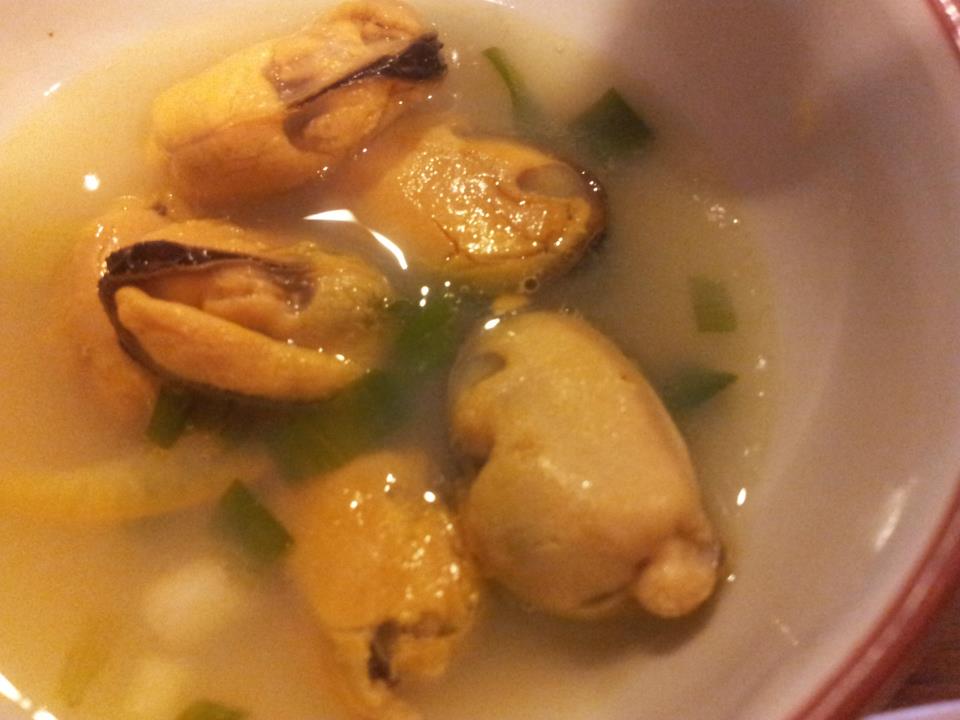
drunken mussels with wine & orange zest
This is another very easy dish to make.
I bought shelled mussels from Sheng Shiong previously but they were not as good, plump and big as the ones sold at QB Food.
For this dish, you just need to add 20g butter in a soup pot, throw in chopped spring onions (I used the white parts and reserve the green portion for garnishing) & orange zest from 1/2 an orange and stir-fry for <1minute, add 1 cup of wine and 1 cup of chicken stock and bring to boil, and then add 200g mussels & cook for 1-2 minutes, then garnish with chopped parsley (if you have) – I only use spring onions here.
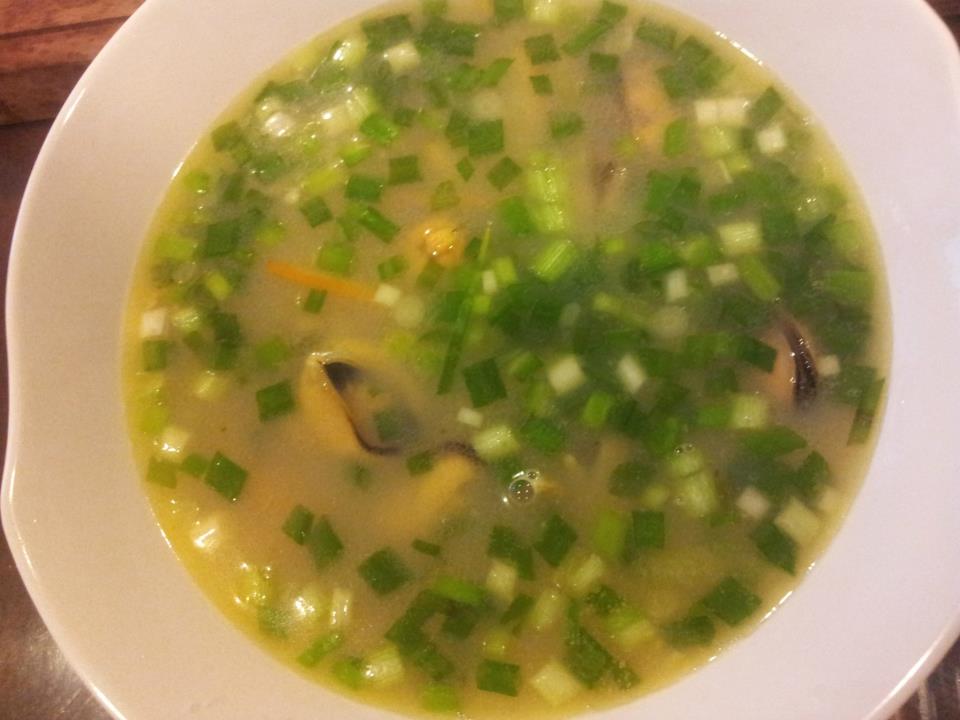
drunken mussels with wine & orange zest
It’s easy, delicious & all comfy goodness!
c.h.e.f andy
Pan-seared Hokkaido Scallops
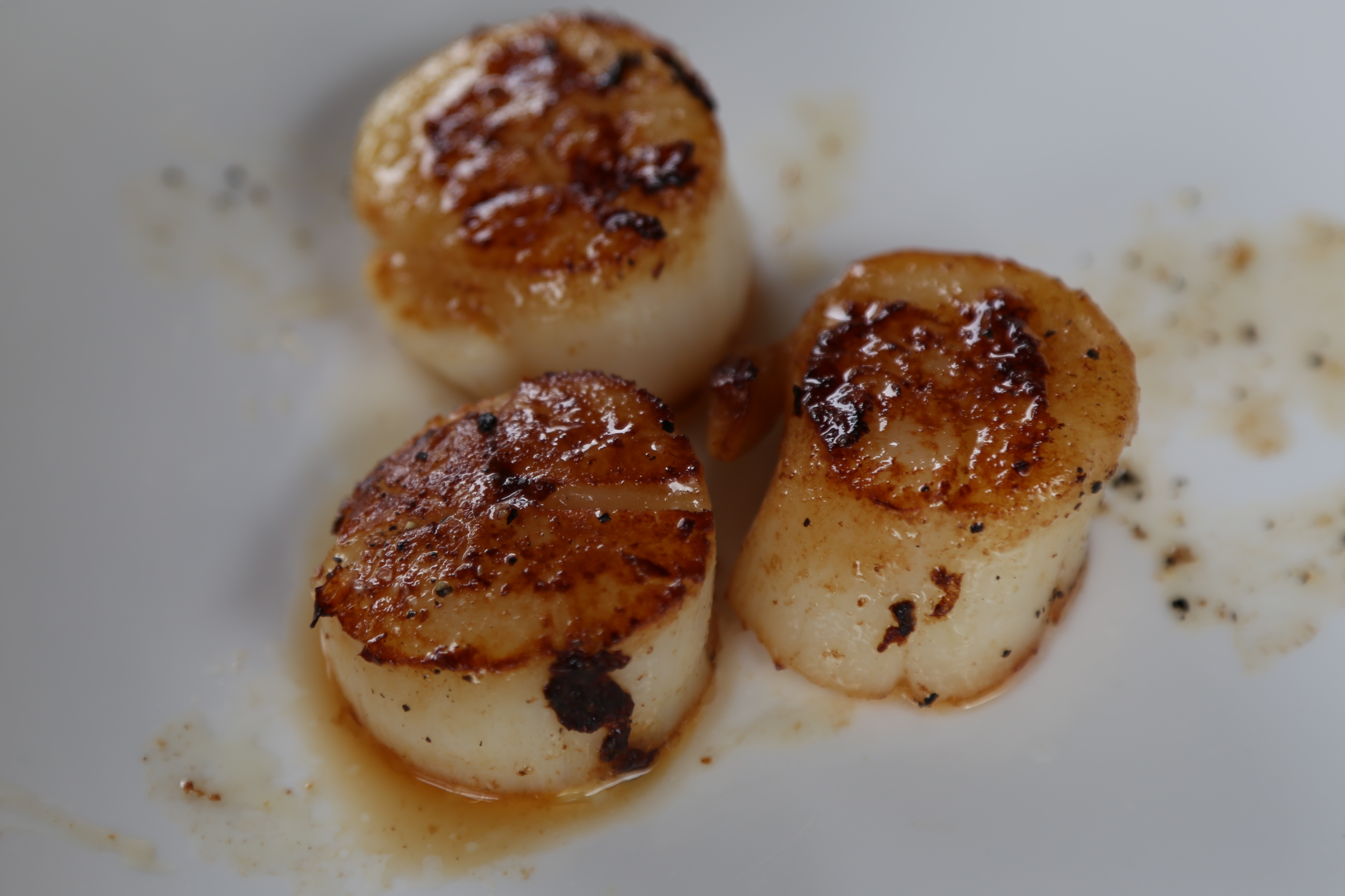
pan-seared Hokkaido scallops
Hokkaido scallops are plump, juicy & sweet.
I bought once from Isetan Orchard during a Japanese Fair and a 1kg box cost S$90 and they were really sweet. I bought also from QB Food frozen USA scallops at S$17 for 500g but these were not so great. Recently I bought 1 box 900g from Sheng Shiong on promotion at S$24.80, and these were quite ok.
I previously had difficulty searing scallop because the technique was wrong. So again after I check out Foodwishes.com Chef John’s seared scallop recipe, I can now reproduce quite easily scallops with a nice sear (as in above picture).
As mentioned in the video, the trick is simply (1)a superhot pan & (2)bone dry scallops. Scallops, like fish, retain a lot of moisture and if they are not totally dry, the temperature of the pan will drop sharply and you will be boiling/poaching the scallop rather than searing it, and the burnt layer will come off & stick to the pan.
With the right technique then it is really simple. I dry the scallops on a rack in the fridge so that both top & bottom are dry & the water drip on to a bowl or tray below the rack. I bring out the scallops from the fridge for at least 1/2 hour to get it to room temperature. I lightly season the scallop with sea salt & coarse black pepper and place them in a superhot pan with olive oil & sear for 3minutes, watching the side cook to opaque white colour 1/3 to 1/2 way up & then flip the scallops. I cook for another 2-3minutes and then serve. It is that simple.
I have tried also Chef John’s orange supreme sauce, however I don’t really find much there as I don’t feel the sauce add anything to the scallop & maybe reduce the seared flavour & texture. I would rather have my seared scallops with rockets and cherry tomatoes dressed with olive oil, balsamic vinegar and sea salt.
c.h.e.f andy
Creamy Mushroom Soup
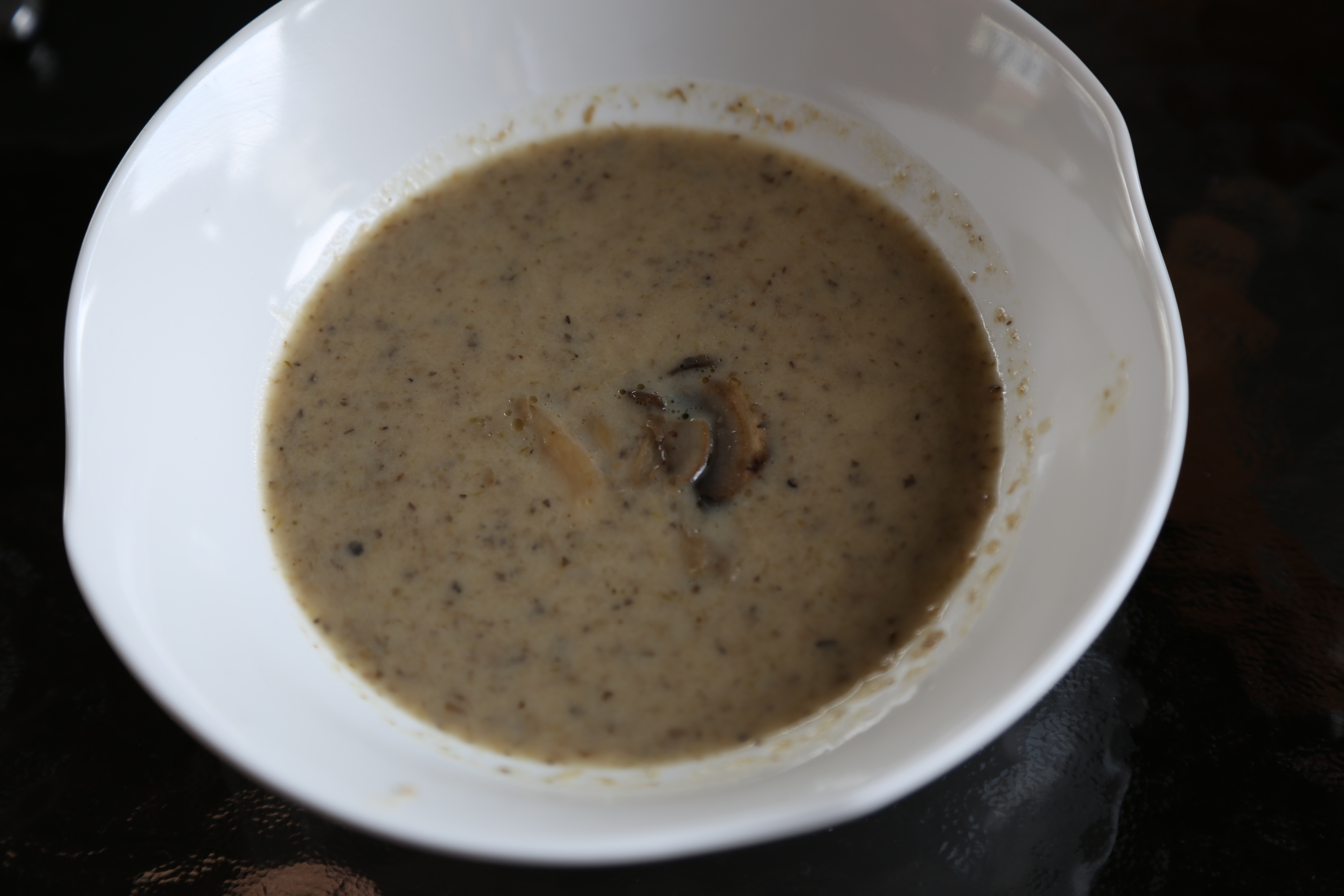
creamy mushroom soup
soup. auntie Bes, my Filipino help who has been with us for 24 years, makes very good Chinese soup. They could be pork ribs with peanuts or lotus root soup, chicken bones & feet with old cucumbers or carrots or watercress or even green papaya, largely in the vein of Cantonese 例汤 – soup of the day. auntie Bes doesn’t do soup using pork (she only used pork ribs) though this is also common with Chinese soups and these days we don’t use much of Chinese ham (京华火腿) though in the early days when I travel to Beijing & Shanghai more, I did cart some of these back for soup. when I started doing homecooked dinners for friends, if I were doing dishes like braised duck, curry chicken and kakuni (Japaense braised belly pork), auntie Bes’ soup was a perfect fit. But then I also started doing western dinners, and soon afterwards after several visits to and enjoyable meals at La Cicala Spanish Gastrobar, I learned to cook a Basque seafood bisque, using prawn shells with white wine & brandy to create the bisque, with leek, yellow onions & carrots to add vegetable sweetness to the soup. It was quite successful & I used it for several of my homecooked dinners. But that was the only soup I knew how to cook, that is until yesterday. I had another 8-course lunch for 9pax yesterday so I thought I would test out another soup, and I kind of thought mushroom soup would be the most common, easiest to do and acceptable to most. So who do I turn to? you guess it right – Foodwishes.com Chef John’s creamy mushroom soup recipe. It went really well at first try, and all my friends enjoyed the soup very much.
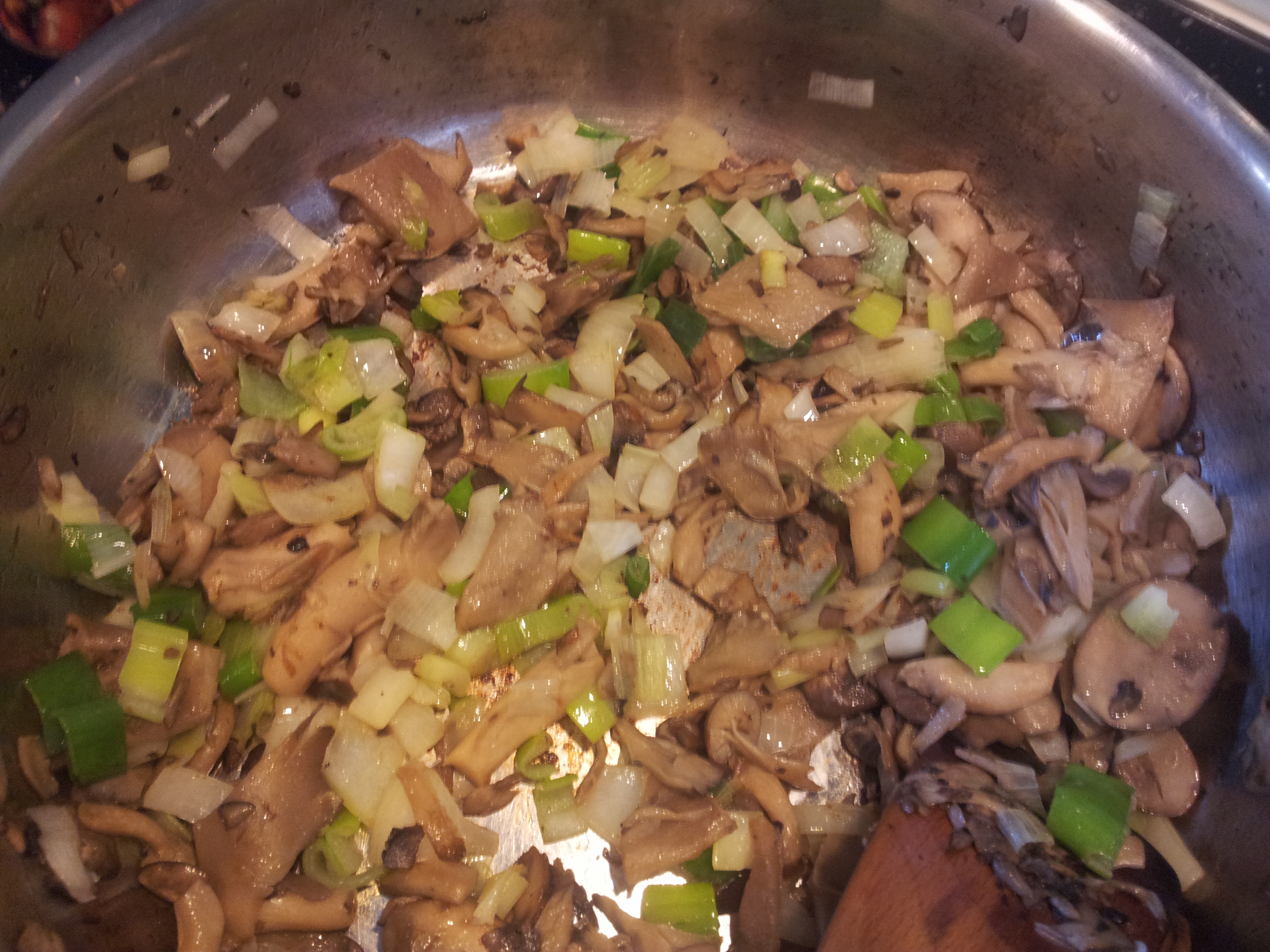
caramelising 3 different mushrooms + leek + yellow onions
I bought 250g of cut brown button mushrooms, 200g of oyster mushrooms & 150g of shimeji mushrooms from Sheng Shiong. I added a teasppon of salt & caramelised them in a soup pot according to the video instructions, then added the diced yellow onions & leek. I cooked them further & then fished out a few caramelised mushrooms as toppings for the soup later. I then added the flour and stirred them to thicken a little. 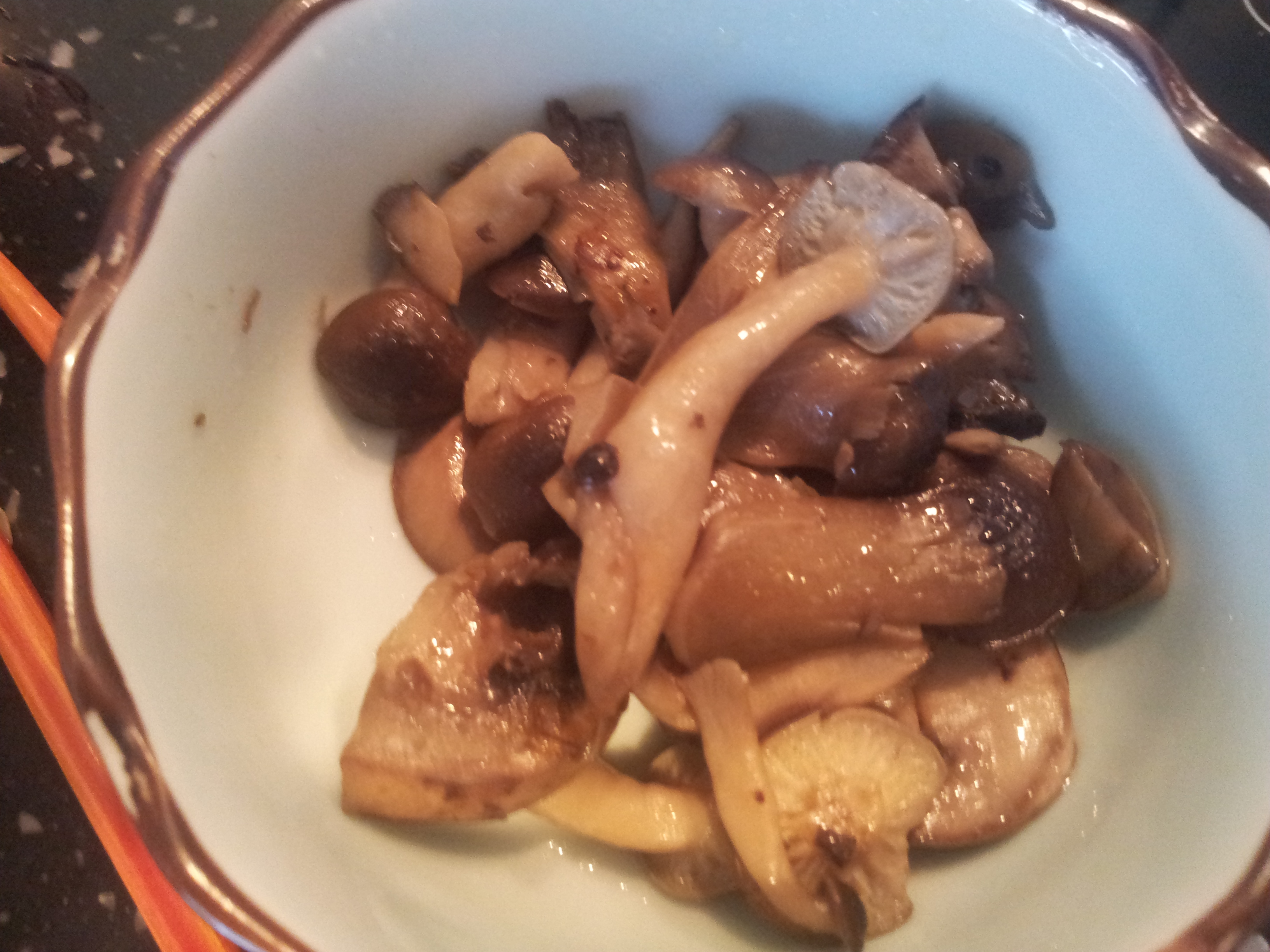 Next I added the white wine, reduced and then added the chicken stock (made in a crockpot with chicken bones). I then put it on an induction cooker & put to the lowest at 100W & let it cooked for 1.5hrs. I let the soup cooled down, and then blended it in a blender in small batches. Then I brought it to boil in the pot, turned to low fire and added 2 tablespoon of heavy cream and mixed in the soup, and added sea salt & pepper to taste. To serve, I added a dash of extra virgin olive oil & placed couple caramelised mushrooms I reserved earlier as toppings. c.h.e.f andy Ingredients:
- 600g mushrooms (button mushrooms or with other combinations) – served 8
- 1/2 large yellow onion diced
- 1 leek diced
- 1 tbsp flour
- 1 cup white wine
- 5 cups of chicken stock
- 1 tsp salt (to sweat the mushrooms)
- 2-3 tbsp heavy cream
- sea salt & coarse black pepper to taste
Directions:
- slice the button mushrooms, and diced the yellow onion & leek.
- caramelise the mushrooms in a soup pot with 1 teaspoon salt in high then medium heat. add the yellow onion and leek & cook until they soften. take out some caramelised mushrooms for toppings if you like. add a tablespoon of flour to thicken. add 1 cup of white wine and reduce, and add 3 cups of chicken stock. bring to boil & then turn fire to low & cook for 1.5hrs. let the soup cool or add more cold chicken stock or water, then blend it in a blender in batches. bring the blended soup to boil adding stock or water as necessary to taste according to your own preference. turn fire to low and add 2 tablespoon of heavy cream and mix well. serve with dash of extra virgin olive oil & caramelised mushroom toppings.

